Español
 Franch
  русский
Why Do UK Padel Court Groundworks Costs Frequently Exceed the Court Itself?
The most common moment of shock for first-time UK padel investors is not seeing the court hardware quote — it is seeing the padel court groundworks cost UK estimate sitting directly below it.
A high-specification padel court package, including LED floodlighting, typically costs around £20,000 to £30,000. When the civil engineering contractor then submits their estimate, the figure reads £30,000 to £45,000 or more — frequently matching or exceeding the court itself. For projects that include a weatherproof canopy structure, the groundworks bill can climb to nearly double the hardware cost.
This is not an anomaly. It is a structural feature of the UK padel construction market.
According to LTA (Lawn Tennis Association) benchmark project data, the groundworks-to-hardware ratio follows a consistent pattern across all build sizes:
- Build 1 court Cost £30,000, Groundworks Cost £30,000, Groundworks as 50%;
- Build 2 courts Cost £60,000, Groundworks Cost £60,000, Groundworks as 50%;
- Build 4 courts Cost £120,000, Groundworks Cost £100,000, Groundworks as 41%
In canopy projects, the ratio becomes even more pronounced. Adding a single-court weatherproof canopy structure costs approximately £50,000, with a further £25,000 required for dedicated canopy foundations and water management.
Why padel court groundworks cost UK Exceeds Hardware?
Cause 1: Glass Wall Wind Loads Place Extreme Demands on Foundation Anchoring
A padel court's glass enclosure spans approximately 100 square metres of solid, impermeable surface. In structural engineering terms, this is equivalent to a large sail — and in the UK's notoriously windy climate, the lateral forces this "sail" generates during storms are far greater than those produced by a standard tennis court fence.
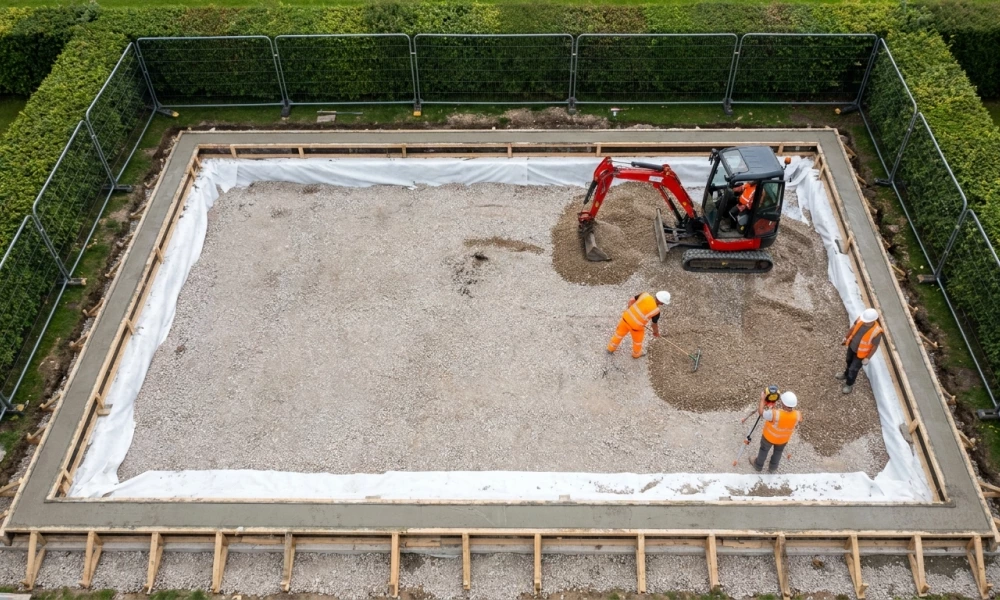
The padel court ring beam foundation UK must be engineered to resist these forces without any deflection. UK standard specification for a padel court perimeter ring beam is as follows:
| Parameter | Specification |
| Width | 400–500 mm |
| Depth | 500–800 mm (must penetrate the clay active zone) |
| Main reinforcement | 4 x high-yield steel bars |
| Stirrups | R8 or R10 at 200 mm centres |
| Concrete grade | C35/C40 |
These depth and reinforcement requirements — driven by the UK's wind exposure and clay geology — mean significantly more concrete and steel rebar than equivalent projects in southern European climates. This alone accounts for a large proportion of the padel court foundation UK cost differential.
Cause 2: Shrink-Swell Clay Geology — A Warning for Southern England Investors
Across Southern England, the Midlands, and East Anglia— the ground is dominated by shrink-swell clay. Addressing padel court clay soil UK correctly is one of the most consequential engineering decisions in a UK padel project.
Shrink-swell clay absorbs moisture and expands during wet winters, then dries out, contracts, and cracks during dry summers. Annual ground movement can reach several centimetres. The chain failure mechanism for a padel court built on inadequately engineered clay foundations is well-documented:
This failure mode is most common during hot summer droughts or sudden cold snaps. A single shattered glass panel costs £800–£1,500 to replace and requires specialist labour, forcing temporary court closure.
Direct cost impact: Clay geology typically adds £8,000–£15,000 to the base groundworks budget — before any contamination issues are discovered.
Cause 3: SuDS Drainage Regulations — The Hidden Five-Figure Line Item
Padel court SuDS drainage UK compliance is the most consistently underestimated cost category in UK padel construction budgets.
| Base Type | Drainage Approach | Additional Drainage Cost |
| Porous asphalt / permeable macadam | Rainwater drains naturally through the surface into the aggregate sub-base; standard perimeter French drains typically satisfy SuDS requirements | £2,000–£5,000 |
| Non-porous reinforced concrete slab | Fully impermeable; requires underground cellular attenuation crate system with flow control valves to hold and slowly release water | £10,000–£20,000 additional |
Beyond drainage infrastructure, securing padel court planning permission UK for sites within 50 metres of residential properties also requires a formal noise impact assessment (£1,500–£3,000).
Cause 4: ±3mm Flatness Tolerance — Padel Is a Zero-Tolerance Sport
The padel court concrete slab specification UK flatness requirement is one of the primary technical drivers of elevated labour costs.
Achieving ±3mm precision requires:
- Laser-guided screed machinery during concrete placement
- Power-float finishing by experienced sports surface operatives
- Bay-pour sequencing to control differential shrinkage cracking
These techniques add approximately £3,000–£6,000 per court compared to standard commercial concrete floor finishing — costs that are unavoidable if the court is to meet SAPCA certification requirements.
Cause 5: Electrical Infrastructure — The Budget Surprise That Can Halt an Entire Project
LED floodlighting for a single padel court draws between 1.2 kW and 2.4 kW of power. A standard padel court electrical connection UK — covering cable trenching, conduit installation, sub-distribution board, and cable pulling — typically costs £2,000–£5,000 per court.
However, for commercial facilities of four to six courts, a far larger cost can emerge:
Best practice: Before signing any lease, purchasing any court equipment, or making any capital commitment, request a formal capacity assessment from the DNO. This assessment is free of charge and takes two to four weeks — but the information it provides can determine whether the project is financially viable before a single pound is spent.
Indoor vs Outdoor — The Single Decision That Most Determines Your Budget
Padel court indoor vs outdoor foundation UK cost differences represent the largest single budget variable in any UK project:
| Comparison Dimension | Outdoor Court | Indoor Warehouse Conversion |
| Foundation type | Deep reinforced concrete ring beam + porous asphalt | Core drilling and anchor installation into existing slab |
| Wind load requirement | High — ring beam 500–800 mm deep | None — all loads are purely vertical |
| Drainage requirement | Full SuDS-compliant system mandatory | None required (fully enclosed environment) |
| Damp-proofing | Not required for porous base | Damp Proof Membrane (DPM) mandatory |
| Flatness tolerance | ±3 mm (3 m straightedge) | ±2 mm (stricter — no slope gradient to mask errors) |
| Civil cost per court | £30,000–£45,000+ | £5,000–£15,000 |
Key insight: Indoor warehouse conversion groundworks cost one-third to one-sixth of a new outdoor build. For the UK's wet climate, where outdoor courts face significant weather-related revenue loss, the combination of lower civil costs and higher court utilisation rates makes warehouse conversion the most commercially rational build pathway — provided the existing structure and floor slab are in sound condition.
Cost Optimisation Strategies for padel court groundworks cost UK
1. Repurpose Existing Hardstanding (Save Up to 60%)
The most impactful single padel court groundworks cost saving UK measure available to UK developers is building on structurally sound existing tarmac or concrete — most commonly a redundant tennis court or car park.
Rather than excavating and removing the existing surface, contractors cut and pour the perimeter ring beam directly into the existing hardstanding. The cost outcome is transformative:
Approach:
Full excavation and new-build groundworks cost £30,000–£35,000
Ring beam cut into existing sound tarmac cost £12,000–£15,000
It can Saving Up to 60%
The existing surface must be assessed by a structural engineer to confirm it can support the court frame's static loads and dynamic wind forces without remedial work.
Strategy: Deploy Without Groundworks — The Modular Foundation Route
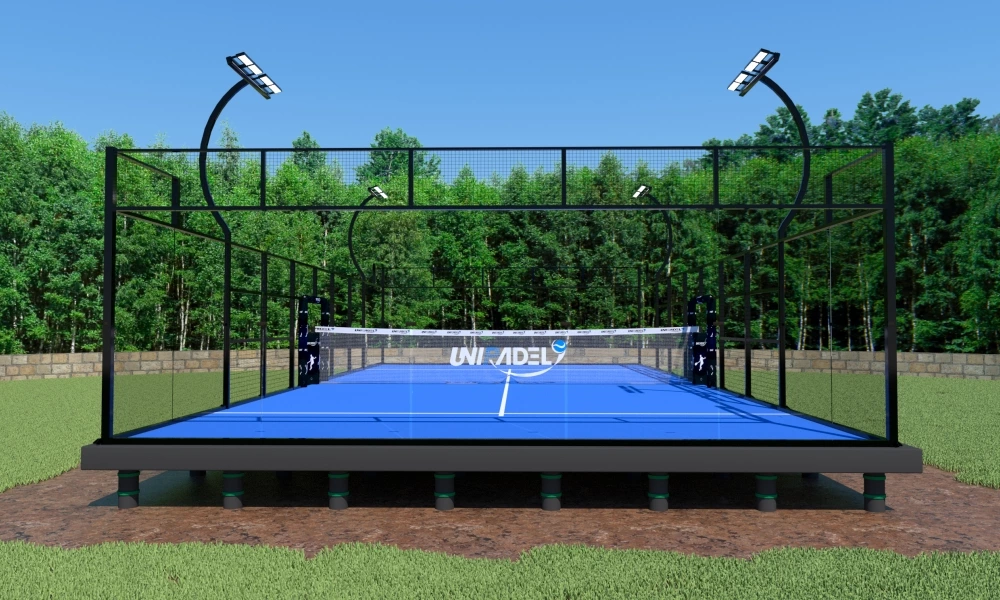
For sites where existing hardstanding is structurally unsuitable, or where lease terms, planning conditions, or site access prevent excavation work entirely, the UNIPADEL Modular Foundation | Portable Base removes the groundworks cost line from the budget completely.
Rather than cutting a ring beam into existing tarmac (£12,000–£15,000 per court) or excavating a new-build foundation (£30,000–£45,000), the Modular Foundation system installs directly onto any reasonably level surface — grass, gravel, or existing hard ground — at zero civil engineering cost.
This strategy is particularly suited to:
- Grass tennis club sites exploring padel as a seasonal addition without permanent civil works
- School and education sites where excavation requires regulatory approval
- Hotel and resort grounds where landscape impact is a planning sensitivity
- Short-lease commercial sites where groundworks capital cannot be depreciated over a long enough period to justify the investment
2. Build Multiple Courts Simultaneously (Save 15–25% Per Court)
Heavy plant mobilisation — concrete pump lorries, excavators, site welfare setup — represents a largely fixed cost regardless of how many courts are being built. Constructing four courts simultaneously reduces the per-court groundworks allocation by 15–25% compared with single-court builds sequenced over time.
Recommendation: Where feasible, commit to a minimum of two to three courts in the first phase to maximise plant utilisation and reduce unit civil costs.
3. Strategy 3: Optimise Site Layout to Avoid Retaining Walls
Positioning courts on the flattest available area of the site minimises cut-and-fill earthworks. Where significant level changes exist across the site, structural retaining walls may be required at the lower perimeter — adding £10,000–£30,000 in reinforced concrete engineering per affected side.
Recommendation: Commission a topographic survey and involve an experienced sports civil engineer in court layout planning before the architectural drawings are finalised. A small adjustment in court orientation can eliminate an entire retaining wall.
4. Choose Porous Asphalt Over Concrete Slab for Outdoor Courts (Save £10,000–£20,000)
For outdoor installations, a porous asphalt macadam base is the most SuDS-compatible and cost-efficient surface system available. Compared with a non-porous reinforced concrete slab requiring underground attenuation infrastructure, porous asphalt typically saves £10,000–£20,000 in drainage costs per court and is more straightforward to approve through the padel court planning permission UK process.
5. Engage the DNO Before Any Capital Commitment
Before signing any lease agreement, equipment contract, or heads of terms, submit a formal grid capacity enquiry to the local DNO. This step costs nothing and takes two to four weeks — but the information it returns is essential:
- If existing grid capacity is sufficient: electrical budget is £3,000–£5,000
- If a three-phase upgrade or substation is required: electrical budget is £15,000–£50,000+, with a 3–6 month programme impact
Discovering a grid constraint after signing a lease removes almost all negotiating leverage. Discovering it before preserves every option.
Why Choose UNIPADEL — Full Technical Support
| Support Category | What UNIPADEL Provides |
| Structural calculation report | Compliant with BS EN 1991 wind load standards |
| Foundation design guidance | Ring beam depth and reinforcement recommendations based on geotechnical survey results |
| Glass certification | 12 mm toughened safety glass to BS EN 12150-1, with full documentation |
| Corrosion protection certificate | Hot-dip galvanised to ISO 1461; marine-grade powder coat available for coastal sites |
| Lighting specification | LED system to EN 12193 Class B standard |
| Programme planning | Project timeline structured around UK planning determination cycles to eliminate avoidable delays |
Beyond the traditional build path: the UNIPADEL Modular Foundation
For UK investors where the groundworks cost breakdown above is the primary concern — or where site conditions, planning timelines, or lease flexibility make a conventional concrete-slab build commercially unattractive — UNIPADEL offers a structural alternative that eliminates the majority of the costs itemised in this article.
The Padel Court Modular Foundation | Portable Base is a precision-engineered interlocking steel platform system that replaces the traditional poured-concrete slab entirely. The court is suspended above the existing surface using a structural platform rated to a maximum load-bearing capacity of up to 2,765 kg per leg — with no ground excavation, no concrete, and no 28-day curing period.
How the Modular Foundation addresses each UK groundworks cost driver:
| UK Groundworks Cost Driver | Traditional Fixed Court Cost | Modular Foundation Impact |
|---|---|---|
| Ring beam foundation (wind load) | £30,000–£45,000+ per court | Eliminated — no perimeter ring beam required |
| Shrink-swell clay engineering | +£8,000–£15,000 additional | Eliminated — system sits above ground, not bonded to it |
| SuDS drainage (concrete slab) | +£10,000–£20,000 attenuation system | Substantially reduced — zero new impermeable surface added |
| Precision flatness works | +£3,000–£6,000 per court | Eliminated — 180mm height-adjustable supports self-level to the existing surface |
| Planning permission (engineering operation) | 8–16 weeks, full application | Reduced — demountable classification opens a faster approval pathway |
Conclusion
The core mindset shift every UK padel investor needs to make is this: building a padel court is not a procurement decision — it is a civil engineering project, and the court is simply the last component to be installed.
Geotechnical surveys, ring beam depths, SuDS drainage systems, and DNO grid capacity checks — each of these elements, if overlooked before contracts are signed, will resurface during construction at a higher cost and under far greater time pressure.
The developers who control their padel court groundworks cost UK most effectively are not those who spend the least on civil engineering — they are those who invest the most time in pre-construction planning, choose the right base specification for their specific site conditions, and work with suppliers who understand the full UK regulatory picture, not just the court hardware.
Planning a padel court project in the UK? If eliminating groundworks costs entirely is a priority for your project, UNIPADEL's Modular Foundation | Portable Base provides a tested structural alternative to the conventional UK build pathway — removing ring beam costs, SuDS attenuation requirements, precision flatness works, and the engineering-operation planning classification in a single product decision. Contact the UNIPADEL team for court specifications, structural calculation documents, and project planning support tailored to UK planning and construction requirements.