Español
 Franch
  русский
UNIPADEL vs. Low-Price Padel Court Suppliers: A Complete Quality, Service & Factory Comparison
Introduction: The Price You See Is Not the Price You Pay
The global padel court market in 2026 is crowded. A search for "padel court supplier" returns hundreds of manufacturers — from established certified producers to resellers who assemble catalogues overnight. The price range is extraordinary: ex-works quotes range from $6,000 per court to $32,000 per court, for what appears, on a product page, to be broadly the same thing.
It is not the same thing.
A padel court is not a commodity. It is a structural asset — a combination of load-bearing steel, safety glass, synthetic turf, and electrical systems — that will generate revenue (or fail to generate revenue) every day for the next 10 to 20 years. The financial model only works if the court works. And the court only works if the materials, manufacturing processes, certifications, and post-delivery support meet a standard that cheap suppliers, almost without exception, cannot provide.
This article provides a systematic, data-driven comparison across seven dimensions: materials, structural engineering, glass specification, turf quality, certifications, factory capability, and after-sales service. The purpose is not to attack competitors — it is to give padel investors the technical framework to evaluate any supplier's claims with precision.
The Real-World Failure Record — What Happens When Quality Is Compromised
Before examining specifications, it is worth understanding what poor-quality courts actually do in the field. These are documented failure modes, not hypothetical risks.
Failure Mode 1: Spontaneous Glass Explosion
A club owner installs 10mm non-heat-soaked tempered glass courts to save $3,000 per court. During the first winter, thermal contraction causes two glass panels to shatter spontaneously during peak playing hours — no impact, no warning. Club membership drops 30% due to social media coverage. Insurance claim is contested because the glass specification did not meet the venue's local building code.
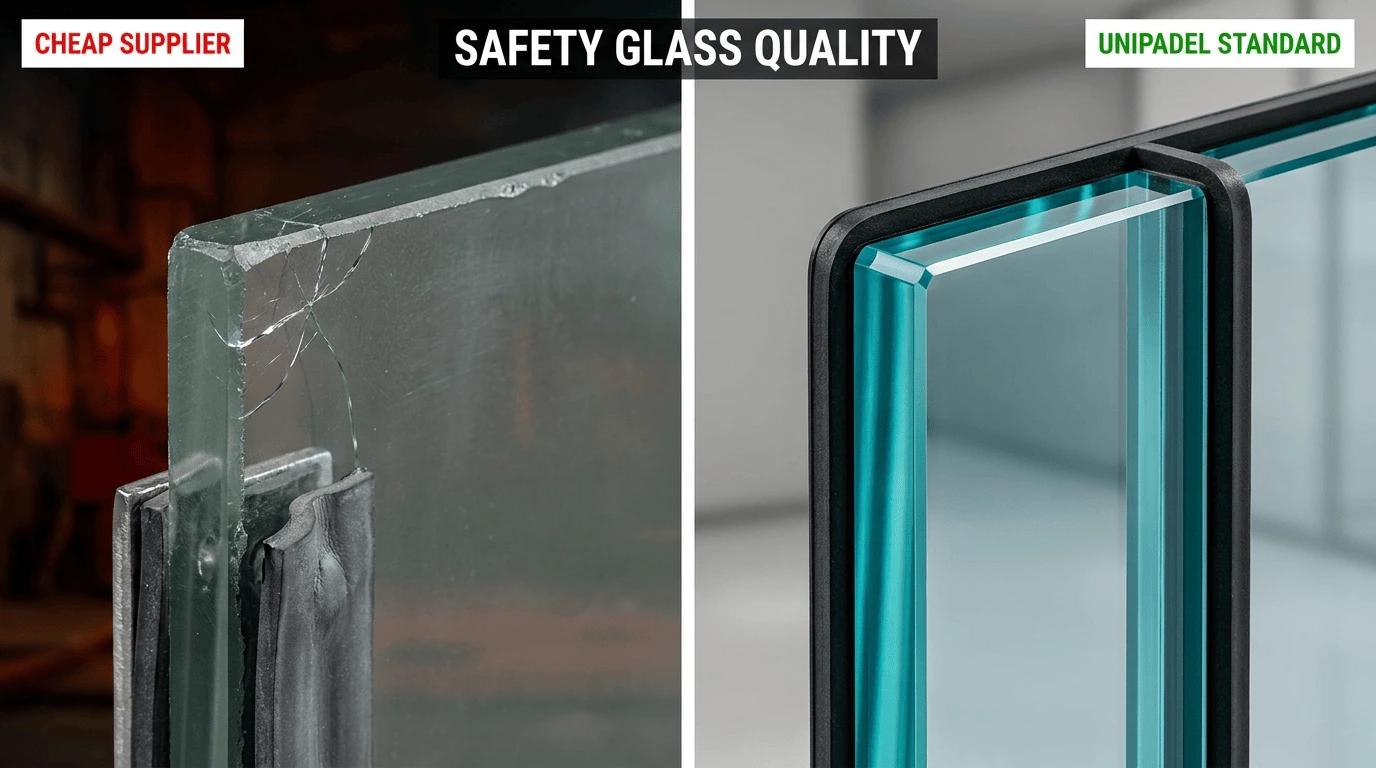
Root cause: Microscopic Nickel Sulfide (NiS) inclusions — naturally occurring in tempered glass manufacturing — expand under thermal cycling. Without a Heat Soak Test (HST), these inclusions remain active and can trigger spontaneous breakage months or years after installation. Premium-grade courts eliminate this risk through mandatory HST (DIN EN 14179-1).
Failure Mode 2: Coastal Corrosion — Complete Loss of Investment
An operator purchases four "galvanized" courts from an unverified overseas supplier, saving $35,000. Within 14 months, rust blisters through the powder coating at structural joints. A local engineering inspector declares the courts a safety hazard and orders closure. The operator loses the entire original investment plus 14 months of revenue.
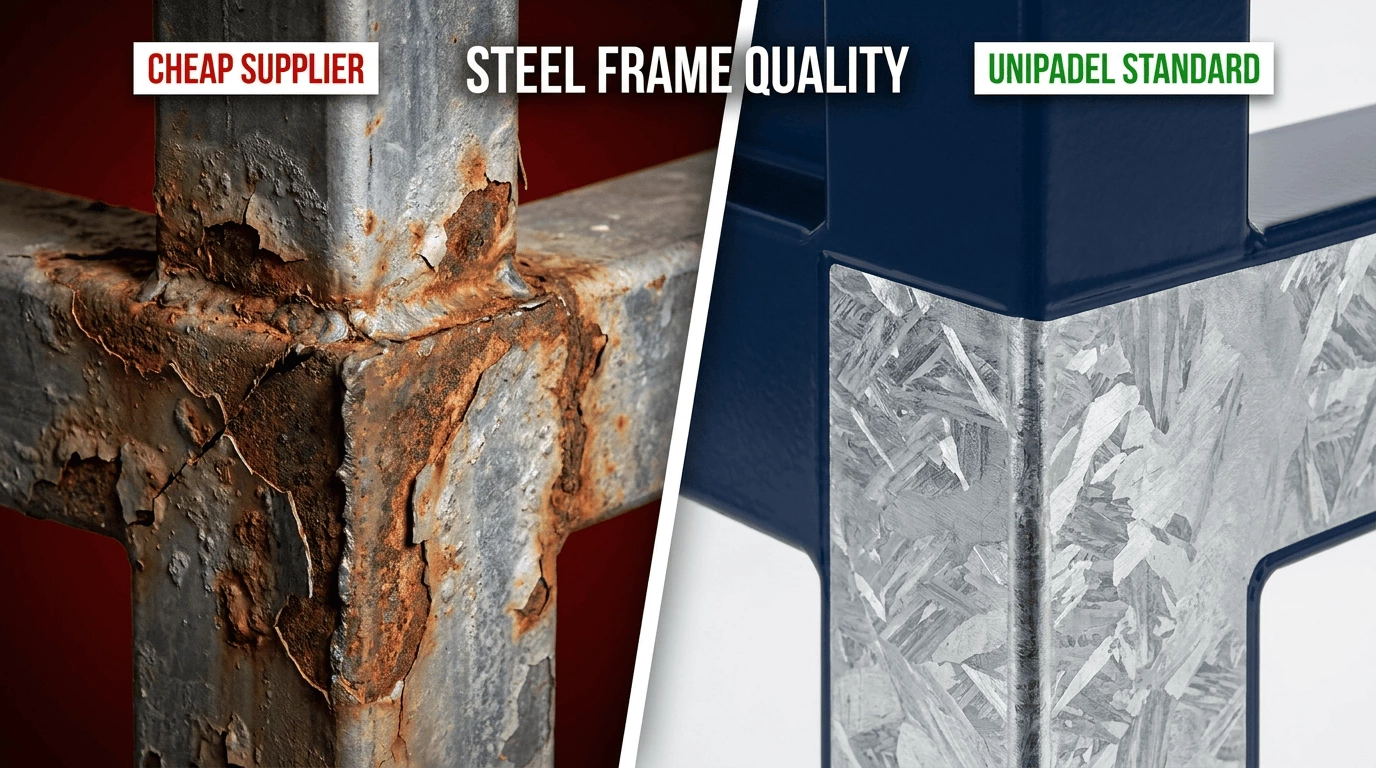
Root cause: The supplier used spray galvanizing (cold-applied zinc paint, 30–40 microns) instead of true hot-dip galvanizing (HDG, ≥85 microns, metallurgically bonded). Spray zinc is a cosmetic treatment — it provides no meaningful sacrificial protection at welds, cut edges, or drilled holes where corrosion always begins.
Failure Mode 3: Frame Deflection Under Wind Load
A club in a coastal location installs courts manufactured from S235 steel with 2.0mm wall thickness. During the first winter storm, the frame deflects under lateral wind load, pinching the glass panels against the steel uprights. Three panels crack from the compression stress. Replacement takes 6 weeks. Revenue lost: $18,000+ at $50/hour × 6 hours × 60 days.
Root cause: S235 steel has a yield strength of 235 MPa — adequate for sheltered low-wind environments, completely inadequate for exposed sites where lateral glass-wall wind forces require S355 steel (355 MPa yield strength) and minimum 3mm wall thickness.
Failure Mode 4: Turf Degradation and Dead Spots
A club installs polypropylene (PP) turf with no HALS UV stabiliser package. Within 24 months in a sun-exposed outdoor environment, fibres fibrillate, sand migrates unevenly, and "dead spots" appear — areas where ball bounce is unpredictably inconsistent. Player complaints accelerate membership cancellations. Full turf replacement at $15,000 is required in Year 3.
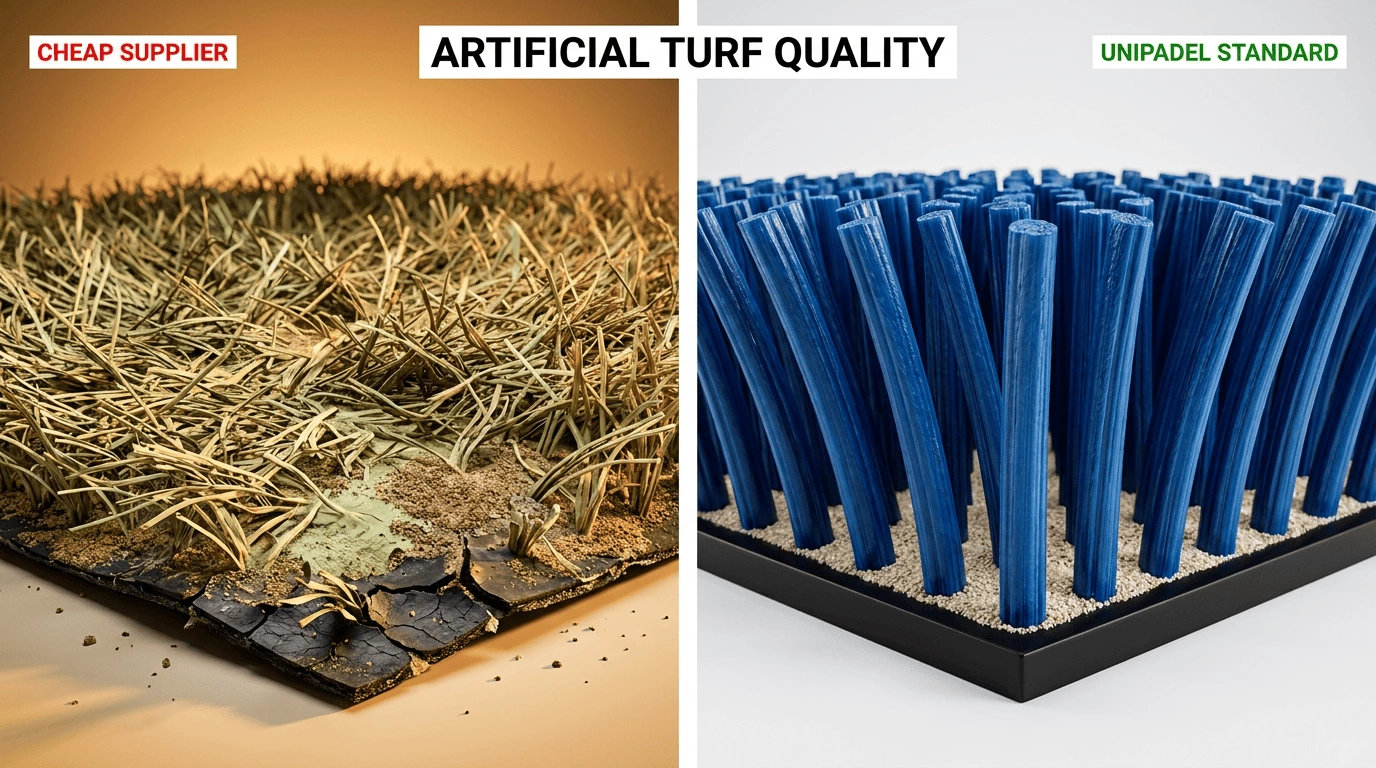
Root cause: PP fibres have inherent UV vulnerability due to tertiary carbon atom molecular structure. Without a full HALS (Hindered Amine Light Stabiliser) UV protection package, degradation is rapid. Even PE fibres without adequate stabiliser concentration (≥6,000 ppm) will fail prematurely in high UV environments.
Material Specification — The Technical Divide
Structural Steel
The structural frame is the skeleton of the court. Every other component — glass, turf, lighting — depends on the frame maintaining dimensional precision under wind, thermal expansion, and physical loading over decades.
| Specification | Cheap padel court problems | UNIPADEL Standard |
|---|---|---|
| Steel grade | S235 (235 MPa yield strength) | S355JR (355 MPa yield strength, EN 10025-2) |
| Main column wall thickness | 2.0–2.5mm | 3.0–4.0mm |
| Column profile | 80×80mm square | 100×100mm or 120×80mm rectangular |
| Corrosion protection | Spray/electro-galvanizing, 30–40 µm | Hot-dip galvanizing (ISO 1461), ≥75–85 µm |
| Powder coating | Standard industrial spray | QUALICOAT Class 2 thermosetting polyurethane, 80–100 µm |
| Weld quality | Manual hand-welding, inconsistent penetration | Certified welding per EN ISO 3834-2, EXC2 execution class |
| Material traceability | No mill certificate | EN 10025-2 mill certificate, grade S355JR confirmed |
Why hot-dip galvanizing is non-negotiable: True HDG creates a metallurgical bond between steel and zinc — zinc diffuses into the steel surface to create an intermetallic alloy layer. This cannot be scratched away. Spray zinc sits on top of the steel surface with no metallurgical bond — one scratch exposes bare steel. At every weld point, cut edge, and drilled anchor hole on a spray-galvanized frame, corrosion begins from day one.
Safety Glass
| Specification | Cheap Supplier | UNIPADEL Standard |
|---|---|---|
| Glass type | Tempered monolithic (ESG) | 12mm ESG, EN 12150-1 certified |
| Thickness | 10mm | 12mm |
| Heat Soak Test | None (NiS risk active) | HST per EN 14179-1 — NiS inclusions eliminated |
| Glass mounting | Basic rubber strips or direct metal contact | 5mm neoprene gasket, full perimeter, 70 Shore A hardness |
| Thermal expansion gap | None or inadequate | Minimum 5mm clearance on all four sides |
| Fragmentation pattern | Variable (unverified) | ≥40 small blunt fragments per 50×50mm (EN 12150-1) |
| Documentation | Marketing claim only | Factory test certificate, traceable batch number |
The 10mm vs 12mm difference: This is not marketing preference. At equivalent wind loads and glass span dimensions, 12mm glass deflects 37% less than 10mm glass under the same lateral pressure. Reduced deflection means less stress concentration at mounting points — which is where glass breakage always initiates.
Artificial Turf
| Specification | Cheap Supplier | UNIPADEL Standard |
|---|---|---|
| Fibre polymer | PP (polypropylene) or low-grade PE | 100% high-density PE monofilament |
| Fibre linear density | 6,000–7,000 dtex | 8,000–12,000 dtex |
| UV stabiliser | None or single-component <3,000 ppm | HALS system ≥6,000 ppm (Cyasorb UV-3529 + Irganox 1010/1076) |
| Backing type | SBR latex (off-gases, cracks in cold) | PU (polyurethane) — heat-stable, non-toxic |
| Tuft bind strength | <20N (fibres pull out under play) | >30N per EN ISO 4919 |
| FIP colour certification | None | FIP-approved: blue, green, orange, black |
| Expected lifespan | 3–4 years (outdoor) | 8–12 years (outdoor, maintained) |
Certifications — The Compliance Chasm
Padel court certification comparison reveals the sharpest divide between market tiers. Certifications are not marketing badges — they are legal prerequisites in certain markets and technical proof of manufacturing process control.
| Certification | Low-Price Supplier | UNIPADEL |
|---|---|---|
| UNE 147201:2024 (padel-specific construction standard, path to ISO 25808) | None — budget courts are almost never tested | Compliant |
| EN 1090-1/1090-2 (CE marking for load-bearing steel structures) | None or self-declared | CE certified — FPC audited by Notified Body |
| EN 12150-1 (toughened safety glass) | Claimed but rarely documented | Factory certificate with traceable batch numbers |
| EN 14179-1 (Heat Soak Test) | None | Available on request — standard for commercial venues |
| ISO 1461 (hot-dip galvanizing) | Claimed; zinc thickness often below standard | Test report confirming ≥75 µm average coating |
| ISO 9001:2015 (quality management) | None | Factory QMS certified |
| FIP Approval | None — dimensional tolerances frequently out of spec | Court dimensions within FIP ±0.5% tolerance |
| Spanish trademark registration | None | UNIPADEL registered trademark, OEPM M4.316.700 |
The CE marking issue: The EU Construction Products Regulation (CPR 305/2011) makes CE marking under EN 1090-1 a legal requirement for load-bearing steel structures permanently installed in EU member states. Many budget suppliers ship courts with CE labels — but these labels may reference EN 10025 (a steel product standard) rather than EN 1090-1 (the structural execution standard). The distinction matters: EN 10025 confirms the steel grade; EN 1090-1 confirms the entire manufacturing, welding, and quality control process that determines whether the structure is safe under load. Ask for the Declaration of Performance (DoP) and verify the Notified Body registration number.
Factory Capability — Where Quality Is Actually Made
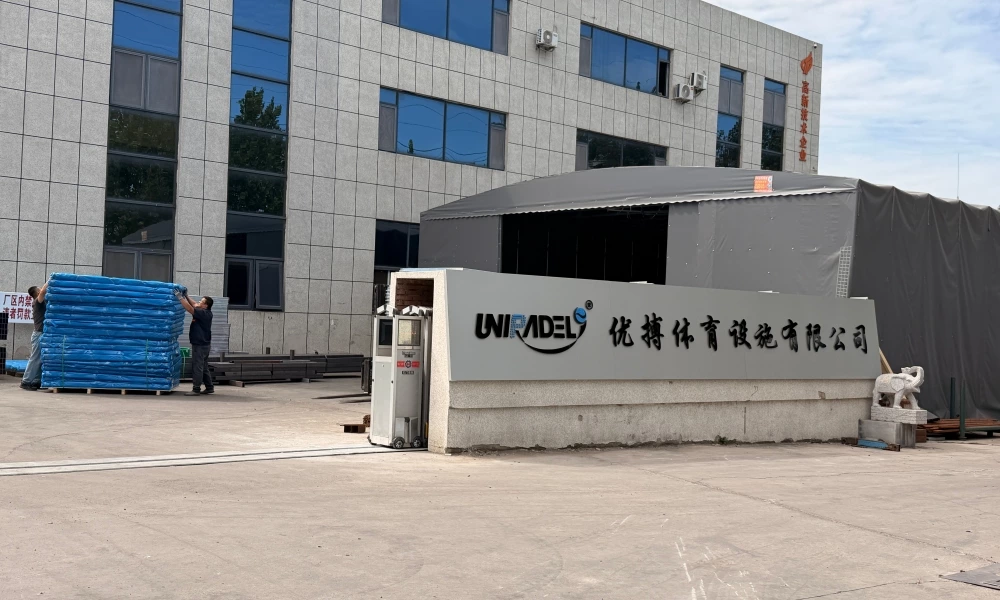
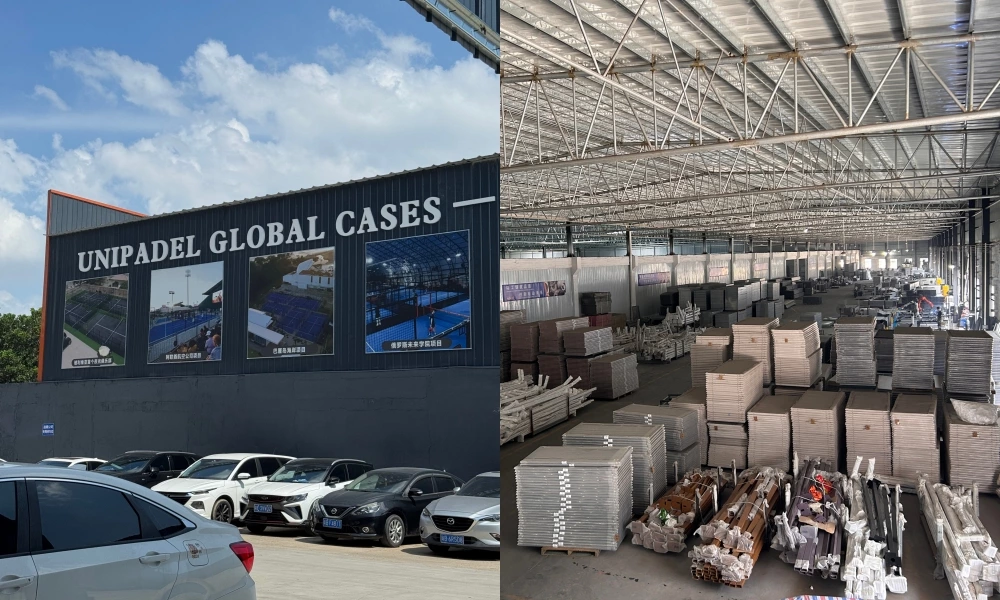
Padel court factory quality control separates manufacturers from assemblers. The difference is not visible on a product page — it is visible in the factory.
UNIPADEL Manufacturing Standards
Production capacity: UNIPADEL's manufacturing facility operates with a monthly output capacity that supports concurrent delivery to multiple markets — Europe, Central Asia, Southeast Asia, and the Middle East — without compromising production scheduling or quality inspection timelines.
Steel fabrication process:
- Raw steel coil and section — S355JR grade, verified by mill certificate
- CNC laser cutting — dimensional tolerance ±0.5mm on critical connection points
- Robotic/semi-automatic MIG welding — weld quality per EN ISO 3834-2
- Full-frame dimensional inspection before surface treatment
- Hot-dip galvanizing — full immersion in 450°C molten zinc bath, post-treatment zinc thickness measurement recorded per frame
- QUALICOAT Class 2 powder coating — electrostatic application, 180–200°C curing oven, 80–100µm DFT verified
- Final visual inspection and packaging — frame sections protected with corner guards and stretch-wrap for international freight
Glass inspection process:
- Incoming inspection of glass batches — visual, dimensional, and fragmentation test sampling
- Heat Soak Test documentation verified before dispatch
- Individual panel labelling with batch traceability
Turf quality control:
- Incoming fibre dtex verification per EN ISO 1973
- Tuft bind strength test per EN ISO 4919 — minimum 30N
- UV resistance sampling (accelerated weathering per EN ISO 4892-3)
Contrast with budget supplier factory processes: Manual hand-welding with no in-process inspection; no robotic fabrication; frame dimensions verified by eye rather than CMM or laser measurement; spray galvanizing applied to already-assembled frames without verification of coating thickness; no material traceability documentation.
Warranty and After-Sales Service — The Promise That Matters After Delivery
Padel court warranty comparison is where the commercial reality of cheap supplier promises becomes most visible.
Warranty Structure Comparison
| Component | Low-Price Supplier Warranty | UNIPADEL Warranty |
|---|---|---|
| Structural steel frame | 1–2 years ("manufacturer defects") | 5 years structural integrity |
| Galvanizing coating | Not separately specified | 5 years anti-corrosion performance |
| Safety glass panels | No warranty | Warranty available (but with a certain rate of spontaneous breakage), it's advisable to have several on hand. |
| Artificial turf | 1–2 years ("normal wear excluded") | 3 years against UV-induced fibre degradation |
| LED lighting | 1 year | 5 years on driver and fixture |
UNIPADEL After-Sales Service Model
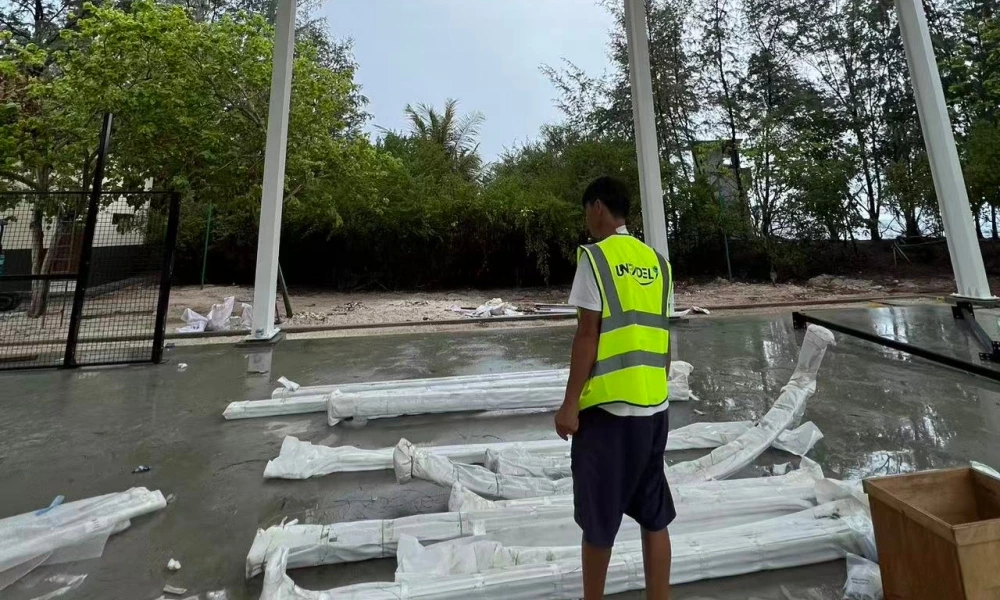
Installation support:
- Complete bilingual (English/Russian/Spanish) assembly manual with detailed technical drawings
- Remote video supervision for standard installations — real-time guidance via video call during critical assembly stages (glass installation, anchor torqueing, turf seaming)
- On-site technical supervisor available for projects of 4+ courts — supervisor travels to site for the assembly period
Spare parts:
- Critical replacement parts (glass panels in standard sizes, net posts, gate hardware, turf seam strips) available for dispatch within standard production cycles
- Clients with multi-court facilities recommended to hold one spare glass panel per court on-site — UNIPADEL supplies with the original order at cost
Technical documentation:
- Full structural calculation reports available per project — suitable for submission to local building authorities (UK LPA, German Bauordnungsamt, Kazakhstan Bauordnung)
- Material certification pack: mill certificate, HDG test report, glass EN 12150-1 certificate, EAC/GOST-K documents for CIS markets
- Photometric plans for LED lighting — suitable for UK planning applications and German Baugenehmigung
10-Year TCO Comparison: 4-Court Indoor Club
| Cost Component | Low-Price Supplier (4 Courts) | UNIPADEL (4 Courts) |
|---|---|---|
| Initial court kit cost (ex-works) | $36,000 | $48,000 |
| Freight and logistics | $8,000 | $8,000 |
| Certification gap costs (structural engineer, re-inspection) | $12,000 | $0 (documents included) |
| Year 1–3 operating costs | ||
| Glass panel replacement ×4 (spontaneous breakage) | $8,000 | $0 |
| Revenue loss during closure (4 incidents × 14 days) | $33,600 | $0 |
| Frame rust remediation (Year 2–3) | $16,000 | $0 |
| Year 3–5 operating costs | ||
| Full turf replacement (all 4 courts) | $24,000 | $0 |
| Court closure revenue loss (18 days) | $14,400 | $0 |
| Frame recoating (all 4 courts) | $12,000 | $0 |
| Year 5–10 | ||
| Second turf replacement | $24,000 | $0 |
| Structural component replacement | $20,000 | $0 |
| Revenue loss across multiple incidents | $25,200 | $0 |
| 10-Year Total Cost of Ownership | $233,200 | $56,000 |
The cheap option costs more over the asset lifecycle — before accounting for the reputational damage, membership loss, and investor confidence erosion that accompanies public-facing quality failures.
Why Choose UNIPADEL?
UNIPADEL padel court quality is defined not by marketing language but by the specifications, certifications, and documented processes outlined throughout this article. Here is the summary of what UNIPADEL delivers that low-price suppliers cannot.
The UNIPADEL Difference — At a Glance
| Dimension | Low-Price Market Average | UNIPADEL Standard |
|---|---|---|
| Steel grade | S235, 2.0–2.5mm | S355JR, 3.0–4.0mm |
| Galvanizing | Spray zinc, 30–40µm | Hot-dip ISO 1461, ≥75µm |
| Powder coating | Standard industrial | QUALICOAT Class 2, 80–100µm |
| Glass | 10mm, no HST | 12mm ESG, HST available (EN 14179-1) |
| Glass mounting | Basic rubber | 5mm neoprene gasket, full perimeter |
| Turf fibre | PP or low-grade PE | 100% HD PE monofilament |
| UV stabiliser | None or <3,000ppm | HALS ≥6,000ppm, three-component system |
| Turf backing | SBR latex | PU polyurethane |
| CE certification | None or unverified | EN 1090-1 compliant |
| Glass certificate | Claimed | EN 12150-1 factory certificate, batch-traceable |
| Trademark | None | Spain OEPM M4.316.700 |
| FIP compliance | Dimensional tolerance often non-compliant | ±0.5% FIP dimensional tolerance |
| Structural warranty | 1–2 years | 5-10 years |
| Installation support | PDF manual | Bilingual manual + remote video supervision + on-site supervisor (4+ courts) |
| Technical documents | None | Structural calc, material certs, photometric plan, EAC/GOST-K for CIS |
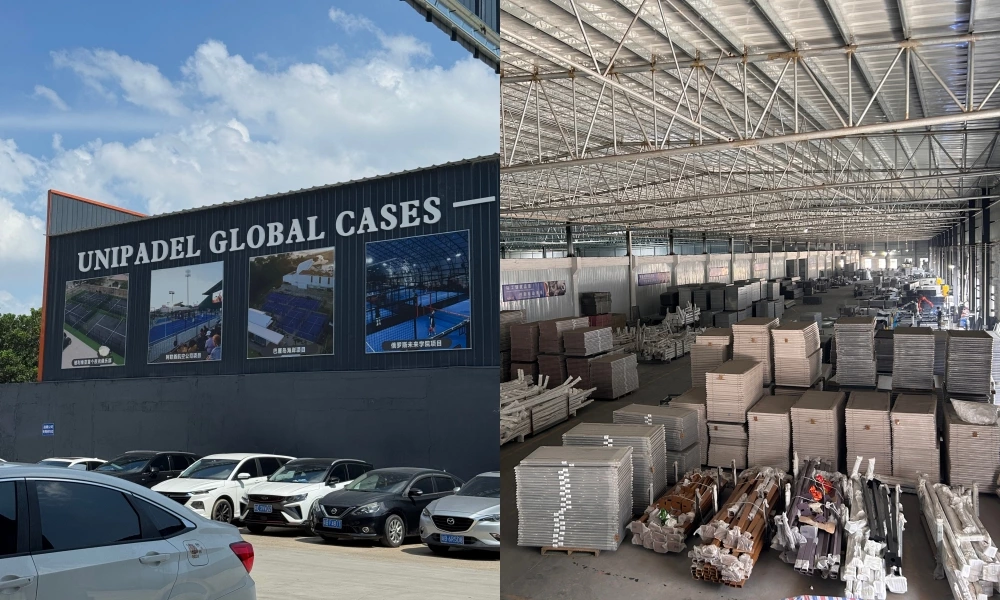
UNIPADEL's Global Track Record
UNIPADEL has delivered certified padel court systems to projects across 20+ countries — including the UK, Germany, France, Kazakhstan, Russia, Indonesia, Malaysia, South Africa, Chile, and Colombia. Each project is supported by the same complete documentation package, the same material specifications, and the same after-sales structure. We do not have a "premium" range and a "budget" range. We have one standard — and it is built to last.
The Decision Framework
The padel court market in 2026 presents investors with a choice that looks like a price decision but is actually a risk decision.
The courts that generate returns — consistent bookings, low maintenance, zero unplanned closures, tournament eligibility, planning authority compliance — are built to a technical standard that cheap suppliers are structurally unable to meet. They lack the manufacturing processes, material traceability, certification infrastructure, and after-sales organisation to deliver reliable long-term performance.
The courts that consume returns — spontaneous glass breakage, accelerating corrosion, premature turf replacement, failed planning inspections, insurance disputes — are distinguished from quality courts by specifications that are invisible on a product page but entirely visible in a material certificate, a galvanizing test report, and a factory audit.
Padel court manufacturer comparison is ultimately a documentation exercise. Ask the nine questions. Request the certificates. Compare the specifications. The supplier whose documentation is complete, traceable, and issued by credible third-party bodies is the supplier whose product will perform.
UNIPADEL's documentation is available in full. Request it, verify it, and build your padel investment on a foundation that will hold.