Español
 Franch
  русский
Padel World Summit 2026 Barcelona | Global Padel Trends & Standards
UNIPADEL Invited to Attend the World Padel Summit
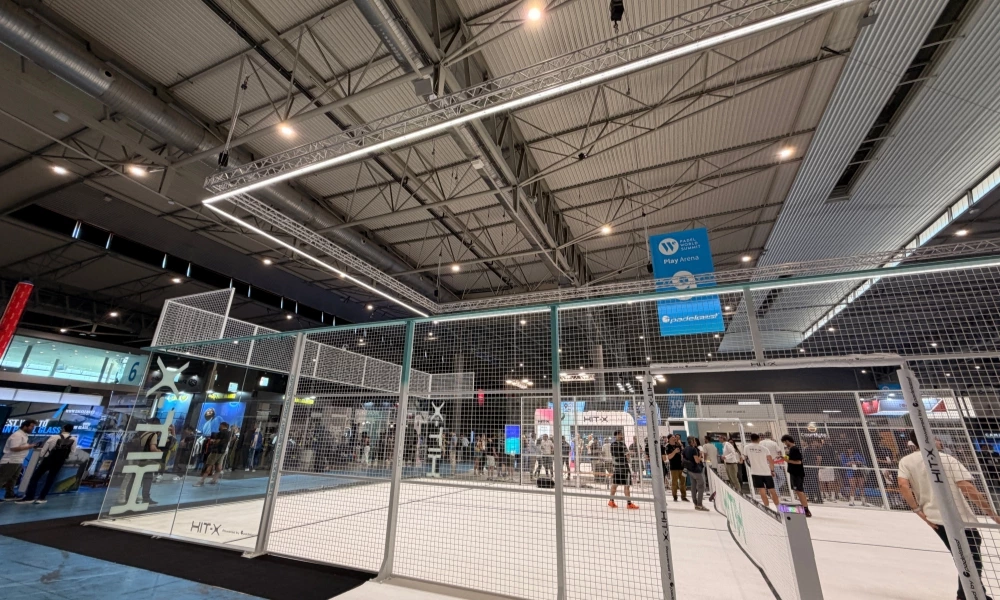
In 2026, UNIPADEL, as a professional industry observer, officially participated in the Padel World Summit 2026 (PWS 2026) held in Barcelona, Spain—the most influential and authoritative annual industry summit in the global Padel industry.
The summit, themed "Next Padel: Vision, Alliances and Transformation," brought together representatives from European official sports organizations, the FIP International Padel Federation, top equipment brands, global operators, and industry investors. Over three days, through exhibitions, forums, and closed-door meetings, the summit systematically released the latest development directions for the global Padel industry in 2026.
The UNIPADEL team was deeply involved throughout the summit, systematically studying the updates to official European standards, the direction of intelligent operation upgrades, and new material certification requirements. They also comprehensively compared and evaluated the summit's core insights with UNIPADEL's existing product system.
The conclusion is clear: in 2026, the global Pader industry will officially enter a new era of "standardization + intelligence + high security".
Three Core Industry Trends Announced at PWS 2026
During the three-day summit, exhibition, and industry forums, the following three development trends reached a consensus among European official institutions, top brands, and international operators:
Trend 1: AI-Powered Intelligent Management Systems Become Standard for High-End Padel Clubs
The most attention-grabbing highlight of PWS 2026 was the widespread adoption of AI-powered intelligent Padrás stadium management systems.
Traditional Padrás club operations heavily rely on manual scheduling, manual inspections, and manual statistics. The new generation of AI management systems is fundamentally reshaping club operations:
- Intelligent Booking and Dynamic Pricing: The system analyzes match popularity and user behavior in real time, automatically adjusting pricing strategies for different time periods. While ensuring premium pricing during peak hours, it activates off-peak periods with discounted prices, maximizing revenue around the clock.
- Real-time IoT Sensor Monitoring: Key indicators such as padel court lighting standard, glass damage status, and turf temperature and humidity are all connected to a sensor network. The system automatically pushes maintenance warnings, transforming "passive maintenance" into "predictive maintenance," significantly reducing average annual operating costs.
- User Profiling and Precise Operations: Based on player historical booking data, skill level tags, and consumption behavior analysis, clubs can achieve precise activity recommendations, matching of teaching courses, and intervention in member retention.
Summit data shows that clubs deploying AI management systems have seen an average increase of 28% in venue utilization and a decrease of approximately 15% in annual operating costs.
UNIPADEL Observation: AI-powered intelligent operations are rapidly shifting from a "competitive advantage" to a "basic industry threshold." Investors planning to build or renovate stadiums are advised to reserve IoT interfaces and intelligent lighting control wiring during the stadium design phase to avoid high costs associated with later modifications.
Trend Two: UNE 147201:2024 Standard Officially Implemented, Comprehensive Upgrading of Glass Safety Standards
In 2026, the glass safety standards for the Padel Stadium in Europe will undergo a major upgrade.
The Spanish Standards Association (UNE) has officially released and mandated the implementation of UNE 147201:2024, the most comprehensive technical specification update to date in the construction of Padel Stadiums in Europe.
The core changes are concentrated in the following three points:
1. 12mm Hot-Dip Tempered Glass (HST) Becomes a Mandatory Requirement in the European Market
Ordinary 10mm tempered glass has been explicitly listed as "non-compliant" in professional stadiums in Europe. The new standard requires that the side and rear walls of the stadium use 12mm tempered glass and undergo a heat-soak test to pre-emptively remove nickel sulfide impurities from the glass, significantly reducing the risk of spontaneous breakage during operation.
2. FIP Certification Glass Documentation Becomes a Venue Entry Barrier
Any venue wishing to host an official FIP event must provide the organizer with an FIP certification report for its glass materials and UNE 147201:2024 compliance documentation. Venues unable to provide these documents will be directly excluded from event application eligibility.
3. Enhanced Glass Installation Standards: 5mm Neoprene Pads Installed Around the Circumference
The new standard clearly stipulates the glass installation process: a 5mm neoprene pad must be installed around the entire circumference between the glass and the metal frame to absorb impact vibrations and prevent breakage due to contact stress caused by thermal expansion and contraction.
UNIPADEL Observation: The implementation of UNE 147201:2024 will create a market watershed in the next 2 to 3 years - suppliers who can provide compliant documentation will quickly establish competitive barriers, while those who cannot will be gradually eliminated from the mainstream European market.
Trend 3: Upgraded Professional Lighting Standards, LED Systems Entering a Stage of Refined Competition
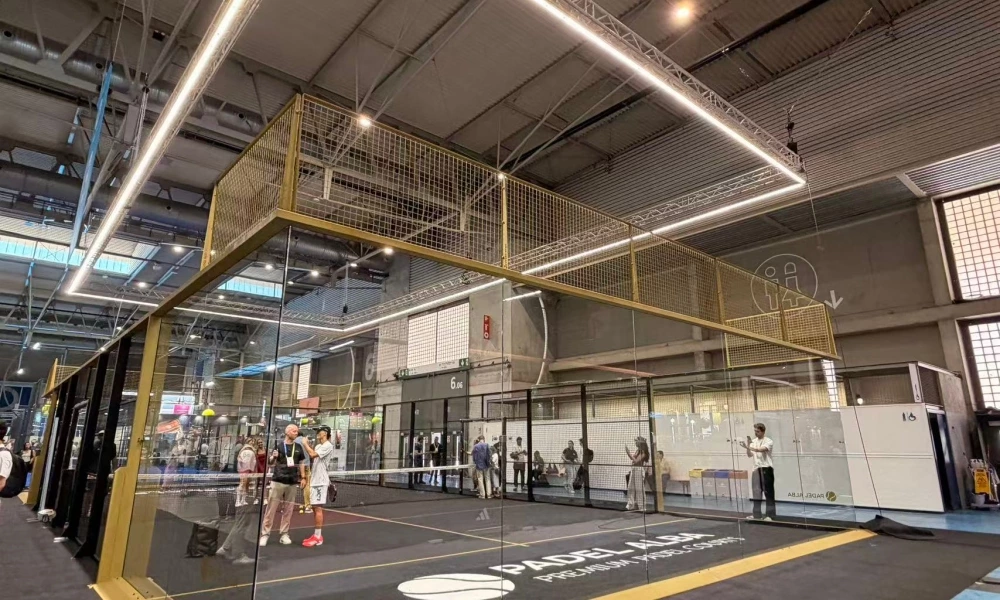
Lighting is no longer just an "accessory" for Padel Stadium, but a core system influencing the sporting experience, tournament eligibility, and operating costs.
At the lighting forum of PWS 2026, European official bodies and top stadium operators jointly confirmed the following industry standard directions:
| Event Level | Minimum Illumination Requirement | Uniformity Coefficient |
| Recreational/Entertainment Level | 200 lux | ≥0.5 |
| Club/Regional Event Level | 300 lux | ≥0.7 |
| National/International Event Level | 500 lux and above | ≥0.7 |
Three new requirements for professional LED floodlights:
- Anti-glare design (UGR≤19): During high-speed sports events, glare can severely interfere with players' judgment of the ball. The new standard requires floodlights to be equipped with precise optical lenses to completely confine the light within the field area, eliminating glare spill.
- High color rendering index (CRI≥80): Ensures the color of the ball is accurately reproduced under artificial light, avoiding visual misjudgment.
- Instant full illumination (no preheating): Unlike traditional metal halide lamps, LED lights must achieve rated illuminance immediately upon switching on, meeting the immediate needs of live broadcasts and player training.
UNIPADEL observation: Summit data shows that LED systems meeting the new lighting standards can save up to 65% more energy than traditional halogen lamps. In the European market where electricity prices are constantly rising, the energy-saving performance of lighting systems directly affects the annual operating profits of clubs.
UNIPADEL's Key Takeaways from PWS 2026
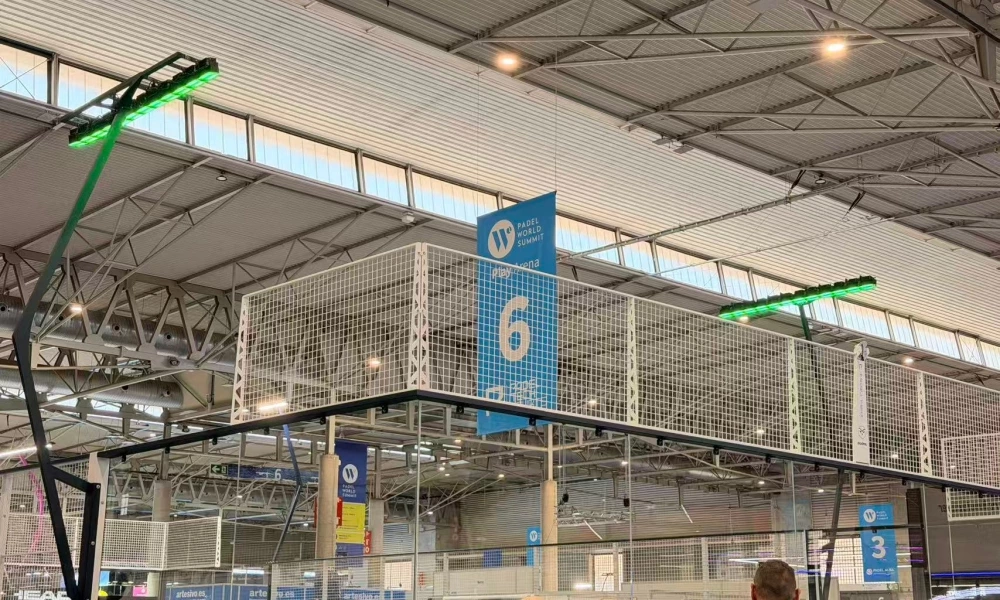
Participating in this summit, UNIPADEL not only observed industry trends but also proactively benchmarked against best practices and assessed strategic objectives.
- Comprehensive Product Standard Verification: UNIPADEL's existing product line was benchmarked against the new UNE 147201:2024 standard item by item, confirming that core configurations such as 12mm HST glass, hot-dip galvanized steel frames, and FIP-certified PE turf meet or exceed the requirements of the new standard.
- Intelligentization Roadmap Confirmation: Based on insights from the summit's AI operation trends, UNIPADEL confirmed that it recommends customers reserve IoT hardware interfaces in new project deliveries, establishing compatibility design standards with mainstream intelligent management platforms.
- Strengthened Industry Positioning: As one of the few Chinese Padel stadium manufacturers to have completed trademark registration in Spain (registration number M4.316.700) and actively participated in the world's highest industry summit, UNIPADEL further solidified its market position as an international professional supplier at PWS 2026.
2026 Global Padel Industry Strategic Outlook
Based on full participation and systematic research in PWS 2026, UNIPADEL makes the following strategic assessments of the global padel industry from 2026 to 2028:
1. Standardization will accelerate market reshuffling. The mandatory implementation of new standards such as UNE 147201:2024 will create a clear supplier stratification in the European market. Compliant manufacturers capable of providing complete technical documentation will win more high-quality projects, while those failing to meet standards will gradually exit the mainstream market.
2. Emerging markets are entering a critical window of opportunity. Markets such as Spain, Germany, France, Poland, and the UK are in a phase of rapid growth with supply falling short of demand. Early entrants will gain a difficult-to-replicate first-mover advantage in terms of venue location, customer relationships, and brand recognition.
3. Intelligentization is the core battleground for the next round of competition. The adoption rate of AI management systems has exceeded industry expectations. Suppliers capable of providing integrated solutions combining "field hardware + intelligent interfaces + operational advice" will occupy a more advantageous negotiating position in the high-end market.
The Padel World Summit 2026 is the most important industry indicator for the global padel industry in 2026. UNIPADEL's deep involvement is not only a comprehensive calibration of its own product standards but also a systematic confirmation of its future market strategic direction.
We believe that driven by the three trends of standardization, intelligentization, and high security, the next golden decade for the padel industry has just begun.
UNIPADEL will continue to track global industry trends and support padel infrastructure construction in markets around the world with products and services that meet the highest international standards.