Español
 Franch
  русский
Why Cheap Padel Courts Fail German DIN/Eurocode Structural Inspections?
Across Germany, sports club directors, tennis club boards, private investors, and municipal developers are rushing to break ground on new padel facilities. With demand soaring and court bookings filled weeks in advance, the business case is compelling.
And yet many fall into the same financial trap: the temptation of the cheap overseas court.
Online wholesale suppliers frequently advertise complete padel courts for €12,000–€15,000. Against prices from fully certified manufacturers — typically €22,000–€28,000 — the "save €10,000" offer looks irresistible. Investors picture themselves importing the hardware, pouring a basic slab, and collecting court fees within weeks.
In Germany's highly regulated infrastructure sector, that shortcut is an illusion. The German proverb says it precisely: "Wer billig kauft, kauft zweimal" — He who buys cheap, buys twice.
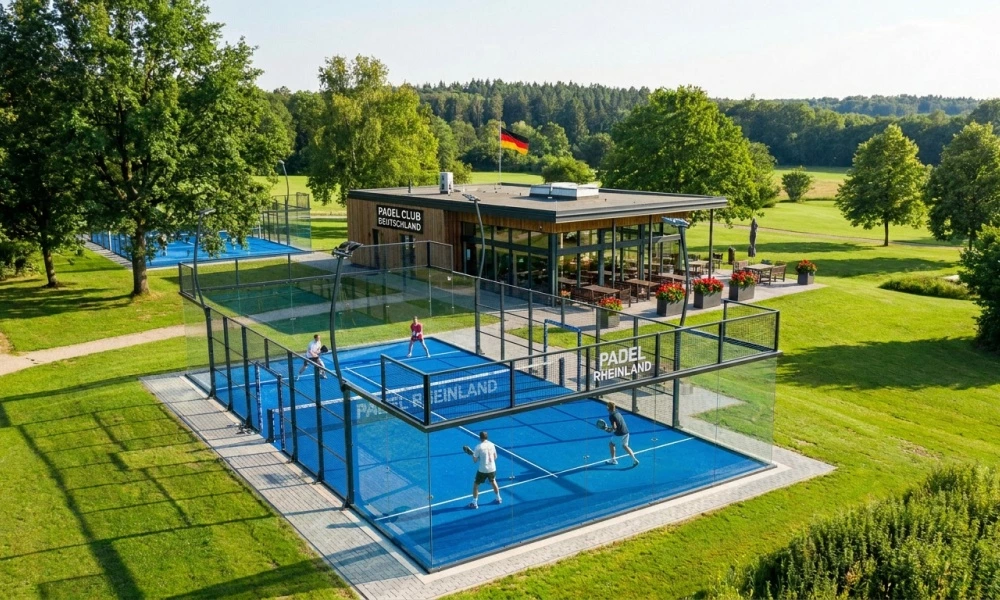
Why German Law Requires a padel court Germany building permit for Every Court?
The most expensive misconception in the German padel market is that a padel court can be classified as temporary playground equipment (Spielgerät) or a temporary structure (fliegender Bau), bypassing formal planning approval.
Under the Federal Building Code (Baugesetzbuch — BauGB) and each state's Building Regulations (Landesbauordnung — LBO), an outdoor padel court is unambiguously classified as a permanent building structure (bauliche Anlage). A padel court meets this definition on every count:
- Permanently anchored into reinforced concrete foundations
- Steel framework standing 3–4 metres high
- Approximately 100 m² of load-bearing tempered safety glass
- Total structural weight exceeding 3.5–4.5 metric tonnes
Operating without a valid permit exposes operators to:
- Immediate construction stop orders (Baueinstellung)
- Administrative fines up to €50,000
- Mandatory demolition at the owner's expense
No savings on a cheap court compensate for these outcomes.
Typenstatik padel court: The Most Overlooked Compliance Document
When submitting a Baugenehmigung padel court Germany [LONG-TAIL] application, structural engineering calculations (Tragwerksplanung) are the most critical document in the package. There are two routes:
- Option A — Einzelstatik (Individual Calculation) You commission a local German structural engineer to calculate the court from scratch. Timeline: several months. Cost: €5,000–€12,000 per court model.
- Option B — Typenstatik (Pre-Approved Type Calculation) Your manufacturer supplies a pre-verified Typenstatik padel court [PRIMARY] — a standardised structural report approved once by a recognised German testing authority (Prüfamt für Baustatik) and valid across multiple wind zones and soil classes.
What happens without a Typenstatik from a cheap supplier?
The manufacturer sends a basic PDF in Chinese or English that references no DIN or Eurocode standards. German authorities reject it immediately.
The Technical Standards Behind padel court structural certification Germany
Standard 1 — Steel Fabrication: DIN EN 1090 padel court steel structure
Under the EU Construction Products Regulation (CPR 305/2011), any load-bearing steel structure permanently installed in Germany must carry a CE marking padel court Germany [PRIMARY] issued under DIN EN 1090 padel court steel structure [LONG-TAIL].
Cheap overseas manufacturers possess none of this. Without a valid CE declaration, their steel components cannot legally be installed in Germany. If discovered on-site, the Prüfingenieur will halt assembly and void any commercial liability insurance — meaning the club bears full legal responsibility for any accident.
Standard 2 — Wind Load Engineering: DIN EN 1991-1-4
Germany is divided into four wind load zones under DIN EN 1991 wind load padel court:
- Southern Bavaria, inland flatland:Wind Zone 1,~120 km/h
- Central Germany, Ruhr region:Wind Zone 2,~130 km/h
- Northern Germany, Hamburg suburbs:Wind Zone 3,~140 km/h
- North Sea / Baltic coast:Wind Zone 4,~150 km/h
Because padel court glass walls are completely solid, they exert massive wind pressure on the steel frame. Compliant courts require column profiles of 100×100mm or 120×80mm with 3.0–4.0mm wall thickness.
Cheap manufacturers use 80×80mm columns with 1.5–2.0mm walls — designed for Mediterranean climates with 80–100 km/h winds. In a standard German autumn storm, these thin profiles buckle and collapse, producing a catastrophic cheap padel court Germany structural failure
Standard 3 — Safety Glass: DIN EN 12150-1 + DIN EN 14179
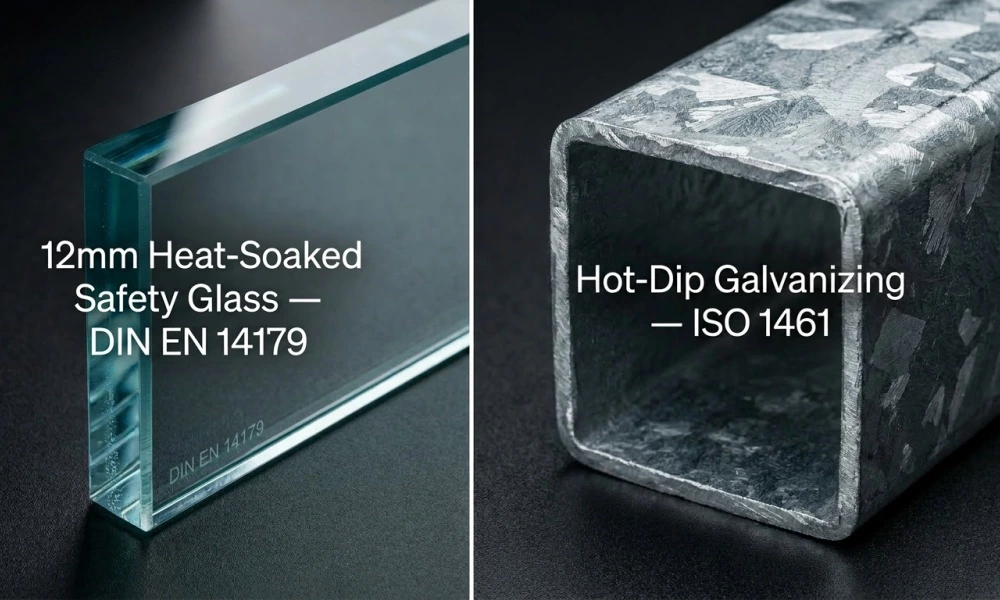
German building codes require fully tempered safety glass conforming to DIN EN 12150-1. For commercial and public facilities, standard tempered glass is insufficient. Checking engineers demand 12mm heat soaked tempered glass padel DIN EN 14179.
Cheap courts routinely skip this test. Multiple German sports clubs have reported glass panels exploding without warning mid-match — triggering immediate court closure, insurance disputes, and costly emergency replacement.
Standard 4 — Corrosion Protection: DIN EN ISO 1461
Germany's climate — high humidity, winter frost, coastal salt air — destroys untreated steel rapidly. The only reliable solution is hot-dip galvanizing padel court ISO 1461.
Cheap manufacturers use pre-galvanized sheet steel — coated at the mill, then cut and welded, which burns away the zinc at every joint. Within 12–24 months, water enters the hollow sections through exposed weld seams and rusts the frame from the inside out. By year three, load-bearing columns show visible structural degradation.
Padel court foundation Germany DIN 1054: Why Shallow Slabs Destroy Glass
Foundation engineering for a German padel court must comply with padel court foundation Germany DIN 1054 combined with DIN EN 1992 (Eurocode 2) for reinforced concrete design.
Core requirements:
- A professional soil survey (Bodengutachten) before design commences
- Reinforced concrete (minimum C25/30) with perimeter ring beam (Streifenfundament)
- Foundation base extending to minimum 80cm below ground level — the German frost-free depth
The padel court Prüfingenieur in Germany
Unlike many markets where a planning officer performs a cursory drawing review, Germany operates under a principle of independent technical verification.
The padel court Prüfingenieur Germany is a state-licensed checking engineer appointed directly by the building authority — not by the project owner — to eliminate conflicts of interest. They conduct:
- Full review of structural calculations limits
- Material certificate verification (steel grade, glass certification, weld quality)
- Foundation design check for DIN 1054 compliance and frost depth
- CE declaration review for the steel frame
- On-site reinforcement inspection (Bewehrungsabnahme) before concrete pour
- On-site anchor and steel element inspection at frame installation
Full Cost Comparison: Cheap Import vs. padel court manufacturer CE certified Germany
| Cost Component | Cheap Non-Compliant Import | UNIPADEL Compliant Court |
| Steel specification | 1.5–2mm thin wall, no CE, no FPC | 3–4mm S355JR, full DIN EN 1090 CE certification |
| Wind load compliance | Fails Zone 2+ (collapse risk) | Verified to DIN EN 1991 all zones |
| Glass specification | 10mm non-heat-soaked (self-explosion risk) | 12mm HST, DIN EN 14179 certified |
| Corrosion protection | Pre-galvanized, rusts within 2 years | Hot-dip galvanized ISO 1461, 25yr lifespan |
| Foundation design | Shallow slab (frost heave risk) | Deep ring beam per DIN 1054, 80cm depth |
| Prüfingenieur outcome | Rejection, revisions, delays: +€4,000–€8,000 | Fast-track approval, nominal checking fee |
| Total Year 1–2 Project Cost | €30,000–€43,000+ (with demolition risk) | €28,000–€32,000 (fully operational) |
Conclusion
In Germany, choosing a padel court supplier is not a price comparison exercise — it is a document comparison exercise.
Typenstatik. DIN EN 1090 CE marking. DIN EN 14179 heat-soaked glass. ISO 1461 hot-dip galvanizing. DIN 1054-compliant foundations. These are not premium extras — they are the legal conditions for operating in one of Europe's most regulated and most lucrative padel markets.
A cheap court saves €10,000 on paper. It cannot protect €50,000+ in civil works investment. It cannot survive a German winter storm. It cannot pass a Prüfingenieur review. And if authorities issue a demolition order, it produces a 100% capital loss.
In Germany's padel market, compliance is not the price of quality — it is the price of entry.