Español
 Franch
  русский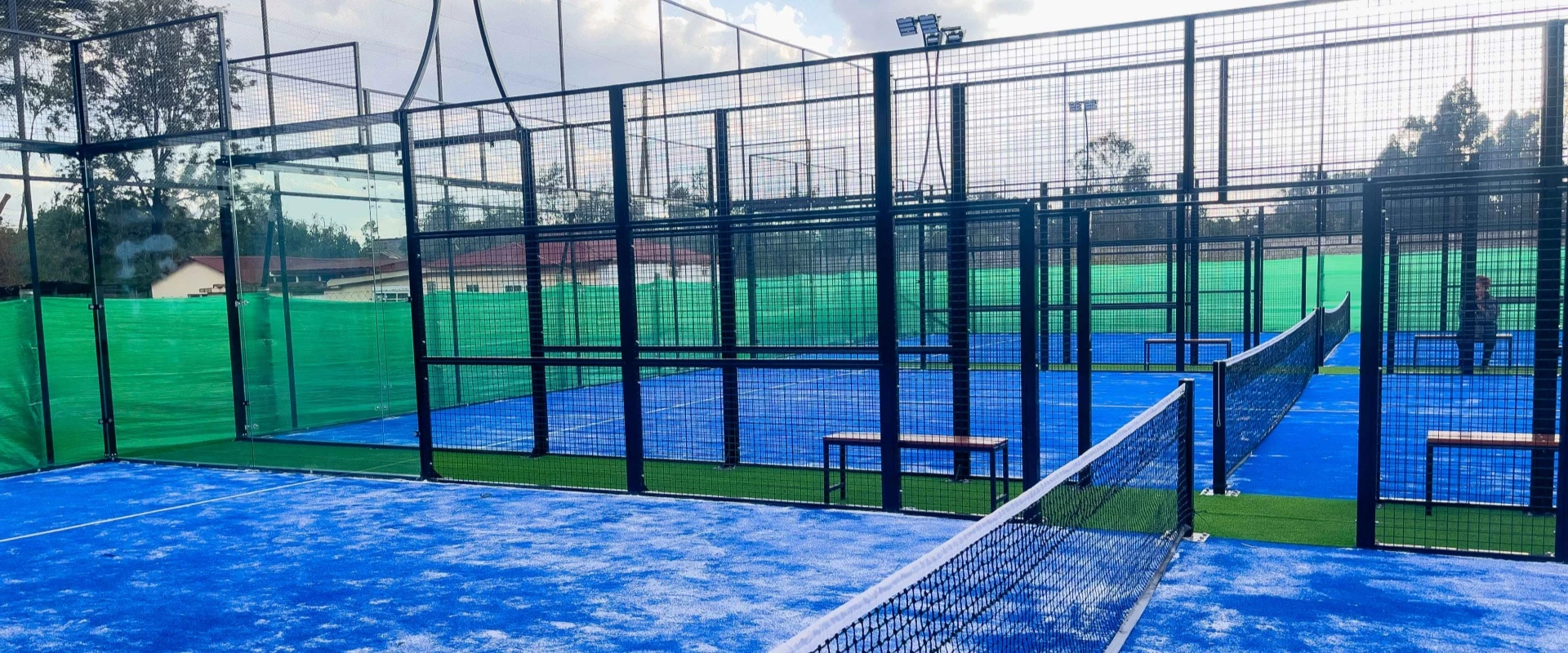
What are the UV protection standards for turf and steel frames in Australia?
Australia's Sun Is Not Ordinary Sun
Brisbane. Peak summer UV Index: 16.3. Sydney. Peak summer UV Index: 15.2. Central Europe. Peak summer UV Index: 6 to 8.
Solar UV radiation in Australia is up to 40% more intense than in Europe at comparable latitudes. Two atmospheric factors drive this: the Earth's elliptical orbit places the Southern Hemisphere closer to the sun during its summer solstice, and the Southern Hemisphere's ozone layer is measurably thinner than its Northern Hemisphere equivalent — allowing a higher proportion of UV-B radiation to reach the surface.
In this context, any supplier telling you their "standard UV treatment" is sufficient for an Australian outdoor installation owes you a detailed technical data sheet to back that claim.
Research by Western Sydney University (WSU) and the NSW Chief Scientist confirms that unshaded synthetic turf surfaces in Australia regularly reach 74°C to 84.5°C on summer days — far beyond the operating conditions for which standard padel court materials are designed. Under these conditions, standard-specification padel court artificial turf Australia has an average outdoor lifespan of just 3 to 4 years. Standard frame coatings in coastal locations fail in as little as 18 months.
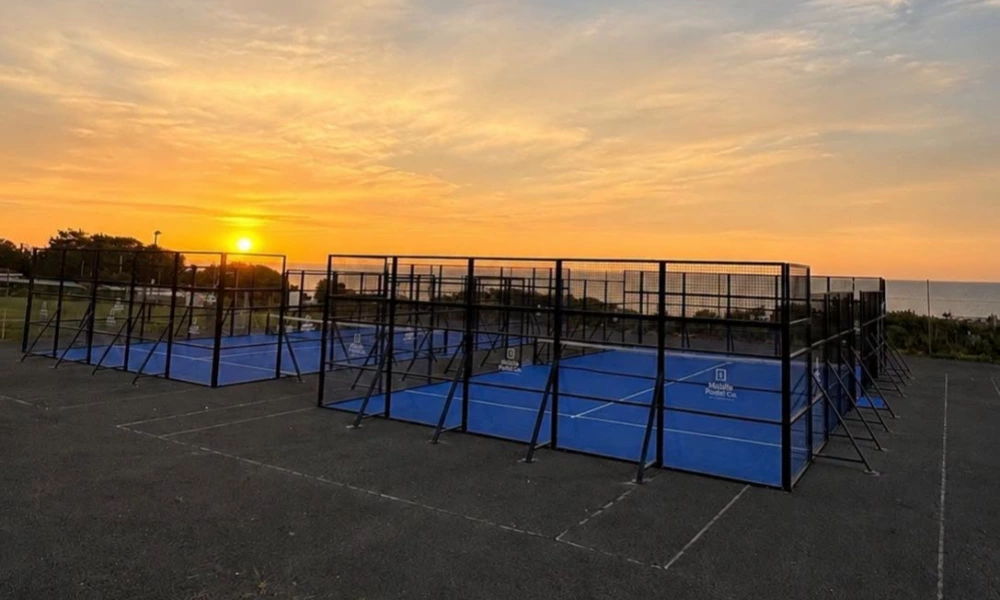
Australian UV Radiation — What Your Court Absorbs Every Day
The Australian Radiation Protection and Nuclear Safety Agency (ARPANSA) long-term monitoring data reveals the UV exposure intensity across four major cities:
1、Brisbane:
Latitude 27°28';
Subtropical; extreme humidity; high UV-A and UV-B;
Peak Summer UV Index: 16.3 (Extreme)
2、Perth:
Latitude 31°54';
Mediterranean; intense dry heat; high wind
Peak Summer UV Index: 15.0 (Extreme)
3、Sydney:
Latitude 33°55';
Mediterranean; Temperate; aggressive coastal marine salt spray
Peak Summer UV Index: 15.2 (Extreme)
4、Melbourne:
Latitude 37°40';
Temperate; rapid temperature fluctuations; thermal stress
Peak Summer UV Index: 14.4 (Extreme)
Across every major Australian capital, peak summer indices consistently exceed 14 — reaching an extraordinary 16.3 in Brisbane. The vast majority of padel court turf and steel coating specifications are designed and tested against European temperate climate benchmarks. In Australian conditions, this specification gap is not marginal — it is fundamental.
Court Surface Temperatures — The Hidden Accelerator
UV radiation alone does not tell the complete story. The synthetic materials used in padel courts — particularly the artificial turf and silica sand infill — absorb and trap solar radiation, converting the court into a thermal heat sink.
The padel court surface temperature Australia far exceeds ambient air temperature:
- Ambient Air 25°C ──► Turf Surface Temperature: >65°C
- Ambient Air 30°C ──► Turf Surface Temperature: >75°C
- Ambient Air 35–40°C ──► Turf Surface Temperature: 74°C – 84.5°C
- Extreme Unshaded Asphalt Base ──► >88°C (approaching boiling point)
At surface temperatures above 75°C, the mobility of polymer molecules within the turf fibres increases significantly, causing UV stabilisers to migrate out of the fibre matrix at an accelerated rate. Even where standard-quantity UV stabilisers are present at point of installation, Australia's high-temperature conditions deplete these protective agents at 3 to 5 times the rate seen in European climates — leaving the turf unprotected well before its rated service life is reached.
PP vs PE Turf Fibres — Why the Molecular Structure Determines Survival
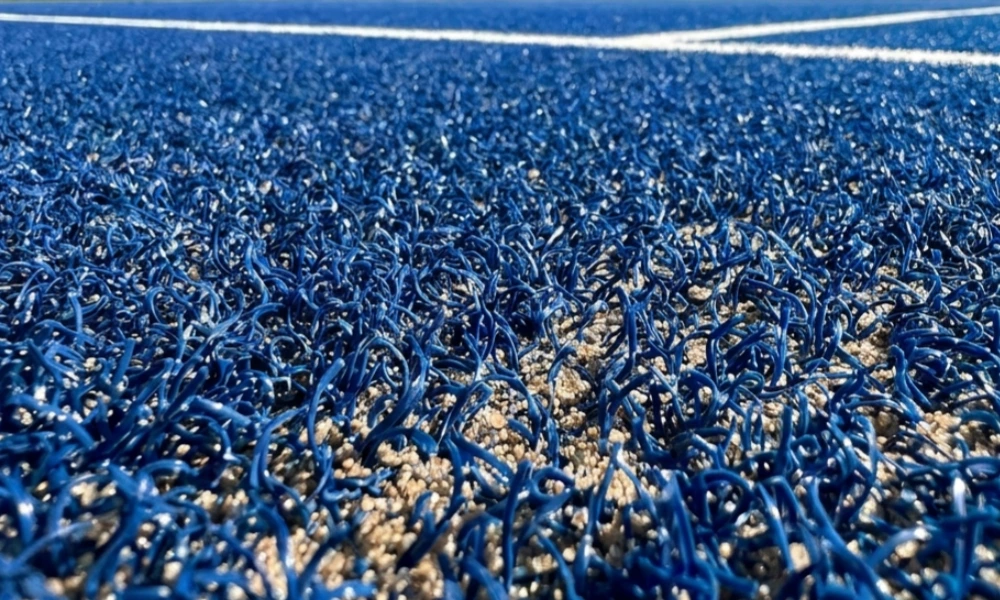
For any padel court outdoor Australia installation, the choice between Polypropylene (PP) and Polyethylene (PE) as the base turf polymer is the most consequential material decision made during procurement.
Polypropylene (PP) — Fundamentally Unsuitable for Australian Outdoor Conditions
PP's molecular chain contains a methyl group (–CH₃) attached to every alternate carbon atom, creating a high density of tertiary carbon atoms. These tertiary bonds have lower dissociation energies than primary or secondary carbon bonds, making them highly susceptible to UV-induced free radical attack.
PP has specific UV absorption peaks at 290–300nm, 330nm, and 370nm — wavelengths that align precisely with the most energetic UV-B and UV-A bands of Australian sunlight. Exposure triggers photo-oxidative chain scission: UV photons break long-chain polymers into shorter, brittle fragments, causing progressive loss of tensile strength and elasticity.
Polyethylene (PE) — The Correct Choice for Australian Conditions
PE's linear polymer backbone contains no tertiary carbon atoms. This molecular structure is inherently more resistant to UV-induced chain scission, and the fibre retains elasticity and structural integrity under sustained thermal and UV loading.
Padel court polyethylene turf Australia —— specifically 100% high-density monofilament PE — is the only viable specification for outdoor Australian padel installations. With a correctly formulated UV stabiliser system, PE turf maintains playable pile height, consistent ball bounce, and structural integrity for 8 to 10 years, with well-maintained installations reaching 12 to 15 years of service life.
The Truth About UV Stabilisers
Selecting PE fibre is necessary but not sufficient. Padel court HALS UV stabiliser turf formulation quality determines the actual outdoor lifespan of even the correct polymer.
Standard European-specification turf uses a single low-molecular-weight UV absorber at less than 3,000 ppm total concentration. Under Australian conditions, this basic package exhausts its radical-scavenging capacity within 2 to 3 years, leaving the fibre entirely unprotected during the middle portion of its intended service life.
The critical distinction: Unlike conventional UV absorbers that are consumed as they function, HALS operates through the Denisov Cycle — a self-regenerating radical-scavenging mechanism that continuously neutralises the free radicals generated during photo-oxidation, returning to its active state to repeat the process. This regenerative chemistry is why high-concentration polymeric HALS is the defining technical differentiator of Australian-grade turf — not merely an optional upgrade.
Steel Frame Coatings — The Dual Destruction Mechanism in Coastal Australia
Over 80% of Australia's padel court developments are located in coastal zones — subjecting steel frames to a simultaneous attack from high UV radiation and airborne marine chlorides. Standard single-layer powder coatings cannot resist this dual mechanism.
The coastal failure chain for standard coatings:
- Extreme UV Radiation
- Polymeric binder in standard polyester powder coating degrades
- Micro-cracks and pinholes form in the topcoat layer
- Airborne marine chlorides and moisture penetrate through cracks
- Electrochemical oxidation of the carbon steel substrate begins
- Iron oxide (rust) forms — expanding to 6× the original steel volume
- Volumetric expansion generates immense outward pressure beneath coating
- Coating blisters, delaminates, and peels away in sheets
- Exposed steel suffers accelerated pitting corrosion — structural integrity compromised
This failure chain explains why padel court coastal corrosion Australia is the primary cause of premature steel frame replacement — not mechanical damage or installation error.
The only reliable countermeasure is a duplex protection system combining two independent defence layers:
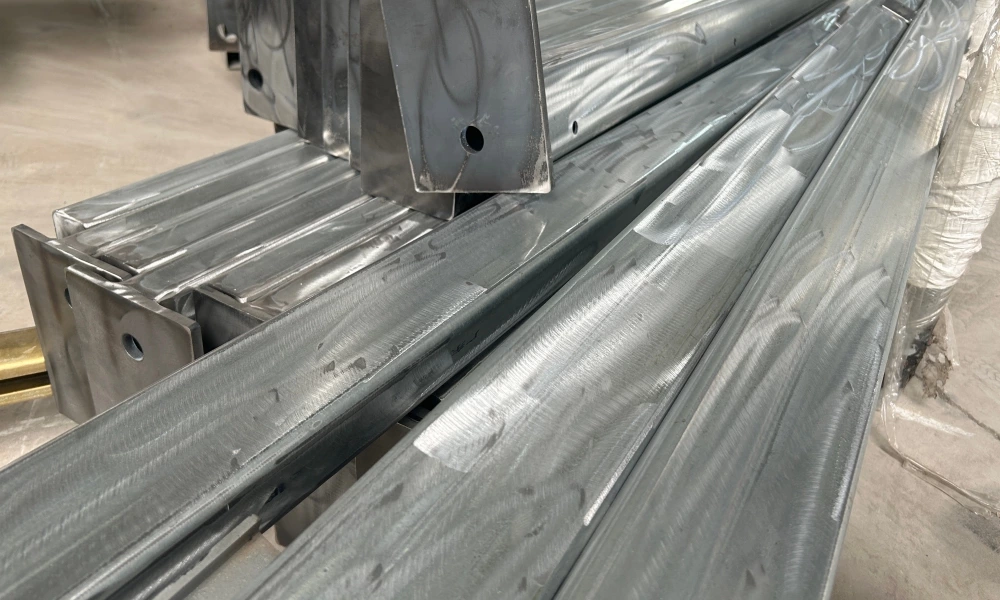
Layer 1 — padel court hot dip galvanizing Australia Post-fabrication hot-dip galvanizing (AS/NZS 4680) submerges the fully welded steel frame in a bath of molten zinc at 450°C. Zinc metallurgically bonds to every surface — including weld seams, hollow tube interiors, and drilled anchor holes — forming a ≥85 micron sacrificial layer that provides galvanic protection even if the topcoat is subsequently scratched or chipped.
Layer 2 — padel court duplex coating Australia Applied over the galvanised surface: a zinc-rich epoxy primer (40 microns) followed by an ultra-durable fluoropolymer topcoat (FEVE or PVDF, 80 microns). FEVE fluoropolymer coatings resist UV-induced chalking, colour fade, and gloss loss for 15 to 20+ years — far beyond the 1 to 3 year performance of standard polyester powder coatings in Australian coastal conditions.
Australian Standards — The Regulatory Framework
Any padel court steel frame coating Australia supplied to the Australian market must comply with the following standards:
| Standard | Title | Requirement Relevant to Padel Courts |
| AS/NZS 4680:2006 | Hot-dip galvanized coatings on fabricated ferrous articles | Minimum zinc coating thickness ≥85 microns for structural steel >6mm. Mandatory for all outdoor structural frames. |
| AS/NZS 2312.1:2014 | Protection of structural steel against atmospheric corrosion | Classifies environments C1–C5. Coastal Australian padel sites typically fall under C4 (High) or C5 (Very High Marine) — mandating duplex coating systems. |
| AS/NZS 4506:2005 | Metal finishing — Thermoset powder coatings | Governs powder coating performance including UV resistance and 1,000-hour salt spray test compliance. |
| AS/NZS 2208:1996 | Safety glazing materials in buildings | Mandates toughened safety glass fragmentation characteristics for structural glass walls. |
Non-compliance with the relevant AS/NZS padel court coating standard creates both structural safety risk and insurance liability exposure. In the event of a frame failure causing injury, courts built with non-compliant coatings may face voided warranties and uncovered liability claims.
Full Specification Australian-Grade
| Component | Australian-Grade Specification |
| Turf polymer | 100% high-density PE monofilament |
| Turf UV stabiliser | Polymeric HALS ≥8,000 ppm + Irganox 1010/1076 + Irgafos 168 |
| Turf backing | PU (polyurethane) backing; heat-stable above 80°C |
| Steel pre-treatment | Sa 2.5 grit blast + multi-stage zinc phosphate conversion coating |
| Corrosion protection | Post-fab hot-dip galvanizing, ≥85 µm (AS/NZS 4680) |
| Topcoat system | Duplex: zinc-rich epoxy primer + FEVE fluoropolymer topcoat (AS/NZS 4506) |
| Fasteners | Marine-grade Grade 316 stainless with neoprene isolating washers |
| Turf service life (outdoor AU) | 8–15 years |
| Frame coating life (coastal AU) | 15–20+ years |
10-Year Total Cost of Ownership (TCO) Analysis
The financial case for Australian-grade specification is clearest when the full 10-year ownership cost is modelled — not just the initial CAPEX figure.
| Cost Component | Ordinary padel court (10 Years) | UNIPADEL Australian-Grade (10 Years) |
| Initial CAPEX | AUD $70,000 | AUD $100,000 |
| Turf replacement (×2 cycles at AUD $15,000 each) | AUD $30,000 | AUD $0 |
| Frame recoating (×2 cycles at AUD $8,000 each) | AUD $16,000 | AUD $0 |
| Court closure revenue loss (18 days total) | AUD $7,128 | AUD $0 |
| 10-Year Total Cost of Ownership | AUD $123,128 | AUD $100,000 |
| Net 10-Year Saving (per court) | - | AUD $23,128 |
Calculation notes:
- Padel court turf replacement cost Australia per cycle (AUD $15,000): includes turf supply, ocean freight, installation labour, 3 tonnes of new silica sand infill, and disposal of degraded turf
- Frame recoating per cycle (AUD $8,000): includes on-site rust remediation, primer application, and polyurethane recoat
- Court downtime revenue loss: AUD 55/hour booking rate× 60396 /day × 18 closure days = AUD $7,128
Conclusion
In Australia, a padel court is not just a sports installation — it is a long-term commercial asset. The difference between a court that returns consistent revenue for 15 years and one that demands emergency turf replacement at 30 months comes down to material specification decisions made at the procurement stage.
Australia's UV indices, summer surface temperatures, and coastal salt environments are categorically more demanding than the conditions for which standard European padel court specifications are engineered. Standard PP turf, pre-galvanised frames, and single-layer polyester powder coatings are not inadequate because of poor quality — they are inadequate because they were designed for a different climate.
Choosing padel court UV protection Australia — 100% PE monofilament turf with polymeric HALS, post-fab hot-dip galvanized steel to AS/NZS 4680, and a FEVE fluoropolymer duplex topcoat — It eliminates the structural safety and liability risks that come with premature material failure in a public sporting facility.