Español
 Franch
  русский
Padel Court UK Cost & Planning Guide 2026: SAPCA Standards & ROI Models
Introduction: Why 2026 Is the Year to Build
The UK padel market has crossed a decisive threshold. With over 1,553 operational courts and more than 860,000 active players nationwide, the sport has moved from niche curiosity to mainstream commercial opportunity — and investor demand for new court infrastructure is outpacing supply in almost every major city.
But understanding how to set up a padel court in the UK involves far more than purchasing a court kit and pouring a concrete slab. The process spans planning law, structural engineering standards, noise compliance, financial modelling, and logistics coordination — each with UK-specific rules that differ materially from European or global norms.
Total Cost of Setting Up a Padel Court in the UK
Padel court UK cost is the first question every developer asks — and the most underserved answer in the market. Here is a realistic, component-level breakdown.
Court Kit vs. Total Project Cost
| Cost Component | Budget Range (per court) |
|---|---|
| Court kit (frame + 12mm glass + turf + LED) — factory direct | £15,000 – £22,000 |
| Site preparation and groundworks (excavation, ring beam, drainage) | £25,000 – £45,000 |
| Concrete foundation slab (reinforced, laser-levelled) | £8,000 – £15,000 |
| LED floodlighting and electrical connection | £5,000 – £12,000 |
| Planning application and acoustic survey | £2,500 – £6,000 |
| Installation labour (UK-based crew) | £8,000 – £15,000 |
| Total per outdoor court (turnkey, standard site) | £55,000 – £100,000 |
| Total per indoor court (warehouse conversion) | £35,000 – £65,000 |
Why such a wide range? Site conditions drive the majority of cost variation. Clay-heavy soils in Southern England, contaminated brownfield sites, and sloped terrain can add £15,000–£30,000 per court in additional groundworks. A geotechnical survey (£1,500–£3,000) before signing a lease is the single most cost-effective risk mitigation measure available.
[Get a Customized UK Project Quote]
UK Padel Club ROI Model (4-Court Indoor Facility)
| Utilisation Rate | Annual Court Hire Revenue | With Coaching + F&B | Payback Period |
|---|---|---|---|
| 50% (conservative) | ~£198,000 | ~£290,000 | 6–7 years |
| 65% (realistic) | ~£257,000 | ~£370,000 | 4–5 years |
| 80% (high performance) | ~£316,000 | ~£450,000+ | 3–4 years |
Padel court ROI UK is strongest for indoor multi-court facilities with diversified revenue (coaching programmes, corporate packages, F&B, pro shop). Single outdoor courts, particularly in weather-exposed locations, carry materially longer payback periods of 6–8+ years.
UK Planning Permission — The Rules That Determine Your Site
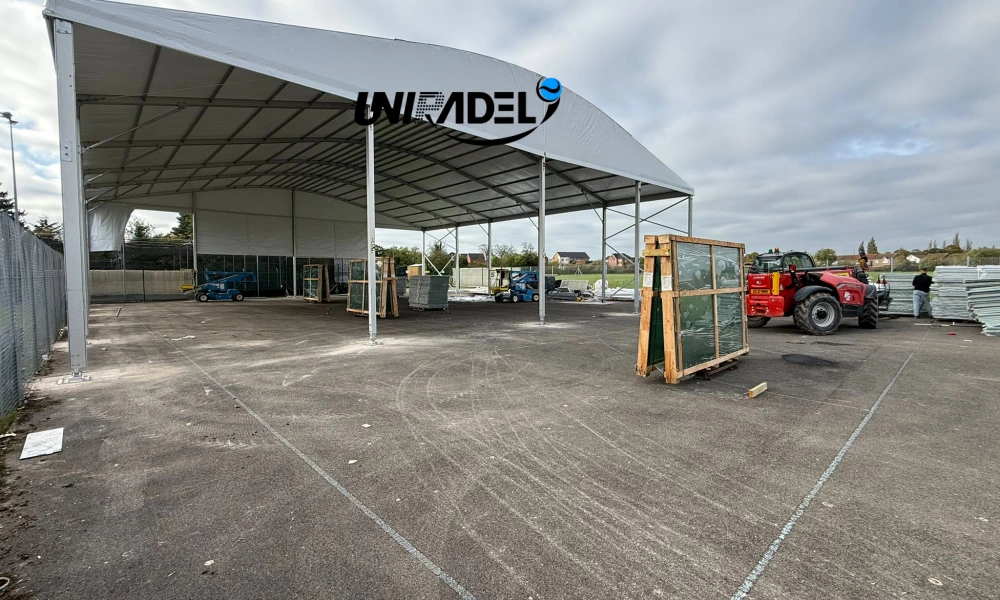
Padel court planning permission UK requirements are determined by two factors: whether your court is indoor or outdoor, and what the land's existing planning use class is.
Use Class Classification
| Court Type | Planning Use Class | Planning Requirement |
|---|---|---|
| Indoor padel (warehouse conversion from Class E) | Class E(d) — Indoor sport and recreation | No permission required if the building is already Class E |
| Indoor padel (conversion from B8 Storage or B2 Industrial) | Change of Use to Class E(d) | Full planning application required |
| Outdoor padel (new build at a sports club) | Class F2(c) — Outdoor sport and recreation | Planning permission required in most cases |
| Agricultural barn conversion (≤1,000 sqm) | Class R Permitted Development | Prior Approval only — faster, limited LPA powers |
Padel court UK planning Class E conversions from existing Class E premises — former gyms, retail units, offices — are the fastest and lowest-risk planning route. The principle of the change of use cannot be refused, which is why warehouse conversions dominate new UK padel development in 2025–2026.
Key Triggers That Require Planning Attention
Noise: Any outdoor court within 50 metres of a residential property will require a formal noise impact assessment. Padel's distinctive impulsive sounds — the racket "pop" and glass "thwack" — carry character correction penalties of +3 to +6 dB under BS 4142, making acoustic design a planning critical path item, not an afterthought.
Lighting: Floodlighting installations require a photometric lux plan demonstrating no light spill beyond site boundaries. LED systems must be directional with spill shields — this is now standard LPA requirement across most English councils.
Sustainable Drainage (SuDS): Non-porous concrete slabs require underground attenuation systems to satisfy SuDS requirements. Porous asphalt bases drain naturally and typically satisfy SuDS at lower cost — an important design decision made at the planning stage, not after.
Planning Timelines
Pre-application advice from the LPA (£150–£2,000) before formal submission is strongly recommended for any commercial multi-court development — it clarifies acoustic and lighting requirements specific to your site before costly design work is finalised.
UK Industry Standards — SAPCA, LTA, and What Compliance Actually Means
The two governing standards bodies for padel court construction in the UK are SAPCA and the LTA. Understanding their requirements is non-negotiable for any commercial padel court installation UK project.
SAPCA Code of Practice — 5th Edition
| Specification | SAPCA 5th Edition Requirement |
|---|---|
| Steel tube profile (uprights) | Minimum 80×80×3mm box section; high-load zones 140×80×5mm |
| Hot-dip galvanizing | ISO 1461 post-fabrication galvanizing — pre-galvanized sheet is not acceptable |
| Wind load resistance | Structural calculations must certify resistance to 80–98 mph gusts (Eurocode 1, EN 1991-1-4) |
| Concrete ring beam depth | Minimum 500mm from finished surface level; 750mm+ on shrink-swell clay |
| Drainage capacity | Base must drain ≥60 litres per m² per hour — porous macadam or SuDS-compliant attenuation |
| Floor flatness | Maximum deviation ±3mm under any 3-metre straightedge |
| Glass specification | 12mm toughened safety glass, EN 12150-1 certified; HST (heat-soaked) recommended for commercial venues |
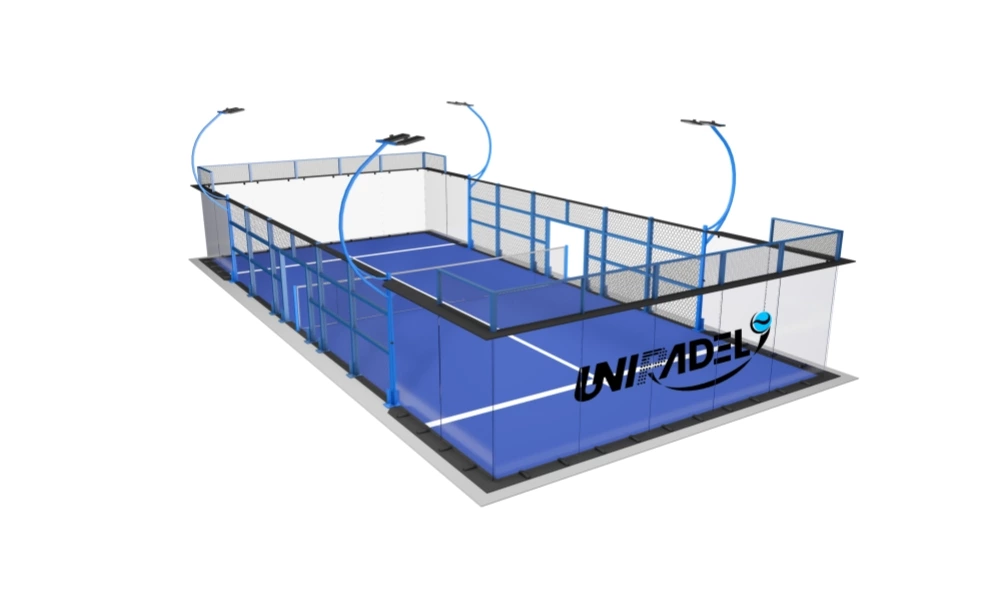
UNIPADEL courts meet or exceed all SAPCA 5th Edition structural requirements. Our steel profiles, hot-dip galvanizing process (ISO 1461, ≥75 micron zinc layer), and 12mm ESG/HST glass specifications are fully documented and available for submission to UK local authorities and SAPCA-registered installation partners.
Foundationworks — The Largest and Most Variable Cost
Padel court groundworks UK cost typically represents 45–55% of total project budget and is the single most common source of cost overruns for first-time developers.
The Two Standard Base Systems
Option 1: Porous Macadam Base + Perimeter Ring Beam (Recommended Outdoor)
- Excavation to 350mm depth; MOT Type 3 aggregate sub-base
- Perimeter reinforced concrete ring beam (500–800mm deep, T12/T16 rebar, C35/C40 concrete)
- Porous macadam wearing course — natural SuDS compliance, lower drainage cost
- Cost per court: £25,000–£35,000
Option 2: Full Reinforced Concrete Slab (Indoor / Low-Bearing Soils)
- 150–200mm C35/C40 reinforced concrete, A252/A393 mesh
- Power-floated to ±3mm flatness tolerance
- Requires SuDS attenuation system if non-porous outdoor installation
- Cost per court: £35,000–£50,000
The Hidden Cost: Electrical Infrastructure
Standard LED court lighting draws 1.2–2.4 kW per court. For 4+ court facilities, grid capacity upgrades from the Distribution Network Operator (DNO) can cost £15,000–£50,000 and add 3–6 months to the programme. Engage the DNO at feasibility stage — not after planning is approved.
Indoor vs. Outdoor — The UK Climate Decision
The UK receives approximately 1,500 hours of sunshine per year — roughly half of Spain's average. Outdoor courts face significant weather-related revenue disruption, particularly from October to April.
| Factor | Outdoor Court | Indoor Warehouse Conversion |
|---|---|---|
| Annual playable hours | ~1,800–2,200 hrs | ~4,000+ hrs (unrestricted) |
| Groundworks cost per court | £30,000–£45,000 | £8,000–£18,000 |
| Planning complexity | Moderate–High | Low (if existing Class E use) |
| Revenue ceiling | Lower (weather-dependent) | Higher (year-round bookings) |
| Capital cost per court (total) | £55,000–£100,000 | £35,000–£65,000 |
Indoor padel court warehouse conversion UK has become the dominant development model in 2025–2026 precisely because it combines lower civil costs, simpler planning, higher utilisation, and faster payback. Former retail units, light industrial buildings, and leisure centres all present viable conversion opportunities — provided column spacing and ceiling height (minimum 6m clear) are adequate.
UK Building Regulations — The Complete Compliance Checklist
Beyond planning permission, all indoor padel facilities are subject to padel court UK building regulations :
Part A (Structure): Reinforced concrete slab min. 150mm, C35/C40 grade; floor flatness ±2mm (±3mm outdoor). Glass walls: 12mm toughened ESG to BS EN 12150.
Part B (Fire Safety): Maximum travel distance to fire exit: 18m (single direction), 45m (multiple escape routes). Acoustic panels: minimum Euroclass B-s1, d0 fire rating. Visual fire alarm strobes mandatory — players cannot hear audible alarms over court noise.
Part E (Sound): Target reverberation time T60 < 1.5 seconds. Class A sound-absorbing panels (αw ≥ 0.80) on un-glazed walls reduce internal reverberation by 3–6 dB.
Part F (Ventilation): Minimum 8–20 litres/second/person fresh air supply. Mechanical ventilation with heat recovery (MVHR) — 80–90% heat recovery efficiency. CO₂ monitoring mandatory; maximum 1,000 ppm during peak occupancy.
Part L (Energy): LED lighting minimum efficacy 95 lm/W (general) or 80 lm/W (sports display). PIR presence detection and daylight dimming controls required.
Part M (Accessibility): Court gate clear opening width minimum 850mm (1,000mm recommended for wheelchair sport). Flush threshold — no steps. Accessible WC and changing facilities mandatory.
The Noise Challenge — What Developers Get Wrong
Padel court noise assessment UK is the single most common cause of planning delays, refusals, and post-approval enforcement actions in the UK. The sport produces two acoustically distinctive sounds:
- Racket-on-ball "pop": 70–80 dB(A) at source, high-frequency, impulsive
- Ball-on-glass "thwack": 65–75 dB(A) at source, lower frequency, carries through building structures
Under BS 4142:2014, these characteristics attract impulsivity correction penalties of +3 to +6 dB — meaning the acoustic rating level exceeds the raw measured sound by up to 6 dB. In residential areas, LPAs typically require the Rating Level to be at or below the existing background noise (LA90) — a standard that demands engineered mitigation for most outdoor sites.
Practical mitigation hierarchy:
- Anti-vibration rubber gasket mounting between glass and steel frame — reduces structure-borne transmission by 10–15 dB
- Class A acoustic absorption panels on internal walls (αw 0.80–1.00) — reduces reverberant noise by 3–6 dB
- High-density acoustic boundary fencing (≥12 kg/m², Rw 25–30 dB) — reduces external receptor levels by 10–20 dB
- Operational hour restrictions (typically 07:00–22:00, reduced Sunday hours)
Recent refusals in Milford (Guildford, June 2024) and Whitefield (Bury, March 2026) were both upheld on noise grounds — demonstrating that acoustic evidence quality directly determines planning outcomes.
UNIPADEL UK Projects — Technical Case Studies
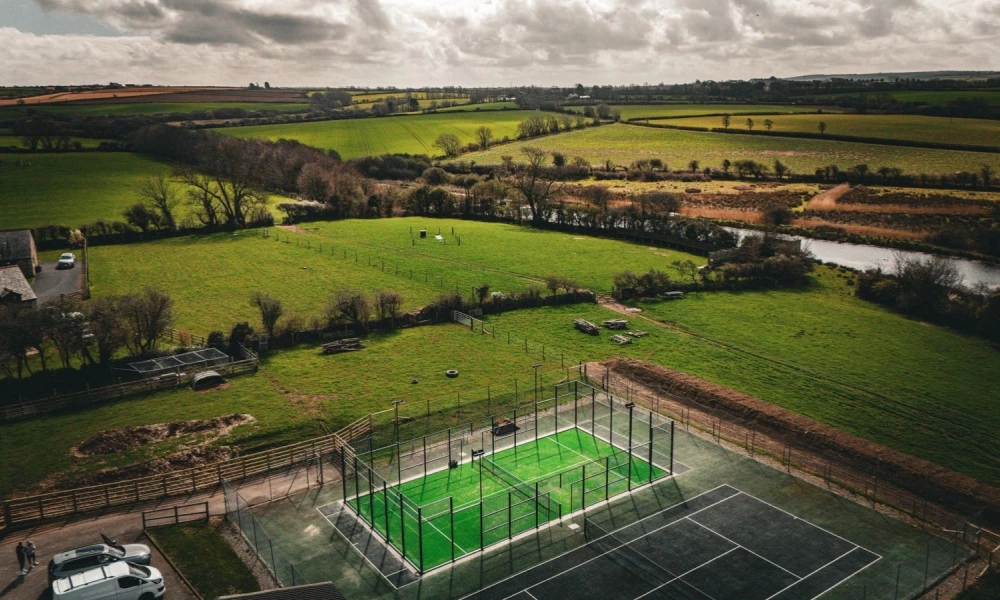
North Cornwall, England
Challenge: Coastal location with high wind exposure and salt-spray corrosion risk. Client required a panoramic court capable of year-round outdoor play on the Atlantic-facing southwest coast.
UNIPADEL Solution:
- Hot-dip galvanized steel frame (ISO 1461, ≥75 micron zinc layer) + marine-grade polyurethane powder coat topcoat
- 12mm heat-soaked tempered glass (HST) with anti-vibration neoprene gasket mounting
- FIP-certified PE monofilament turf with UV-stabilised fibres and PU backing
- Structural calculations provided for coastal Wind Zone 3 (EN 1991-1-4), submitted to client's planning consultant for LPA discharge of planning condition
Outcome: Court operational within 11 weeks of order confirmation. No structural or glass issues through two full UK winter seasons.
Stafford, England
Challenge: Landlocked inland site; client required complete turnkey support from factory production through to UK installation, with no prior padel procurement experience.
UNIPADEL Solution:
- Full DAP (Delivered at Place) logistics — factory to Stafford site, with UK customs clearance and final-mile delivery coordinated
- Russian/English technical passport and assembly manual provided to UK installation crew
- Remote video installation supervision across 4-day assembly period
- Lighting photometric plan supplied for client's planning application
Outcome: Club operational on schedule. Client has since engaged UNIPADEL for a second 2-court expansion in 2026.
How to Work With UNIPADEL on a UK Project
UNIPADEL is a factory-direct padel court manufacturer supplying the UK market with courts that meet or exceed SAPCA 5th Edition and LTA structural standards. As a UNIPADEL UK padel court client, here is exactly how the supply and project coordination process works:
| Project Phase | UNIPADEL Deliverable |
|---|---|
| Feasibility | Court specification sheet, pricing, and lead time confirmation within 48 hours of enquiry |
| Planning support | Structural calculation report (EN 1991-1-4 wind loads), glass certification (EN 12150-1), lighting photometric data for LPA submissions |
| SAPCA compliance | Hot-dip galvanized steel documentation (ISO 1461), glass HST certification (EN 14179-1), foundation specification guidance |
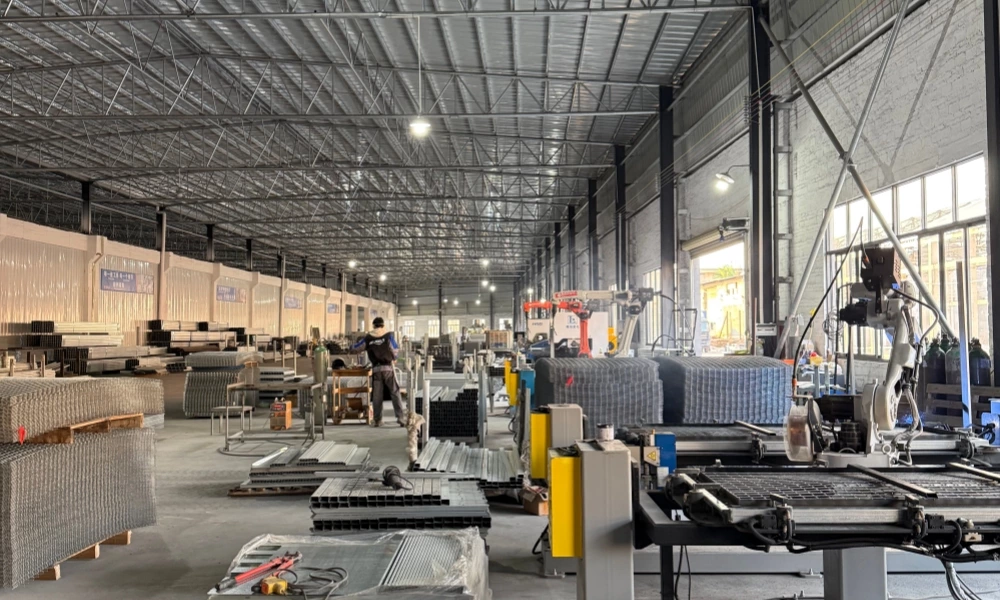
| Production | 20–30 day manufacturing; QC inspection available with photo/video documentation at key stages |
| Logistics | DAP delivery to UK site or FOB; UK customs clearance support; 40ft container optimised for 4-court loads |
| Installation | Full Russian/English assembly manual; remote video supervision; on-site technical supervisor for 4+ court projects |
| After-sales | Structural warranty; turf replacement supply; spare glass panels available from UK-based stock |
Court kit pricing (factory-direct, CIF UK port):
- Panoramic court (12mm HST glass, hot-dip galvanized frame, PE UV-stabilised turf, LED 300 Lux): from £7500 per court
- Super Panoramic court (full panoramic glass configuration): from £8,500 per court
Conclusion
Setting up a padel court in the UK in 2026 is one of the most compelling sports infrastructure investment opportunities in the European market — but it requires precise navigation of planning law, structural standards, noise compliance, and financial modelling to deliver a project that is both commercially viable and regulatory compliant.
The developers who succeed are those who treat planning, acoustics, and groundworks as critical path items from day one — not afterthoughts addressed after signing a lease. They source courts from manufacturers whose documentation supports SAPCA compliance and LTA standards. And they build financial models that account for realistic utilisation rates, not best-case projections.
UNIPADEL provides factory-direct courts at a price point that makes the unit economics of UK padel development work — with the technical documentation, structural specifications, and project support that UK planning authorities and SAPCA-registered installers require.
Frequently Asked Questions
Do I need planning permission to build a padel court in the UK?
Almost always yes for outdoor courts, and for indoor conversions from B8/B2 industrial use. Indoor conversions from existing Class E premises (gyms, offices, retail) can proceed without planning permission for the change of use, though Building Regulations approval is always required.
How long does planning permission take?
Standard applications: 8 weeks statutory, 12–16 weeks real-world average. Major applications (>1,000 sqm): 13 weeks statutory, often 16–26 weeks. Pre-application advice from the LPA reduces risk of delays.
What is the minimum ceiling height for indoor padel?
FIP standard requires 6 metres clear height above the playing surface. This eliminates most traditional retail units but is compatible with the majority of light industrial and warehouse premises.
Can I convert a tennis court into a padel court?
Yes. One standard tennis court (23.77m × 10.97m) accommodates one padel court with compliant runoff margins. The existing hardstanding can often be retained, with a perimeter ring beam cut and poured into the existing surface — reducing groundworks costs by up to 60%.
How long do UNIPADEL courts last?
The hot-dip galvanized steel frame (ISO 1461) carries a 20+ year structural life expectancy in UK outdoor conditions. PE monofilament turf with full HALS UV stabiliser system: 8–12 years. 12mm HST toughened glass: 15–25 years without incident.
Do UNIPADEL courts meet SAPCA 5th Edition standards?
Yes. Our panoramic courts use 80x80x3mm steel box sections, ISO 1461 hot-dip galvanizing, and 12mm HST toughened glass, all of which meet or exceed SAPCA and LTA structural guidelines for UK installation.
How do I handle the noise assessment (BS 4142) for my UK project?
Any outdoor court within 50m of a residence needs a BS 4142 assessment. UNIPADEL supports this by providing anti-vibration rubber gaskets that reduce structural noise transmission by 10-15 dB, a key factor in securing LPA approval.
What is the typical lead time for a UK project?
Factory production takes 20-30 days, followed by 35-40 days for shipping (FOB/DAP). Overall, you should plan for a 3-6 month window to include planning approval and groundworks.