Español
 Franch
  русский
Central Europe: The Padel Market With the Widest Supply Gap in Europe
When padel investors talk about European opportunity in 2026, the conversation defaults to Germany, France, and the UK — markets that are growing fast but are increasingly competitive, with rising land costs, tightening planning regulations, and operators already fighting for prime locations.
Meanwhile, padel Central Europe investment is delivering a market profile that Western European operators would recognise from 2018 — before the rush began.
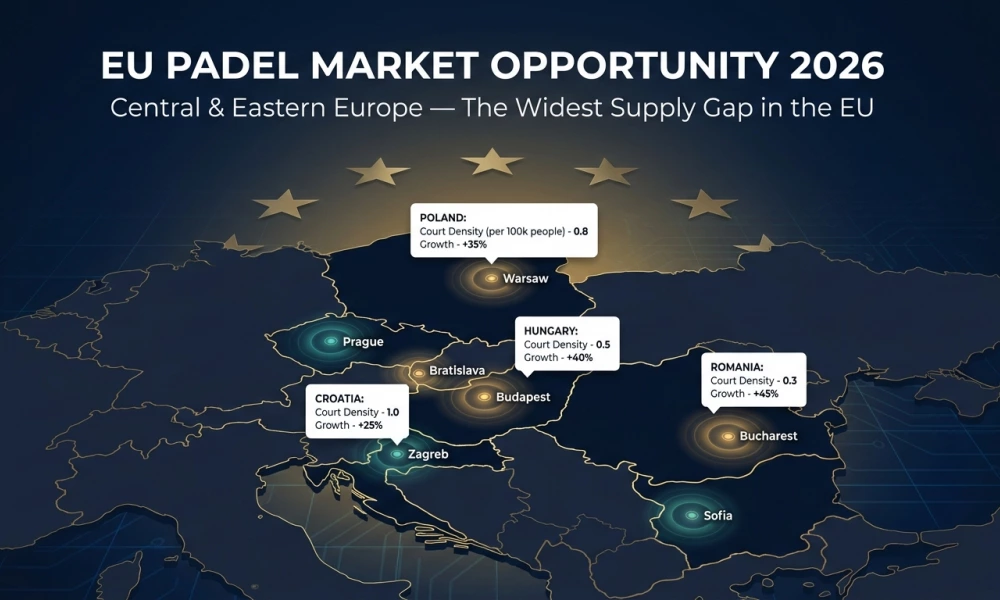
Poland has 60 tracked venues across 32 cities serving a population of 38 million. The Czech Republic has 220+ courts for a population of 10.9 million. Hungary, Slovakia, Romania, Croatia, and Bulgaria collectively have fewer courts than the city of Manchester. Google search interest for "padel" in Poland and Czech Republic has grown at 3–4× the rate of Western European search growth over the past 24 months — demand is building, loudly, in markets where supply is barely present.
This is not a future opportunity. It is a current one — with a window that will close as Western European capital, now consolidating at home, turns its attention east.
The Court Density Gap — Data That Explains the Opportunity
The most striking feature of the padel market is not its growth rate — it is how far behind supply has fallen relative to demand signals already visible in the data.
Court Density Comparison: Western Europe vs. Central Europe (2026)
| Country | Population | Estimated Courts | Courts per Million People | Padel Search Index (vs Spain = 100) |
|---|---|---|---|---|
| Spain | 47.4M | 25,000+ | 527 | 100 |
| Netherlands | 17.9M | 3,000+ | 168 | 82 |
| Sweden | 10.5M | 1,500+ | 143 | 71 |
| UK | 67.4M | 1,553 | 23 | 48 |
| Germany | 84.5M | 1,255 | 15 | 39 |
| France | 68.4M | 3,500+ | 51 | 58 |
| Czech Republic | 10.9M | ~220 | 20 | 34 |
| Poland | 38.0M | ~180 | 5 | 31 |
| Hungary | 9.7M | ~45 | 5 | 22 |
| Romania | 19.0M | ~30 | 2 | 18 |
| Slovakia | 5.5M | ~20 | 4 | 19 |
| Croatia | 3.9M | ~25 | 6 | 27 |
| Bulgaria | 6.5M | ~15 | 2 | 15 |
The critical insight: Poland's court density is 3× lower than Germany — a market already considered underserved by European standards. Romania and Bulgaria are at 1/250th of Spain's density. These are not markets approaching saturation. They are markets where the sport is arriving and infrastructure has not yet responded.
Search volume data confirms the demand side is already active. Google Trends shows padel-related searches in Poland growing at 340% year-on-year between 2023 and 2025 — nearly double the rate of the UK market at the equivalent stage of development.
Country-by-Country Market Analysis
Poland — Largest CEE Market, Earliest Institutional Entry
Market snapshot:
- Population: 38 million
- Courts: ~180 (60 venues across 32 cities)
- Court density: 5 per million — among the lowest in the EU
- Key cities: Warsaw, Kraków, Wrocław, Gdańsk, Poznań
- Peak court rental rate: PLN 120–180/hour (~€28–€42/hour) in Warsaw
What makes Poland structurally attractive:
Poland has the largest economy in CEE (GDP of USD 881 billion in 2024, growing at 2.9%), a young urban demographic concentrated in Warsaw and Kraków, and a sports participation culture anchored in tennis, football, and racket sports. The Polish Tennis Association (PZT) has formally incorporated padel into its national development programme, providing an institutional legitimacy pathway that has historically accelerated club development in other markets.
Padel court Poland cost investment economics are highly favourable compared to Western Europe:
- Commercial property lease rates in Warsaw: €12–€22/m²/month (vs €35–€65/m² in central London or Munich)
- Labour costs for civil works: 35–45% lower than Western European equivalents
- Total project cost for a 4-court indoor club (Warsaw): €280,000–€420,000 — vs €400,000–€650,000 for an equivalent facility in Germany or the UK
Czech Republic — Fastest Growing CEE Market
Market snapshot:
- Population: 10.9 million
- Courts: ~220 (16+ venues across 11 cities)
- Growth rate: ~450% increase from 40 courts in 2022 to 220+ in 2025 — the fastest growth rate of any CEE country
- Key cities: Prague, Brno, Ostrava, Beroun
- Peak court rental rate: CZK 580/hour (~€23/hour); premium Prague venues CZK 800–1,000/hour
Padel market Czech Republic has undergone the fastest structural development of any CEE market — driven by Prague's high density of affluent international residents, strong corporate wellness spending from multinational employers, and the city's established racket sport culture (Czech tennis has produced world-class talent for decades, generating a natural conversion pipeline).
Padel court Czech Republic investment ROI data from operating clubs points to payback periods of 2–4 years for well-located Prague and Brno facilities — superior to comparable German projects due to lower property and labour costs against broadly equivalent court hire revenue potential.
Hungary — Budapest as Regional Hub
Market snapshot:
- Population: 9.7 million
- Courts: ~45
- Court density: 5 per million
- Key city: Budapest (concentration of 80%+ of all courts)
- Peak rental rate: HUF 8,000–14,000/hour (~€20–€35/hour)
Budapest's padel market is developing along the hotel and wellness resort axis — luxury properties are adding padel as a premium amenity, driven by the city's growing status as a high-end short-break destination. The MOL Arena development cluster and several 5-star hotel groups have padel court projects in active planning.
Hungary's EU membership and cohesion fund allocation of €22 billion for 2021–2027 creates significant infrastructure subsidy potential for qualifying sports facility projects. Budapest's regional development plans explicitly include sports and wellness infrastructure as a priority investment category.
Romania — Emerging Market, Bucharest Leads
Market snapshot:
- Population: 19 million
- Courts: ~30
- Court density: 2 per million — the lowest court density of any EU member state with a significant padel search trend
- Key city: Bucharest
Romania has allocated €31 billion in EU Cohesion Policy funds for 2021–2027, with sports and cultural infrastructure explicitly included as eligible investment categories under the Regional Development Programmes. Several Romanian county councils have expressed interest in multi-sport facilities that would accommodate padel courts as part of broader community sports hub developments.
EU Funding — The Capital Mechanism That Changes the Investment Equation
EU funding padel court sports infrastructure represents the most significant financial differentiator between CEE and Western European market entry — and the one most consistently underutilised by padel investors without prior EU project experience.
The Three Primary EU Funding Streams
1. European Regional Development Fund (ERDF) — Infrastructure Capital
The ERDF is the primary mechanism for sports infrastructure co-financing across all CEE EU member states. For the 2021–2027 programming period, ERDF allocations to Poland, Czech Republic, Hungary, Romania, Slovakia, Croatia, and Bulgaria collectively exceed €120 billion, of which sports and community wellness infrastructure is an explicitly eligible category.
Qualifying criteria for padel court projects:
- Project must be located in an eligible NUTS 2 or NUTS 3 region (virtually all of CEE qualifies)
- Must demonstrate social inclusion or community access component (e.g., public booking availability, school programme integration, inclusive pricing tiers)
- Green/sustainable infrastructure elements increase scoring: solar panel integration, heat pump HVAC, rainwater harvesting, EV charging
- Multi-sport facilities score higher than single-sport — combining padel with tennis, fitness, or community sports functions strengthens applications
Typical co-financing rates:
- Less developed regions (Romania, Bulgaria, parts of Poland/Hungary): up to 85% EU co-financing
- Transition regions (Czech Republic, Slovakia, coastal Croatia): 60–75% EU co-financing
- More developed regions (Warsaw, Prague, Budapest metro areas): 40–50% EU co-financing
2. Erasmus+ Sport — Programme Development
Erasmus+ Sport funds padel coaching certification programmes, youth development initiatives, and cross-border sports cooperation projects. While not directly funding physical infrastructure, Erasmus+ programme activity generates institutional demand — clubs affiliated with Erasmus+ sport programmes demonstrate community access credentials that strengthen ERDF applications for subsequent court infrastructure investments.
3. ESF+ (European Social Fund Plus) — Social Inclusion
ESF+ funds padel initiatives framed around health promotion, social inclusion, and active ageing — particularly relevant for projects targeting underserved communities, disability-inclusive programming, or municipal social sports schemes. Combining ESF+ programme funding with ERDF infrastructure co-financing is the most powerful CEE funding structure available.
How to Navigate EU Funding for a Padel Project
The EU funding application process in CEE involves national or regional managing authorities (not direct Brussels applications). The practical steps are:
- Identify the relevant Operational Programme for your region — each country's Managing Authority publishes a list of eligible project types and open funding calls
- Commission a feasibility study demonstrating social/economic impact (typically required for ERDF applications above €500,000)
- Appoint an EU project consultant familiar with the national managing authority — this is not optional for first-time applicants
- Align court design with BREEAM or equivalent sustainability rating — green building certification materially improves scoring
- Submit with multi-sport community access plan — dedicated school hours, subsidised community sessions, disability-inclusive facilities
UNIPADEL provides structural documentation, sustainability specification data (LED energy performance, solar-ready electrical design, permeable drainage specifications), and material environmental declarations (EPDs) to support EU funding application technical annexes.
Regulatory Framework
Poland — PN-EN Standards and Nadzór Budowlany
Padel Poland building permit regulations follow the European EN standard framework, adopted as Polish PN-EN standards. Key requirements:
| Requirement | Standard | Application |
|---|---|---|
| Structural steel | PN-EN 1993-1-1 (Eurocode 3) | Frame design and connection calculation |
| Wind load | PN-EN 1991-1-4 (Eurocode 1) | Site-specific wind zone calculation |
| Safety glass | PN-EN 12150-1 | 12mm tempered safety glass minimum |
| Foundation | PN-EN 1997-1 (Eurocode 7) | Geotechnical design |
| Sports lighting | PN-EN 12193 | Minimum 300 lux (Class B) for commercial courts |
Outdoor padel courts require building permit from the local district office. Structural drawings must be signed by a Polish-licensed structural engineer. UNIPADEL provides CE-certified structural documentation in formats accepted by Polish Nadzór Budowlany.
Indoor conversions of existing commercial premises may qualify for notification procedure rather than full permit — a faster, lower-cost regulatory route that mirrors the UK's permitted development pathway.
Czech Republic — ČSN EN Standards and Stavební Řízení
The Czech building approval process requires submission to the local stavební úřad. For padel courts:
- Outdoor courts with permanent foundations: full stavební povolení required
- Indoor conversions within existing approved commercial use:building notification may suffice — confirm with local authority
- Acoustic assessment required for courts within 50 metres of residential receptors (ČSN EN ISO 9613 methodology)
- Structural calculations per ČSN EN 1991-1-4 wind load standards
Hungary, Romania, Slovakia, Croatia, Bulgaria
All five countries are EU member states and adopt Eurocodes (EN 1990–1999) as their national structural standards, with national annexes specifying local wind load zones, snow loads, and seismic coefficients. Building permit processes vary:
| Country | Building Permit Authority | Typical Process Duration |
|---|---|---|
| Hungary | Építési hatóság (building authority) | 60–90 days |
| Romania | Primăria (municipality) | 30–60 days |
| Slovakia | Stavebný úrad (building office) | 30–60 days |
| Croatia | Ministarstvo prostornog uređenja | 60–120 days |
| Bulgaria | Дирекция за национален строителен контрол (DNSK) | 30–60 days |
Investment Model — The CEE Financial
Full Investment Model: 4-Court Indoor Club, Warsaw (2026)
| Cost Component | Amount (EUR) |
|---|---|
| Court kit — 4× panoramic courts (12mm glass, HDG frame, PE turf, LED) | €84,000 |
| Foundation and civil works | €60,000 |
| Building fit-out (reception, changing rooms, social area) | €45,000 |
| HVAC system (winter heating essential) | €35,000 |
| Electrical connection and lighting | €20,000 |
| Planning, permits, structural engineer | €12,000 |
| Total CAPEX | €256,000 |
| ERDF co-financing (up to 60% — Warsaw transition region) | -€153,600 |
| Net investor contribution | €102,400 |
Revenue Model (Warsaw 4-Court Indoor Club)
| Revenue Stream | Conservative | Realistic | Strong |
|---|---|---|---|
| Court hire (PLN 140/hr avg, 65% utilisation, 12 hrs/day) | €140,000 | €185,000 | €240,000 |
| Coaching commissions | €20,000 | €35,000 | €55,000 |
| Corporate packages | €15,000 | €30,000 | €50,000 |
| F&B and pro shop | €8,000 | €18,000 | €30,000 |
| Total annual revenue | €183,000 | €268,000 | €375,000 |
| Operating costs (rent, staff, utilities, marketing) | €110,000 | €130,000 | €155,000 |
| Net profit | €73,000 | €138,000 | €220,000 |
| Net margin | 40% | 52% | 59% |
| Payback on net investor contribution (€102,400) | 17 months | 9 months | 6 months |
Padel court ROI Poland with ERDF co-financing represents one of the most compelling investment return profiles in the global padel market — payback periods measured in months rather than years, driven by the combination of lower CEE property costs, competitive court hire rates, and EU capital co-financing reducing effective net investment.
First-Mover Advantage — Why 2026 Is the Entry Window
Padel court CEE market opportunity 2026 is defined by a convergence of factors that will not persist beyond 2027–2028:
1. Supply-demand gap is at maximum right now. Search interest is growing. Player numbers are increasing as Western European diaspora returns with padel exposure. Corporate wellness spending is rising across CEE. But the courts are not there. The gap between demand signals and available supply is widest in 2026.
2. ERDF funding calls are open and undersubscribed. The 2021–2027 programming period's mid-cycle funding calls (2025–2026) are the most accessible. Applications submitted now will complete assessments in time for construction in 2026–2027. The 2028+ period will see more competition for remaining funds.
3. Property costs are still manageable. CEE commercial property values are rising as the region converges towards Western European income levels. The lease rate advantage over Western Europe is real today but compresses every year. Sites at €12/m²/month in Warsaw today will not be at that level in 2030.
4. No dominant operator has yet established regional brand leadership. In Spain, UK, and Germany, established operators control the premium locations and community relationships. In Poland, Czech Republic, Hungary, and Romania, the premium positioning is unclaimed. The operator who builds 6–8 high-quality courts in Warsaw between now and 2027 will own the Warsaw padel brand identity for a decade.
FAQ — CEE Padel Investment
Do padel court projects actually qualify for ERDF funding?
Yes — provided the project is structured to demonstrate community access, social inclusion, or sustainable infrastructure components. Purely commercial, private-access clubs with no public booking availability have lower qualification probability. The strongest applications combine commercial viability with documented community access (e.g., 10–15% of weekly court hours allocated to school programmes, subsidised community sessions, or disability-inclusive programming).
How long does ERDF application take?
Typically 6–18 months from application to funding confirmation, depending on country and region. Construction can sometimes begin on a risk basis before formal confirmation. Work with a local EU project consultant who knows the specific managing authority's requirements and typical timeline.
Can a foreign investor access CEE EU funding?
Yes — EU structural funds are available to any legal entity established and operating in the relevant EU member state. Foreign investors typically establish a local SPV (Special Purpose Vehicle) or operating company in the target country, which then applies for funding in its own right.
What is the minimum court number that makes a CEE padel project viable?
The breakeven analysis points to a minimum of 3 courts for commercial viability. The optimal scale for a first-mover club in a major CEE city (Warsaw, Prague, Budapest) is 4–6 courts — sufficient to distribute fixed costs (rent, HVAC, staffing) efficiently, support a full coaching programme, and hold tournaments that generate community brand visibility.
Does UNIPADEL provide courts suitable for CEE winter conditions?
Yes. UNIPADEL's standard specification for CEE projects includes hot-dip galvanized steel (ISO 1461, ≥75 micron), 12mm HST toughened glass with anti-vibration neoprene gasket mounting to accommodate thermal expansion in -20°C to +40°C seasonal ranges, and PE monofilament turf with PU backing rated for low-temperature stability. Indoor HVAC specification guidance is provided as part of the project planning support.
Conclusion: The Window Is Open
The Central and Eastern European padel market in 2026 presents a combination of conditions that experienced sports infrastructure investors recognise as a finite entry window:
- Demand without supply: Search interest and player growth outpacing court development
- Capital leverage: EU ERDF co-financing reducing effective investment by 60–85% in less developed regions
- Operational economics: Lower property and labour costs delivering higher net margins than equivalent Western European projects
- Brand positioning: Premium padel identity unclaimed in every major CEE capital city
Poland's 5 courts per million people against Germany's 15 and Spain's 527 does not represent a market that hasn't discovered padel. It represents a market where padel has arrived — and the infrastructure has not yet caught up.
The operators and investors who build in Warsaw, Prague, Budapest, and Bucharest between now and 2027 will not be competing in a saturated market. They will be creating one.