Español
 Franch
  русский
Why the Gulf Is the World's Most Ambitious Padel Investment Market?
Where Government Budgets, Trophy Real Estate, and Sport Converge
There is no padel market in the world where the investment signals are more concentrated, more institutionally backed, and more durably funded than the Gulf Cooperation Council.
Padel market Middle East investment in 2026 operates at the intersection of three forces that exist nowhere else simultaneously:
Government capital at sovereign scale. Saudi Vision 2030 has a sports sector target of USD 22.5 billion by 2030. Qatar Sports Investments (QSI) owns Premier Padel — the world's professional padel tour. Abu Dhabi Sports Council is running a six-round padel league across three cities. The Oman Padel Committee launched a national expansion strategy in August 2026. These are not private sector experiments. They are state-level infrastructure commitments.
Real estate development at the highest premium tier. DAMAC Properties — delivering 8,800 residential units in 2026 — has made padel courts a standard amenity across DAMAC Hills, DAMAC Lagoons, and its newest launches. Emaar has installed padel across its community portfolio. For Gulf luxury developers, padel is no longer a differentiating feature. It is a baseline expectation.
Compressed market opportunity. Despite being one of the fastest-growing padel regions globally, Oman has just 100+ courts, Qatar an estimated 150–200, and the UAE — the region's most developed market — still operates at a fraction of European density. For court manufacturers, operators, and investors who understand the Gulf's regulatory and climatic requirements, the supply gap is extraordinary.
Four Countries, Four Opportunity Profiles
| Country | Courts | Stage | Key Driver | Court Rate |
|---|---|---|---|---|
| UAE | 950+ / 320+ venues | Maturing | Real estate integration, corporate hospitality, Premier Padel P1 | 190–400 AED/hr |
| Saudi Arabia | 1,097 / 431 venues | High Growth | Vision 2030, PIF sports strategy, 2034 FIFA World Cup | 150–200 SAR/hr |
| Qatar | ~150–200 (est.) | Elite Niche | QSI owns Premier Padel, World Cup host 2026 & 2028 | Premium tier |
| Oman | 100+ / 17+ Muscat | Early Stage | Oman Padel Committee expansion, 10,000+ players, untapped governorates | Emerging rates |
UAE — The Region's Most Dynamic Market
950+ Courts, 250+ Dubai Venues — and Still Growing
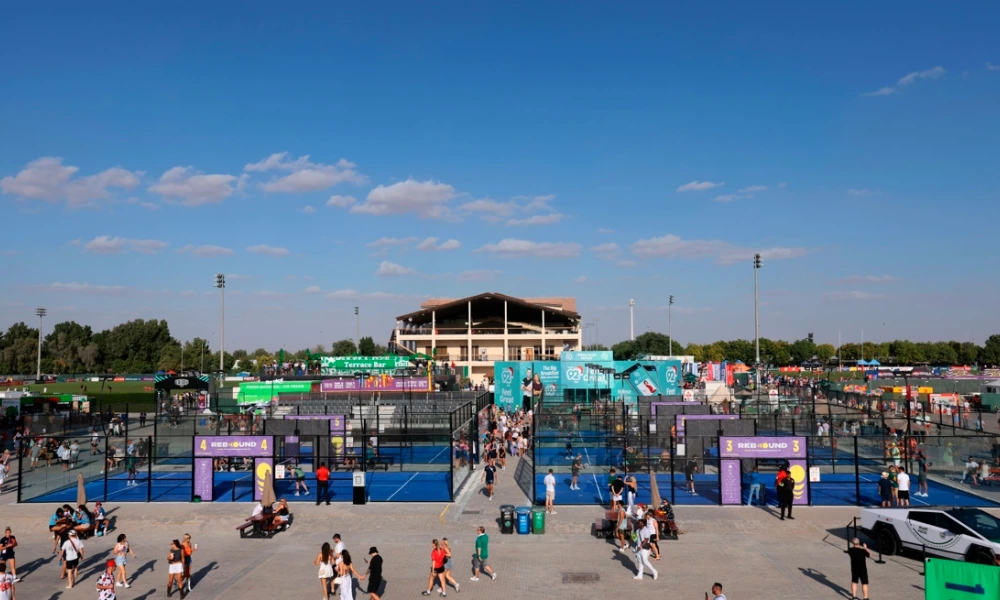
The padel court UAE market has undergone one of the fastest sports infrastructure expansions in global history. From a handful of courts in 2014 — introduced under Crown Prince Sheikh Hamdan — to 950+ courts across 320+ venues in 2026, the UAE now records padel search interest that grew +3,000% over five years and +60.3% in 2025 alone (World Padel Network).
Dubai alone houses 400+ courts across 250+ venues, with Al Quoz establishing itself as the padel heartland — a dense cluster of purpose-built indoor clubs serving a clientele that has made padel the most-played sport in the emirate, surpassing both football and tennis.
Court rental economics are compelling:
| Tier | Rate (AED/hour) | Annual Revenue Per Court (60% utilisation) |
|---|---|---|
| Budget venues | 75–150 | ~330,000–660,000 AED |
| Mid-range clubs | 190–247 (median peak) | ~835,000–1,085,000 AED |
| Premium/hotel | 300–400 | ~1,315,000–1,755,000 AED |
| Corporate packages | 72 AED/person/90 min | Volume-driven, high frequency |
A four-court facility at median pricing generates approximately 1.2–1.75 million AED per year in gross court revenue — before coaching, events, F&B, and membership income are added.
Luxury Real Estate: The DAMAC and Emaar Effect
The most structurally important development in UAE padel is its integration into the region's premium residential ecosystem:
DAMAC Properties — delivering 8,800 residential units in 2026 across DAMAC Hills, DAMAC Hills 2, DAMAC Lagoons, and DAMAC Islands — has made padel courts standard across its luxury communities. DAMAC was the Official Partner of Dubai Premier Padel. AI gyms, resort pools, and padel courts are now the three-pillar amenity bundle in every new DAMAC launch.
Emaar has installed dedicated padel courts across its community portfolio, with "sky padel courts" integrated into new high-rise developments. For buyers paying AED 2,000–5,000 per square foot for Emaar property, the padel court is not a luxury — it is an expectation.
For court manufacturers and resort developers, this creates a high-volume, high-specification procurement pipeline that prioritises certified materials, FIP-compliant dimensions, and tournament-grade LED lighting over cost minimisation.
2026 Calendar: UAE as a Global Padel Stage
| Event | Date | Venue |
|---|---|---|
| Abu Dhabi Padel League | May–Sep 2026 | Abu Dhabi, Al Ain, Al Dhafra |
| Padel World Summit | 30 Oct – 1 Nov 2026 | Dubai Exhibition Centre, Expo City |
| Dubai Premier Padel P1 | 8–15 Nov 2026 | Hamdan Sports Complex |
Saudi Arabia — Vision 2030's Most Scalable Padel Opportunity
1,097 Courts, 30% of Asia's Total — and a Government Mandate Behind Every Build
Padel court Saudi Arabia has the largest court count of any country in Asia, according to FIP's February 2025 data. With 1,097 courts across 431 facilities, Saudi Arabia already represents approximately 30% of all Asian padel infrastructure — and the growth mandate continues.
The Saudi Padel Federation (SAPF) has published explicit Vision 2030 targets:
- 1,000 tournament-grade courts (from the current base)
- 5,000 registered competitive players
- 3 Saudi athletes in the FIP world top 100
These are not aspirational statements. They are KPIs tied to the Quality of Life programme — a USD 22.5 billion sports sector strategy that has already delivered the WTA Finals Riyadh, LIV Golf, Premier Padel Riyadh P1, and a successful bid for the 2034 FIFA World Cup.
Qatar — Owning the Professional Game at the Highest Level
Qatar's approach to padel is categorically different from UAE and Saudi Arabia. Rather than competing on court count, Qatar has invested in owning the global professional infrastructure.
Qatar Sports Investments (QSI) acquired the World Padel Tour in 2023 and co-founded Premier Padel — now Qatar Airways Premier Padel Tour — which runs a 26-tournament global circuit across 18 countries. Qatar is simultaneously the title sponsor and the governing entity of professional padel worldwide.
The domestic market reflects this elite positioning:
- PADEL IN Aspire — the largest indoor padel facility in Asia and Africa, with 13 courts inside the Aspire Zone sports complex
- Khalifa International Tennis & Squash Complex — hosting the Padel World Cup 2026 (2–7 November) and confirmed as venue for the 2028 World Cup
- Premium hotel courts: Kempinski The Pearl, St. Regis Doha, Bay Club Doha
For court manufacturers, Qatar's requirement is simple and non-negotiable: FIP-certified tournament grade, highest specification, price secondary to quality. This is a market where the government literally owns the professional game.
Oman — The Gulf's Most Underserved Market and Highest Growth Potential
With 100+ courts serving 10,000+ registered players concentrated almost entirely in Muscat, padel court Oman market opportunity is structurally the most compelling early-stage entry in the GCC.
The Oman Padel Committee's August 2026 strategy announcement laid out an explicit national expansion plan:
- Extend courts from Muscat to all 11 governorates
- Grow the registered player base beyond 10,000
- Develop national teams for FIP competition
- Attract international tournaments to Oman
- Integrate AI specialists, sports scientists, and physiotherapists into the coaching ecosystem
Vibora Padel Club Oman — the country's premier destination with 5 world-class courts (indoor and outdoor) — demonstrates the format that works: premium positioning, professional academy, tournament hosting. 17+ clubs in Muscat alone, with zero dedicated clubs in most of Oman's other governorates.
For an early-mover court manufacturer with the technical documentation to meet Omani standards and the logistical capability to deliver outside major urban centres, this is the GCC's open frontier.
Technical Requirements: The Four Gulf Climate Challenges
Extreme Heat: 40°C+ From June Through September
Outdoor padel in the Gulf summer is physically impossible at professional level and commercially unviable at any level. The industry consensus is clear: indoor climate-controlled courts are the only viable model for year-round revenue in the GCC. Outdoor courts operate commercially only from October through April.
Indoor court temperature targets: 16–22°C (Redline Sports Club specification), maintained by 3–4 commercial split-unit HVAC systems per court space. Energy cost management through DOAS (Dedicated Outdoor Air Systems) with heat recovery is essential for P&L sustainability at scale.
Coastal Salt Spray and Humidity: Dubai, Abu Dhabi, Doha, Jeddah, Muscat
Every major GCC padel city except Riyadh sits in a high-salinity coastal environment. Padel court UAE hot dip galvanizing is not a quality upgrade in this context — it is a baseline requirement. Standard electro-galvanized or powder-coated frames without metallurgical zinc bonding will corrode from weld points within 12–18 months of coastal exposure, as documented in multiple Gulf climate outdoor sports facility case studies.
The correct specification:
- Hot-dip galvanizing (ISO 1461) — minimum 75–85 micron zinc coating, post-fabrication full immersion
- Marine-grade polyurethane topcoat for coastal projects classified at C4/C5 corrosion category
- EPDM rubber gaskets (not PVC) at all glass-to-frame interfaces — maintains elasticity from -10°C to 120°C without cracking in thermal cycling
UV Radiation: 10–12 on the UV Index Scale Year-Round
Gulf UV radiation is among the most intense on earth. Standard polypropylene (PP) turf — even UV-treated — will fibrillate and fade within 18–24 months of outdoor exposure at these intensities. The correct specification for GCC outdoor courts:
- 100% high-density PE monofilament turf
- HALS UV stabiliser concentration ≥6,000 ppm (Hindered Amine Light Stabiliser, polymeric grade — self-regenerating)
- PU (polyurethane) backing — heat-stable above 80°C surface temperature, unlike SBR latex which off-gasses and delaminates
- 10–12mm heat-soaked tempered glass (HST) — eliminates NiS-inclusion spontaneous breakage risk at extreme temperature cycling
Sand and Dust: The Silent Court Killer
Fine particulate infiltration into turf infill, under door seals, and into HVAC systems is a persistent operational challenge in all GCC locations. Indoor courts significantly reduce this risk. Where outdoor courts are specified, high-stitch-rate turf (≥17,000 stitches/m²) with silica sand infill (not rubber crumb) performs best in Gulf conditions — reduced particulate trapping, easier maintenance, better ball roll consistency.
The Revenue Model — What Gulf Padel Actually Returns
Padel court Dubai investment ROI projections must be based on the GCC's specific economics, not European benchmarks.
UAE Revenue Model (4-Court Indoor Club)
| Revenue Component | Annual (AED) |
|---|---|
| Court hire (4 courts × 200 AED/hr avg × 8 hrs × 65% utilisation × 365 days) | 1,518,000 |
| Corporate packages and events | 180,000 |
| Coaching and academy | 140,000 |
| Memberships | 120,000 |
| F&B and pro shop | 85,000 |
| Total annual revenue | 2,043,000 |
| Operating costs (rent, HVAC, staff, marketing, maintenance) | 950,000 |
| Net annual profit | 1,093,000 AED |
| Net margin | 53% |
| Payback period (CAPEX: ~AED 1,200,000 for 4 courts turnkey) | ~13-15 months |
UNIPADEL's Gulf Track Record — The Dubai Emirates 7s Project
UNIPADEL UAE Dubai padel court capability is not theoretical. It is documented, installed, and performing at one of the most demanding tournament venues in the Middle East.
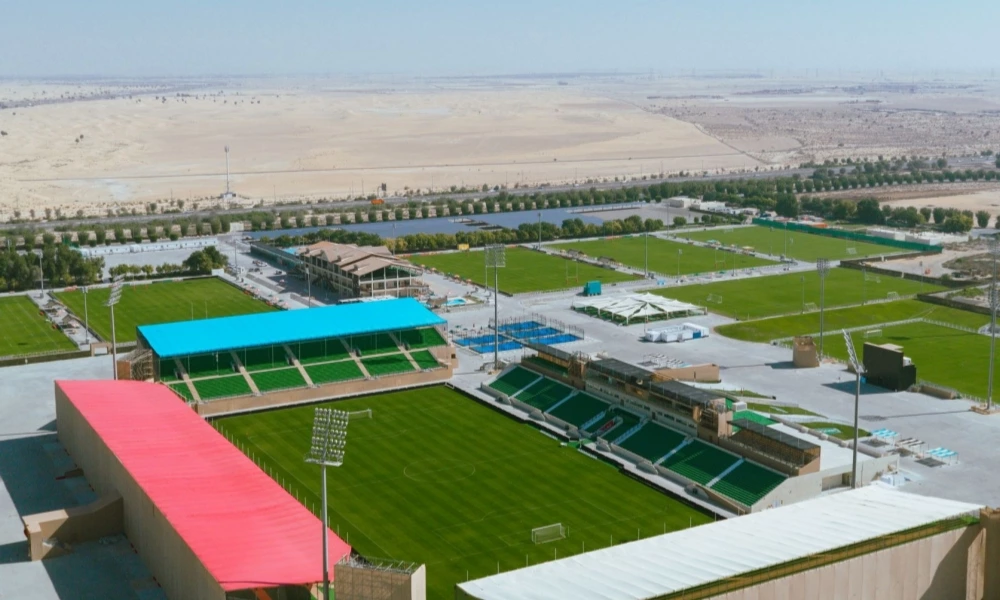
Case Study: Rebound Padel @ Emirates Dubai 7s Stadium
Project details:
- Location: The 7s Stadium, Al Ain Road, E66, Dubai, United Arab Emirates
- Venue: Dubai Sports Complex / Emirates Dubai 7s — one of Dubai's most prestigious multi-sport venues
- Installation: 5 panoramic padel courts (100-tube structural configuration)
- Client: Rebound Padel DXB (@rebound_padeldxb)
- Reference: emiratesdubai7s.com/rebound
Project scope and challenges:
The Emirates Dubai 7s venue is not a standard commercial club environment. It is a multi-sport complex that hosts international rugby sevens tournaments, corporate events, and major public sporting festivals — a venue where court quality is visible to international athletes, media, and corporate clients simultaneously.
UNIPADEL delivered five panoramic courts engineered to withstand Dubai's specific operational demands:
- Hot desert climate durability — the courts operate through Dubai's full temperature cycle, from winter competitive season (October–April) to summer storage conditions exceeding 45°C
- High-frequency event readiness — the 7s venue hosts back-to-back events with rapid court turnaround requirements; structural integrity under continuous, intensive use was a primary specification criterion
- International tournament standard — advanced structural materials, high-quality artificial turf, LED lighting, and comprehensive court protection systems all meeting the standards required for professional padel events
The outcome:
"We like this court very much!" — Rebound Padel DXB client
"From the structure of the court to the detailed craftsmanship, UNIPADEL has always adhered to international standards and won unanimous recognition from clients."
"Customers have highly praised our quality and service, believing that UNIPADEL's technical level and execution have completely exceeded their expectations."
Following installation, the venue became a landmark for padel in Dubai — attracting players from across the region and international touring professionals, while demonstrating that Chinese-manufactured, CE-certified courts can meet the full technical and aesthetic standard demanded by the GCC's most prestigious sports venues.
Why this project matters for investors:
The Emirates Dubai 7s installation proves three things that are non-obvious to first-time Gulf padel investors:
- Factory-direct Chinese manufacturing can deliver the quality standard that Dubai's luxury sports market demands — without the premium pricing of European manufacturers
- Desert climate suitability requires specific engineering (advanced structural materials, climate-rated turf, comprehensive protection systems) that UNIPADEL has already validated in situ
- High-frequency event use — the most demanding operational scenario for any court — does not compromise UNIPADEL court performance
View the complete UAE project →
UNIPADEL's Complete Gulf Market Solution
For resort hotels, luxury real estate developers, government sports facilities, and commercial club operators across the GCC, UNIPADEL provides a complete project solution calibrated to the Gulf's specific regulatory, climatic, and commercial requirements.
| Component | UNIPADEL Specification | Gulf-Specific Rationale |
|---|---|---|
| Super Panoramic Court | 12mm HST glass, ISO 1461 hot-dip galvanized frame (≥75µm), S355JR steel | Tournament-grade visual quality; corrosion-proof for coastal/humid environments |
| Marine-grade topcoat | QUALICOAT Class 2 polyurethane, C4/C5 corrosion category | Coastal Abu Dhabi, Dubai, Doha, Muscat, Jeddah projects |
| UV-resistant turf | 100% HD PE monofilament, HALS ≥6,000ppm, PU backing | Withstands Gulf UV intensity without fibre degradation |
| EPDM rubber gaskets | Full perimeter, 5mm, heat-stable -10°C to 120°C | Maintains elasticity across extreme Gulf temperature cycling |
| LED lighting | EN 12193 Class A (500+ lux), anti-glare optical design | Tournament eligibility; media broadcast standard |
| FIP documentation | Court dimensions 20.00m × 10.00m ±10cm, full certification package | Tournament hosting eligibility across UAE, Saudi, Qatar, Oman |
| Structural calculations | Wind load, thermal expansion, foundation design for Gulf soil conditions | Local authority submission and insurance compliance |
| Factory-direct pricing | CIF UAE/Saudi/Qatar/Oman port from $19,500 per panoramic court | 25–35% below European distributor pricing |
| Installation support | English/Arabic documentation; remote supervision; on-site supervisor (4+ courts) | Gulf project delivery without logistical compromise |
The Market Where Budget Meets Ambition
The Gulf padel market is unique in global sports investment. Government mandates provide demand certainty that private markets rarely offer. Luxury real estate integration creates a procurement pipeline that prioritises specification over cost. An extraordinary climate demands — and rewards — technical excellence.