Español
 Franch
  русский
Why Every Luxury Resort is Adding a Padel Court (And How to Integrate One)
The New Signature Amenity Has Arrived
If you look at the recent amenity upgrades at ultra-luxury properties across the Maldives, Bali, and the Mediterranean, a clear trend emerges: the traditional hotel tennis court is rapidly being replaced or joined by padel tennis.
For hotel general managers and hospitality developers, building a padel court for resort properties is no longer just about following a fitness trend. It is a calculated business decision driven by space efficiency, high guest engagement, and a premium aesthetic.
Here is exactly why the hospitality industry is making the switch, and what developers need to know before installing a padel court resort facility.
The Numbers That Justify the Investment
The scale of the global padel buildout in 2025 is unlike anything the sport has seen before.
According to the Playtomic & PwC Strategy& Global Padel Report 2026, 7,898 new padel courts were constructed globally in 2025 alone — an average of 22 new courts every single day. The worldwide total now stands at 58,334 courts across nearly 20,000 clubs, growing at a 34% CAGR since 2019. The same report projects 91,000 courts by 2028.
The hospitality vertical within this macro trend is growing even faster. The global padel tourism market was valued at $1.8 billion in 2025 and is projected to expand at a 13.4% CAGR, reaching $5.6 billion by 2034, according to DataIntelo's Padel Tourism Market Research Report. The sports equipment market tied to padel participation is expected to reach $514 million by 2030 (source: Houlihan Lokey Active Lifestyle Report).
These are not sports statistics. They are hospitality infrastructure investment signals.
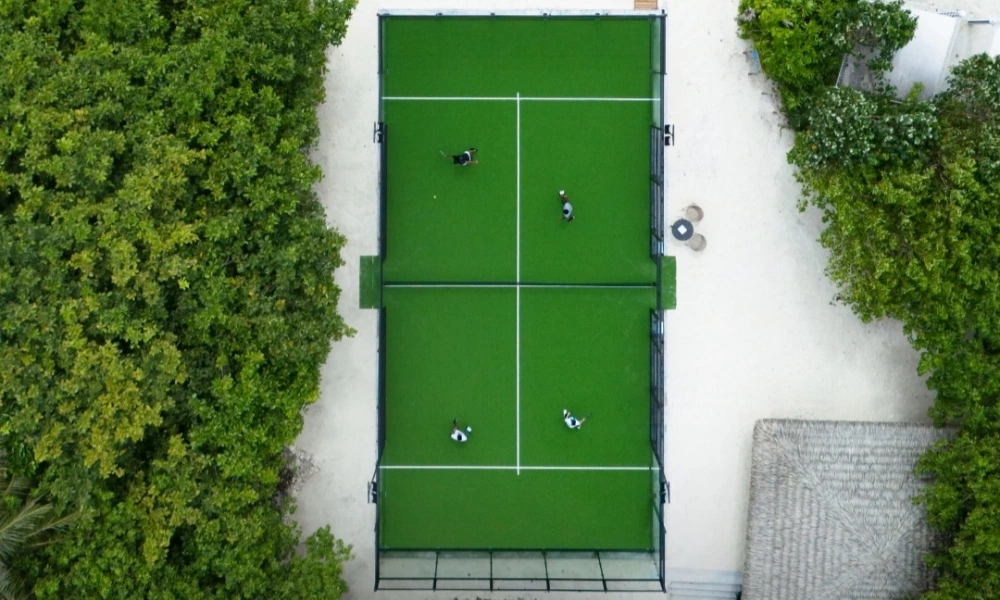
How can padel improve your revenue mechanism?
ADR Uplift: 10–15%
Mediterranean premium resort data analyzed by Playtomic and Deloitte shows that properties integrating padel courts drive an Average Daily Rate uplift of 10% to 15% among active traveler segments — guests who specifically select properties based on available sports programming. One resort case study in Indonesia documented a 10% increase in direct bookings in its first year of padel introduction, according to QH Padel.
Extended Length of Stay
Padel's social architecture — the need to book courts, arrange partners, take lessons, and return for rematches — creates a "stickiness" that extends ALOS (Average Length of Stay). Guests who come for padel stay longer, spend more in F&B, and book return visits at significantly higher rates. This directly elevates TRevPAR (Total Revenue per Available Room), the metric that hospitality investors and REITs track most closely.
Premium Capture Rate from Sports Tourists
Active travelers — those who plan vacations around specific sport or fitness activities — spend 130% more on average than passive tourists, according to the Global Wellness Institute. Padel-equipped resorts position themselves to capture this demographic, which skews heavily toward the ABC1 socioeconomic group: professional, 30–55, high household income, brand-loyal, and highly likely to share experiences on social media.
Spatial Efficiency — Triple the Revenue Density
One of padel's most underappreciated commercial advantages is its land efficiency. A single standard tennis court footprint (approximately 648 m²) accommodates three padel courts side by side. For resort developers working with constrained land parcels, this is transformative: three court rental revenue streams, three coaching slots, three times the hourly booking capacity — on the same piece of land.
The ROI of Space: 1 Tennis Court = 3 Padel Courts
Space is the most expensive asset in a luxury resort. A standard tennis court requires a massive footprint of roughly 600 to 700 square meters. In that exact same space, you can install three standard padel courts (20m x 10m each).
-
For Tennis: You entertain 2 to 4 guests at a time.
-
For Padel: You entertain 12 guests simultaneously.
This footprint efficiency drastically increases the revenue generated per square meter through court bookings, equipment rentals, private coaching sessions, and adjacent F&B (food and beverage) sales.
Operational Considerations for Hoteliers
Before breaking ground on a padel court resort project, consider these operational factors:
-
Acoustics & Location: The sound of padel rackets hitting the ball is distinct. We advise hotel planners to position the courts slightly away from quiet spa zones or private sleeping villas, ideally placing them near the gym, beach club, or active recreation centers.
-
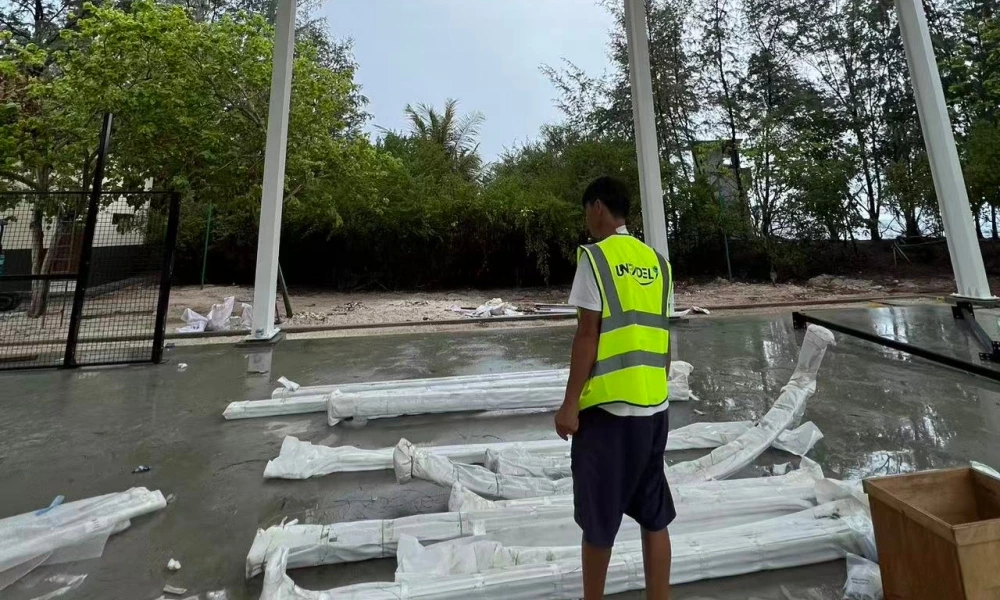
Turnkey Installation: Resort renovations must avoid disturbing active guests. We pack our materials in modular, pre-engineered kits, allowing our supervisory teams to assemble the courts quietly and rapidly—often completing a project in under two weeks.
Complete Resort Solution
Installing a padel court is a capital decision. Installing a padel experience is a revenue decision. The distinction matters enormously in a luxury hospitality context, where every physical element of the property is a touchpoint in the guest experience.
UNIPADEL designs and delivers complete padel environments for resort, hotel, and hospitality projects — not court kits, but integrated guest experience systems. Here is what a full UNIPADEL resort padel solution looks like:
The Panoramic Court — Visual Identity at the Core
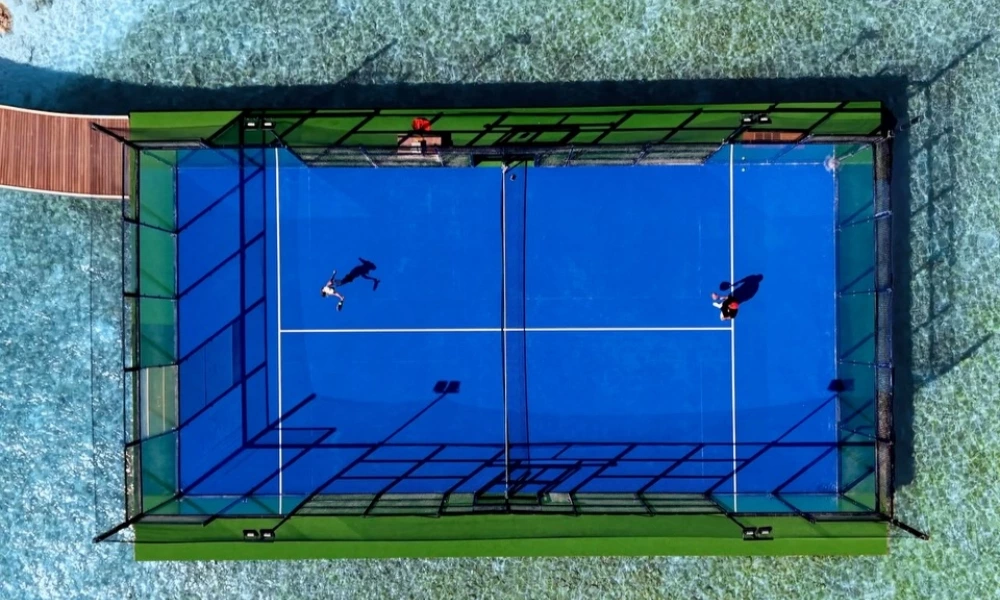
The foundation of every UNIPADEL resort installation is the super-panoramic court — maximum glass, minimum steel interruption, and architectural LED lighting that transforms the court into a visual centrepiece at night. Floor-to-ceiling glass walls on all six panels eliminate visual obstruction and create the immersive, gallery-like aesthetic that luxury resort photography demands.
Specification highlights for resort environments:
- 12mm Heat-Soaked Tempered Glass (HST) — eliminates spontaneous breakage risk, critical for liability management in guest-facing facilities
- Hot-dip galvanized steel frame (ISO 1461, ≥75µm) — 20+ year corrosion resistance for coastal, tropical, and high-humidity resort environments
- HD PE monofilament turf with HALS UV stabiliser (≥6,000ppm) — maintains colour and playability under tropical UV exposure without premature fibre degradation
Weatherproof Canopy System — Year-Round Playability
The padel court canopy resort solution transforms an outdoor court into a year-round revenue asset. UNIPADEL's integrated canopy structures extend annual playable hours from approximately 1,800 (unprotected outdoor) to 4,000+, directly multiplying the court's revenue capacity.
For resort properties that require the highest level of operational control, UNIPADEL's Padel Court with Electric Tent represents the pinnacle of all-weather padel infrastructure.
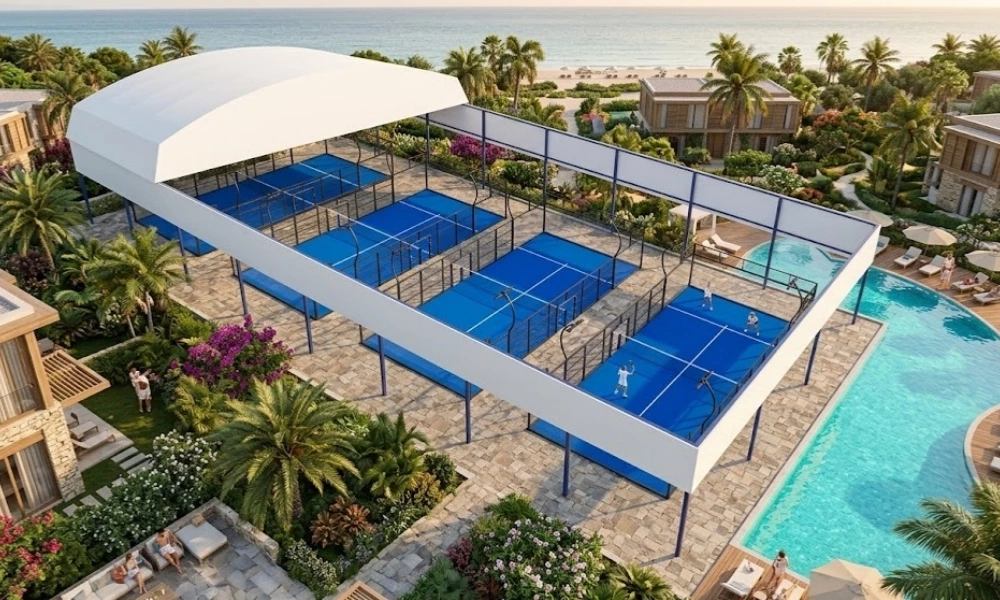
Why resort operators choose the Electric Tent system:
One-button control across the entire facility. The system is equipped with 24 synchronous motors, allowing a single staff member to open, close, or partially open the entire roof structure with one button — no additional staffing required. For resorts where the padel facility operates with minimal dedicated staff, this is operationally transformative.
Three independent modules — charge by weather, not by reservation. The structure consists of 3 independently operable modules. On a fine morning, open only the sections in use and reduce energy consumption. During a sudden afternoon downpour, close the affected courts without interrupting play on the others. This granular control directly supports dynamic pricing: open-air courts command premium rates on sunny days; covered sessions justify a weather-guarantee surcharge during rain.
Built for the world's harshest resort environments. The system is constructed entirely from Q235B national-standard hot-dip galvanized steel, rated to withstand winds of force 8–10 and tested for high-salt-spray coastal environments — the exact conditions found at the Mediterranean, Caribbean, and Southeast Asian beachfront properties where the luxury resort padel opportunity is greatest. The 850g industrial-grade PVC canopy carries B1 flame retardancy certification, 100% waterproofing, and UV protection with a 10+ year design lifespan.
Modular Foundation — The Zero-Disruption Resort Installation
For resort and hotel operators considering padel as a new amenity, one question consistently emerges before the capital decision: What does the installation actually do to the property?
Traditional padel court installation requires excavation, concrete pouring, a 28-day curing period, and in many jurisdictions, a full construction permit process lasting 8–28 weeks. For a resort with ongoing guest operations, this is not just a construction question — it is a guest experience question.
UNIPADEL's Padel Court Modular Foundation | Portable Base solves this problem from the ground up — literally.
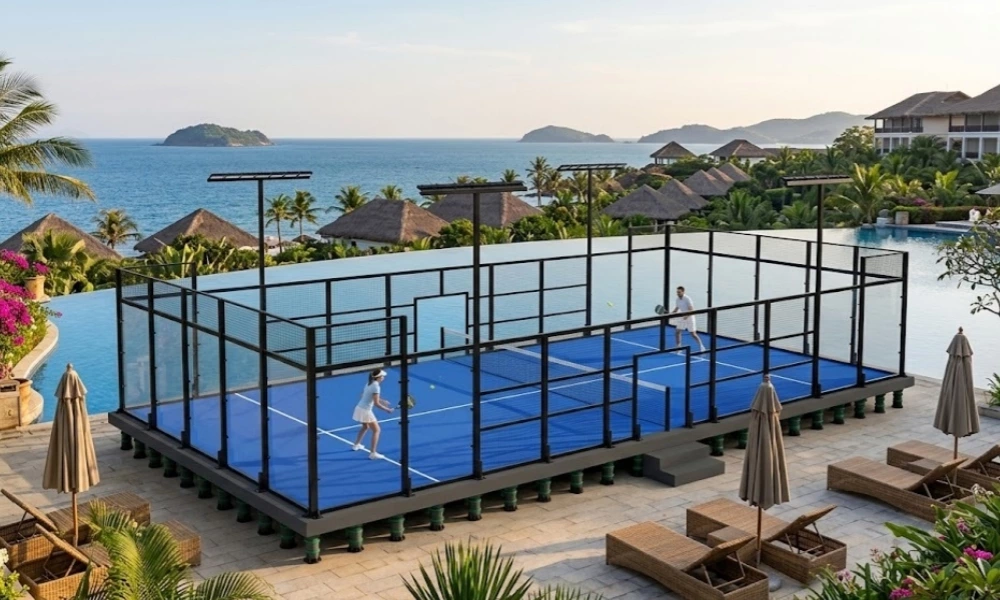
Four reasons resort operators choose the Modular Foundation:
1. Zero disruption to existing resort grounds. The system causes zero damage to the existing surface — no excavation marks, no concrete patches, no permanent alteration to the landscape. This is particularly valuable for resort properties in heritage locations, conservation zones, or properties with strict ground-disturbance restrictions in their planning conditions. When the court is removed, the ground looks exactly as it did before installation.
2. 180mm of elevation tolerance — install on imperfect terrain. The height-adjustable support components accommodate up to 180mm of surface variation, using Grade 8.8 high-strength bolts and 304 stainless steel hardware. This means the system can be installed on lawns, pool terraces, rooftop surfaces, and other resort spaces that would be entirely unsuitable for conventional padel court construction — opening up site locations that would otherwise require significant and costly groundworks.
3. Asset relocation as a business strategy. For resort groups managing multiple properties, the Modular Foundation turns a padel court from a fixed capital expense into a mobile asset. The entire system is fully demountable and reusable. If a property undergoes redevelopment, changes its amenity mix, or the padel facility needs to move to a better-positioned location within the grounds, the court can be relocated without writing off the investment. At end of season or end of lease, the asset moves — not to a skip, but to the next site.
4. Simplified planning and approval in resort jurisdictions. Because the Modular Foundation installs without any permanent structural connection to the ground, it qualifies as a temporary or demountable structure in most European and international jurisdictions. In the UK, Germany, and France — the primary inbound markets for luxury resort padel investment — this classification opens a substantially lighter approval path than a permanent fixed court, reducing both timeline and consultant fees. UNIPADEL provides full CE certification documentation (EU 305/2011 / EN 14566:2008+A1:2009) and EU RoHS compliance reports (2011/65/EU, EU 2015/863) to support planning applications in any jurisdiction.
Brand Racquets and Balls
A premium resort experience extends to the equipment guests hold in their hands. UNIPADEL's branded racquet and ball range is designed specifically for hospitality contexts — equipment that communicates premium quality through material, weight, and finish, reinforces the property's brand identity, and creates a natural in-resort retail and rental revenue stream.
Resort rental programmes typically generate €15–€25 per session in equipment rental revenue, with branded retail sales at 2–4× markup creating an additional category of ancillary revenue from guests who want to take the experience home.
Smart Vending Machine — 24/7 Accessory Revenue
UNIPADEL's padel vending machine eliminates the staffing dependency that makes traditional equipment rental economically marginal in resort contexts. Available 24 hours, stocked with balls, grip tape, wristbands, water, and branded accessories, the smart vending system:
- Operates without dedicated staff allocation
- Captures impulse purchase revenue at peak and off-peak hours
- Tracks inventory automatically with smart restock alerts
- Integrates with property management systems for seamless billing to room account
For resorts where the padel facility operates beyond spa and F&B staffing hours, this is the mechanism that converts late-evening and early-morning court sessions into full revenue-generating events.
Container Pro Shop — The Brand Destination
UNIPADEL's container commercial unit — a retrofitted shipping container transformed into a high-design retail and hospitality pod — provides the physical brand anchor that elevates a court from a sports facility to a destination within the property.
Configured as a padel pro shop, equipment rental point, and F&B outlet, the container unit:
- Requires no permanent construction or planning permission in most jurisdictions
- Can be positioned courtside or poolside without disrupting existing property infrastructure
- Delivers a branded retail and hospitality experience that extends guest dwell time around the court
- Can be relocated or reconfigured as the property's programming evolves
The combination of container pro shop + smart vending machine + branded equipment creates a self-sustaining court ecosystem that generates revenue with minimal ongoing staff investment — the operational model that makes padel financially attractive not just as an amenity, but as a profit centre.
Market Positioning — What a Padel Court Communicates to the Guest
In luxury hospitality, amenities communicate values before the guest has spent a single hour in the property. The amenity list tells the guest who the property is for.
A padel court in 2026 communicates:
- Active: This property understands that luxury travel is no longer passive
- Social: This property is designed for shared experiences, not solitary retreat
- European-calibre: Padel's cultural heritage signals cosmopolitan taste
- Current: This property is tracking where culture is going, not where it has been
- Premium: The capital cost and operational complexity of a quality padel installation signals financial commitment to guest experience
Properties without padel in 2026 communicate, by omission, that they are following rather than leading. In a market where the brands above — Aman, Four Seasons, Ritz-Carlton — have already made their statement, the window for "first mover in our competitive set" positioning is still open in many geographies and property categories. But it will close as the installation rate accelerates.
Elevate Your Resort’s Guest Experience with UNIPADEL
Transitioning your property into a premier padel court resort destination requires a partner who understands both heavy structural engineering and high-end hospitality aesthetics.
Whether you are converting an underutilized tennis court or planning a brand-new sports pavilion, UNIPADEL provides factory-direct pricing, custom architectural designs, and global installation support.
Request a Free Resort Padel Integration Floor Plan
(Click here to share your site dimensions with our engineers, and we will provide a complimentary layout and structural recommendation for your property.)