Español
 Franch
  русский
The world's largest padel court supply gap – the American pickleball + padel hybrid club model
Spain has one padel court for every 3,000 people. Sweden has one for every 2,000. The United States has one for every 505,000.
That single statistic defines the most significant infrastructure investment opportunity in global racquet sports. With 1,073,000 active padel players and just 1,000+ courts across 31 states as of April 2026, the United States is not a market where padel has failed to arrive — it is a market where padel is arriving at speed, with the court infrastructure unable to keep pace.
But the US padel story in 2026 is not simply a replication of the European playbook. It carries a structural feature unique to North America: 24.3 million active pickleball players who represent the world's largest ready-made pipeline of racquet sports converts — already active, already spending, and already looking for their next level.
The pickleball padel hybrid club USA model has emerged as the dominant commercial response — combining pickleball's extraordinary volume and community reach with padel's premium pricing, aspirational positioning, and superior revenue-per-court economics. This is not a compromise between two sports. It is a deliberate architecture for maximum revenue-per-square-foot in a market that has never seen anything quite like it.
The Numbers That Define the Opportunity
US Padel Market Snapshot (2026)
| Metric | Data | Source |
|---|---|---|
| Padel courts operational | ~1,000+ (31 states) | USPA / SFIA 2026 |
| Active padel players | 1,073,000 | SFIA 2026 Topline Report |
| Core players (8+ sessions/year) | 238,000 | SFIA 2026 |
| Courts added in 2025 alone | 330 new courts, 250 new clubs | Playtomic Global Padel Report 2026 |
| USPA individual membership growth YoY | +53.5% | USPA 2025 Annual Report |
| Sanctioned tournaments 2026 | 255 (vs 104 in 2025) | USPA |
| US search interest growth "padel" (2025) | +72% YoY | WPN Padel Global Search Report 2026 |
| USPA projected courts by 2030 | 10,000 courts | USPA |
| USPA projected players by 2030 | 10,000,000 | USPA |
The United States is not behind Germany or the UK on padel infrastructure. It is behind them by 5× to 7×. At Spain's density, the US would need 175,000 padel courts. At Germany's current density, it would need 5,000. It has 1,000. Every data point confirms the same conclusion: the supply gap in the US padel market is not a regional anomaly. It is the defining commercial opportunity of the sport's next decade.
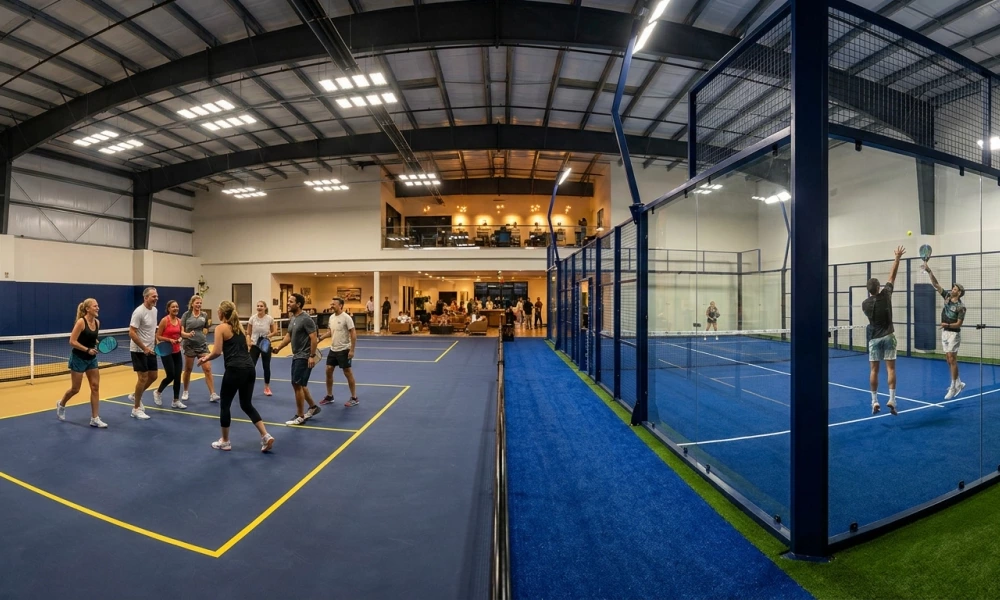
Why Pickleball and Padel Are Not Competitors — They Are Architecture
The most important strategic insight in the US racquet sports market is that padel vs pickleball USA revenue comparison is the wrong frame. These two sports are not competing for the same player or the same court slot. They are serving different functions within the same commercial ecosystem.
The Hybrid Model Logic
Pickleball's role in the hybrid:
- Drives high-volume foot traffic — 24.3 million active players provide an enormous addressable audience
- Low barrier to entry — no prior racquet experience required, multigenerational appeal
- Generates community and social activity — corporate groups, family leagues, round-robins, charity events
- Fills off-peak slots — pickleball players book morning and midday sessions that padel's working professional demographic doesn't fill
Padel's role in the hybrid:
- Commands premium pricing — $120–$200 per 90-minute session (4 players × $30–$50/player) vs pickleball's $20–$40/court-hour
- Attracts the highest-value customer segment — affluent urban professionals, corporate entertainment clients, celebrity-adjacent lifestyle seekers
- Generates retail and equipment spend — US padel equipment sales hit $10 million in 2024 with 70%+ growth in 2025
- Creates aspirational brand identity — padel's status as "the new golf" drives sponsorship interest, media coverage, and premium membership pricing
The crossover pipeline: Pickleball players looking for more complexity, athleticism, and social prestige naturally migrate toward padel. The hybrid club captures both the entry point and the upgrade destination under one roof.
According to Misitrano Consulting's State of Padel in the U.S. Report 2025, 36.7% of all US padel clubs already offer pickleball — a figure that has grown from near-zero three years ago and is accelerating as the hybrid model's financial superiority becomes evident.
The Financial Model — Revenue, Margins, and Payback
Court Revenue Comparison: Padel vs Pickleball
| Metric | Padel Court | Pickleball Court |
|---|---|---|
| Format | 4 players, 90-minute session | 4 players, 60-minute session |
| Rate per player | $30–$50 | $5–$10 |
| Revenue per session | $120–$200 | $20–$40 |
| Sessions per day (12 hrs) | 8 sessions | 12 sessions |
| Daily revenue per court | $960–$1,600 | $240–$480 |
| Annual revenue per court (65% utilisation) | $228,000–$380,000 | $57,000–$114,000 |
Padel vs pickleball USA revenue comparison confirms padel's structural revenue superiority on a per-court basis — generating 4× to 6× the annual revenue of an equivalent pickleball court. This is why hybrid clubs typically allocate the majority of their premium floor space to padel, using pickleball to drive volume and brand awareness while padel drives the P&L.
Full Hybrid Club Financial Model: 6 Padel + 10 Pickleball Courts, Indoor, Midwest City
| Cost Component | Amount (USD) |
|---|---|
| Court kits — 6× padel courts (12mm glass, HDG frame, PE turf, LED) | $165,000 |
| Court kits — 10× pickleball courts (flooring, net systems, line markings) | $40,000 |
| Warehouse lease improvement (concrete, HVAC, lighting, partitions) | $380,000 |
| Reception, changing rooms, social lounge, pro shop | $120,000 |
| Electrical, mechanical, fire safety, ADA compliance | $85,000 |
| Structural engineering, permits, architectural drawings | $45,000 |
| Total CAPEX | $835,000 |
Revenue Model
| Revenue Stream | Annual (USD) |
|---|---|
| Padel court hire (6 courts, 65% utilisation, $160/session avg) | $888,000 |
| Pickleball court hire (10 courts, 60% utilisation, $30/hr avg) | $197,000 |
| Membership subscriptions (400 members × $150/month avg) | $720,000 |
| Coaching and clinics | $120,000 |
| Corporate events and group bookings | $90,000 |
| F&B and pro shop | $85,000 |
| Total annual revenue | $2,100,000 |
| Operating costs (rent, staff, utilities, marketing, insurance) | $1,150,000 |
| Net operating profit | $950,000 |
| Net margin | 45% |
| payback period | < 12 months |
The Regulatory Reality — US-Specific Compliance Requirements
Padel USA building permit compliance is the single most critical technical factor separating successful US padel installations from costly failures. European CE marking and Eurocode structural documentation do not satisfy US building codes. This is non-negotiable.
The Structural Engineering Requirement
All padel court installations in the United States must comply with:
- IBC (International Building Code) — adopted by all 50 states with state-specific amendments
- ASCE 7 (American Society of Civil Engineers) — Minimum Design Loads and Associated Criteria for Buildings and Other Structures
The critical distinction between US and European wind load standards:
| Parameter | European Eurocode (EN 1991-1-4) | US ASCE 7 |
|---|---|---|
| Wind speed basis | 10-minute mean wind speed | 3-second gust wind speed |
| Design approach | Characteristic load with partial factors | Strength Design (LRFD) or Allowable Stress Design (ASD) |
| Structural documentation | CE marking + Eurocode calculations | PE-stamped drawings (Professional Engineer licensed in specific state) |
| US validity | NOT accepted by US building departments | Required for all permit submissions |
The glass panel wind load trap: A standard panoramic padel court contains 18 panels of 12mm tempered glass, each weighing approximately 400 lbs — a total of 3.6 tons of glass per court. Some overseas manufacturers claim high wind-load ratings "with glass panels removed." In practice, removing 3.6 tons of glass before a storm is physically impossible under emergency conditions and violates ASCE 7, which requires compliance in the structure's in-service state — with glass installed.
UNIPADEL's US market requirement: Every outdoor installation in the US must be accompanied by PE-stamped structural drawings from a licensed Professional Engineer in the relevant state. UNIPADEL provides detailed structural calculation packages that US-based PE firms can review, adapt to local soil conditions, seismic zones, and wind exposure categories, and stamp for permit submission.
The Indoor Conversion Advantage
The most effective regulatory risk mitigation strategy for US padel development is the padel court USA indoor warehouse conversion model — and it is now the dominant format, accounting for 39.1% of all US padel courts.
Indoor installations within existing commercial buildings offer:
- Simplified structural review — no outdoor wind load calculations for glass; frame loads are primarily vertical
- Minimal zoning complexity — change of use from commercial to recreation/assembly, typically straightforward in business-zoned parcels
- No noise ordinance exposure — enclosed building envelope eliminates the sound propagation that triggers residential complaints
- Year-round operability — no weather-related revenue loss, critical for the membership-based financial model
Ceiling height requirements:
- 30 feet (9.1m): Competitive gold standard — allows full lob shots at tournament level
- 24–25 feet (7.3–7.6m): Recreational standard — fully playable for club and community levels
- Under 22 feet: Restricts high lob shots significantly; viable only for junior or beginner facilities
Most Class B and C industrial/flex warehouse spaces with 25–35 foot clear ceiling heights are structurally compatible with padel installation.
Noise and Acoustic Regulations
Padel USA building permit ASCE 7 addresses structure, but noise regulation governs where courts can be sited outdoors.
The pickleball noise crisis has reshaped outdoor racquet sports zoning across the United States. The distinctive 1.2 kHz "pop" of a plastic pickleball on a graphite paddle registers 70–75 dBA at 100 feet — well above the 55 dBA daytime / 50 dBA nighttime residential limits enforced in standard residential zones.
Municipal responses across the country include:
- Mandatory residential setback distances of 500–1,200 feet from nearest residential property lines for new outdoor racquet court installations
- Operating hour restrictions (typically 9:00 AM – 7:00 PM weekdays, reduced weekend hours)
- Mandatory acoustic barrier installation before opening — commercial acoustic fencing (Acoustifence or equivalent) adding $15,000–$40,000 per installation
- Community notification and approval processes for new outdoor facilities near residential zones
The padel indoor advantage: Padel's glass walls absorb more lateral sound than open pickleball courts, but the shared regulatory risk has accelerated the US padel market's shift toward enclosed indoor facilities — where acoustic issues are eliminated entirely and operating hour restrictions do not apply.
The Investment Landscape — Who Is Building and Who Is Funding
Private Equity and Venture Capital
The US padel market has attracted institutional capital at a scale unprecedented in any other padel market globally:
- EEP Capital: First dedicated US venture/PE firm focused exclusively on racquet sports infrastructure
- Left Lane Capital + Kactus Capital: Led $10M seed round backing multi-city club rollouts
- Pro Padel League (PPL): Raised $15M Series A in March 2026 (total funding $25M) — the first professional padel league in North America, with teams in New York, Miami, Los Angeles, and Houston
Why institutional capital is entering padel now:
The asset-light franchise model has become the dominant scaling mechanism — analogous to how Planet Fitness scaled national gym coverage through franchise infrastructure rather than corporate-owned real estate. Conquer Padel Club has formalized this with published franchise terms ($60,000 franchise fee, 7% royalties + 2% brand fund) and signed franchise agreements with experienced Planet Fitness multi-unit operators in 2025.
Real Estate Developer Integration
Commercial real estate developers are integrating padel court investment USA into mixed-use developments as a premium amenity driver — replacing vacant big-box retail space with padel and pickleball facilities that:
- Generate foot traffic for surrounding retail and F&B
- Create a "third space" social destination that increases residential and retail lease values
- Provide a differentiating amenity for luxury residential communities
- Appeal to wellness-focused corporate office tenants seeking employee retention amenities
Celebrity Investor Validation
The list of celebrity investors backing US padel ventures now includes Lionel Messi, Serena Williams, Jimmy Butler, Eva Longoria, Drew Brees, and Daddy Yankee. Beyond PR value, celebrity backing accelerates membership acquisition in status-conscious urban markets, attracts media coverage that reduces marketing spend, and signals mainstream cultural legitimacy to institutional investors who might otherwise be skeptical of a sport most Americans have never played.
The Five US Cities With the Greatest Supply-Demand Imbalance
Padel USA market 2026 is not uniform across geography. Five cities combine the demographic profile, existing racquet sport culture, and padel search trend that signal disproportionate unmet demand:
| City | Why It Leads | Current Padel Courts | Estimated Unmet Demand |
|---|---|---|---|
| Miami, FL | Latin American diaspora (Spain/Argentina padel exposure), luxury real estate density, year-round outdoor climate | ~45 | 200+ |
| New York, NY | Highest-income urban density in the US, corporate wellness spending, existing premium sports club culture | ~35 | 300+ |
| Los Angeles, CA | Entertainment industry social capital, health/wellness culture, warm climate | ~30 | 250+ |
| Dallas/Houston, TX | Fast-growing affluent professional population, large indoor sports venue availability, lower property costs | ~20 | 180+ |
| Chicago, IL | Strong racquet sport tradition, large corporate base, dense affluent North Shore catchment | ~15 | 150+ |
How to choose a location for a padel court in the United States?
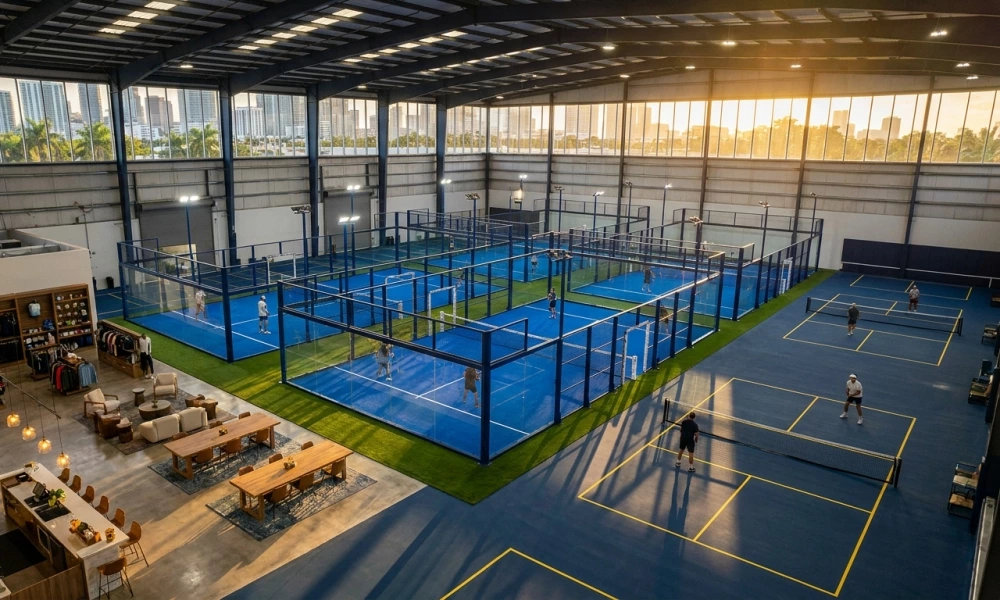
Padel court USA site selection follows different criteria than European markets. Three location types consistently outperform:
Type 1: Converted flex industrial/warehouse (highest ROI path)
- Target: 20,000–50,000 sq. ft. clear-span warehouse, 25–35 ft ceiling height
- Rental market: $8–$18/sq. ft./year in secondary US metros (Midwest, Sun Belt)
- Planning path: Commercial-to-assembly change of use — typically 60–90 days
- Acoustic: Fully enclosed — no residential noise ordinance exposure
- Capital efficiency: Avoids outdoor structural engineering complexity
Type 2: Vacant big-box retail (emerging opportunity)
- Former gyms, sports retailers, and entertainment venues offer turnkey infrastructure (parking, HVAC rough-in, high ceilings)
- Landlords offering below-market rents (sometimes $0 base rent + revenue share) to activate vacant anchors
- Locations in high-traffic retail corridors provide built-in visibility and walk-in traffic
Type 3: Tennis/country club conversion
- Existing tennis clubs with underutilised indoor courts or uncovered land
- Built-in membership base eliminates customer acquisition phase
- Club's existing F&B, pro shop, and locker facilities eliminate ancillary capex
- LTA-equivalent: USTA partnership recognition accelerating planning and community acceptance
UNIPADEL Supports US Market Projects
UNIPADEL USA padel court projects receive a complete technical and commercial support package designed for the specific requirements of the US regulatory and investment environment:
| Support Area | UNIPADEL Provision |
|---|---|
| Structural documentation | Complete structural calculation package (member section data, connection details, anchor bolt forces) in US customary units — ready for US PE firm review, adaptation, and stamp for IBC/ASCE 7 permit submission |
| Wind load variants | Pre-calculated structural data for ASCE 7 Exposure Categories B, C, and D; Wind Speed Map Zones 115–170 mph — covering all 50 states |
| Seismic variants | IBC/ASCE 7 seismic design category documentation for California, Pacific Northwest, and New Madrid Seismic Zone projects |
| Glass specification | 12mm tempered safety glass complying with ASTM C1048 (US standard equivalent to EN 12150-1) with US-format test documentation |
| Galvanizing certification | Hot-dip galvanizing per ASTM A123 (US standard equivalent to ISO 1461) — ≥75 micron average coating, batch test report included |
| ADA accessibility | Court gate clear opening width 36 inches minimum (ADA standard); flush thresholds; compliant with Americans with Disabilities Act |
| Logistics | Factory-direct delivery to any US port of entry (Los Angeles, Miami, New York, Houston, Seattle); US customs brokerage coordination |
| Installation support | English-language assembly manual; remote video supervision; on-site technical supervisor for 4+ court projects |
| Pricing | Factory-direct panoramic court from $12,500 CIF US port — 40–65% below US distributor pricing on equivalent specification |
The Market That Cannot Wait
The arithmetic of the US padel market in 2026 is straightforward:
1,073,000 active players. 1,000 courts. 505,000 people per court.
The hybrid Pickleball+Padel club model is not a compromise between two sports. It is a precision financial architecture — using pickleball's extraordinary volume to fund operations and build community while padel's premium pricing generates the margins that make the investment case work.
For court manufacturers, operators, and investors, the US padel market in 2026 presents a combination of factors that will not repeat:
- Demand dramatically ahead of supply — the gap is widest now
- Institutional capital actively seeking deployment — funding is available for credible operators
- First-mover brand advantages unclaimed — the dominant premium padel brand in New York, Miami, or Los Angeles has not yet been built
The window is open. The infrastructure is missing. The players are waiting.