Español
 Franch
  русский
Padel vs Pickleball in the UK: 2026 Growth Data & Investment Comparison Guide
The Question Every UK Sports Investor Is Asking Right Now
Every UK property developer, leisure operator, and sports infrastructure investor in 2026 is eventually confronted with the same fork in the road:
Padel or pickleball?
It is not a simple question. These are two fundamentally different commercial models, two completely different risk profiles, and two sports at very different stages of institutional maturity in the UK market.
Market Scale — A 20x Infrastructure Gap
UK Market Snapshot: Padel vs Pickleball (2026)
| Metric | Padel | Pickleball |
|---|---|---|
| Dedicated courts (UK) | 1,553 across 325 venues | 270+ (mostly multi-use) |
| Dedicated specialist venues | 325 | 7 (2025) → 14+ target (2026) |
| Active players (2025) | 860,000 (doubled YoY) | ~120,000 (estimated) |
| Court growth since 2019 | +2,253% | Minimal dedicated infrastructure |
| Public awareness (UK adults, Q1 2025) | 43% (up from 23% — +87% YoY) | Not independently tracked |
| Playtomic monthly active users (UK) | 35,000 → 156,000 (12 months) | No unified booking platform |
| Google search growth (UK, 2025) | +121% YoY | Significantly lower |
| Sport governing body | LTA (since 2019) | Pickleball England (Sport England: Dec 2024) |
| International tournament presence | Premier Padel (global), WPT | APP Tour, PPA (primarily US) |
The infrastructure gap is stark. While 1,553 padel courts serve 860,000 UK players, pickleball has just 7 dedicated venues nationally. The overwhelming majority of UK pickleball activity takes place in repurposed space — sports halls, community centres, and resurfaced tennis courts — rather than purpose-built facilities.
This does not make pickleball an inferior investment. It makes it a different one, at a different stage of the infrastructure cycle.
Revenue Per Court — The Structural 2x Advantage
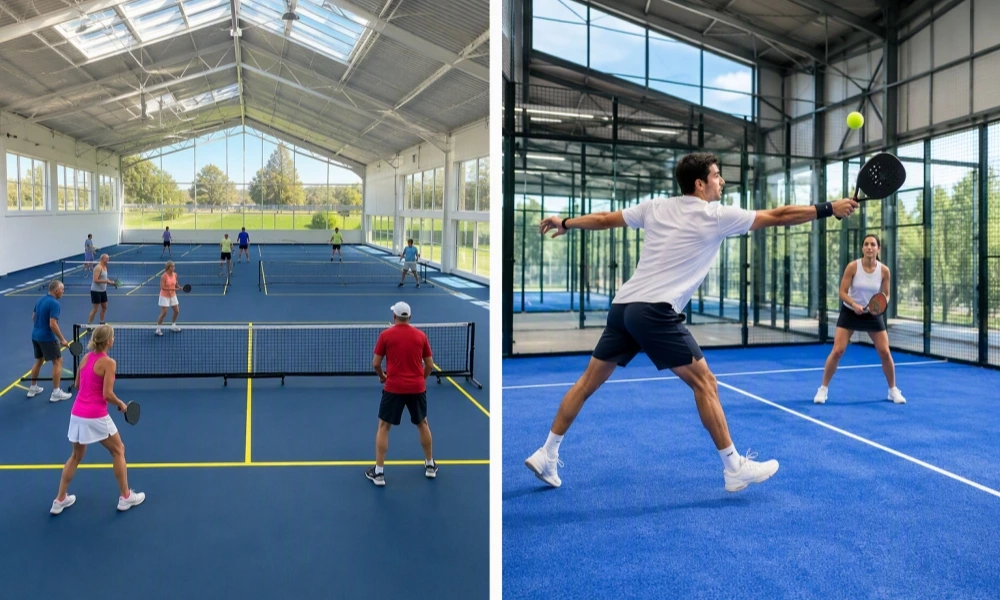
Padel vs pickleball UK revenue per court is the financial metric that most clearly separates the two sports' commercial models — and the gap is structural, not cyclical.
Padel is constitutionally a four-player doubles sport. Every booking — without exception — fills four slots. At £18–£30 per player per hour, four players per booking, and 12 bookable hours per day:
| Scenario | Padel | Pickleball |
|---|---|---|
| Standard hourly rate | £60–£120 per court | £20–£45 per court |
| Players per booking | 4 (mandatory) | Variable (2–4) |
| Revenue per session (90 min) | £90–£180 | £30–£68 |
| Annual revenue per court (65% utilisation) | ~£115,000 | ~£50,000–£70,000 |
| Courts needed to reach £690,000 annual revenue | 6 | 10–14 |
The Racquet Sports Institute (RSI) confirms this unit economics difference directly: padel achieves commercial viability at 5–6 courts; pickleball typically requires 8–12 courts to distribute fixed overheads (rent, staff, utilities) across sufficient revenue-generating units.
Padel's 94% Playtomic booking concentration also enables dynamic pricing — automated peak-hour uplift that pickleball, with no unified UK booking platform, cannot replicate.
Construction Cost — The 6–12x CAPEX Gap
Padel court cost UK vs pickleball represents the most immediate differentiator in any project pro forma.
Build Cost Comparison (UK, 2026)
| Cost Component | Padel | Pickleball |
|---|---|---|
| Converting existing tennis court | £50,000–£80,000 | £3,000–£8,000 (lines + net posts) |
| New outdoor build (full spec) | £55,000–£100,000 | £15,000–£25,000 |
| Indoor warehouse conversion | £100,000+ per court | £30,000–£60,000 |
| 6-court club total CAPEX | £300,000–£600,000 | £50,000–£150,000 (10 courts) |
| Acoustic mitigation (outdoor) | £15,000–£40,000 additional | Rarely required |
Maintenance Cost Reality
| Component | Padel | Pickleball |
|---|---|---|
| Surface lifespan | 5–8 years (artificial turf) | 10–15 years (acrylic/concrete) |
| Annual maintenance per court | £400–£500 | Significantly lower |
| Major replacement (surface) | £5,000–£10,000 per court | ~£500–£1,500 (repainting) |
| Glass panel replacement | £800–£1,500 per panel | Not applicable |
Planning and Noise Risk — Padel's Biggest UK Vulnerability
Padel UK planning permission noise vs pickleball is the dimension of this comparison that most frequently surprises first-time investors — and the one that has derailed the most UK projects in 2025–2026.
The Padel Noise Problem: BS 4142 in Practice
The Daily Telegraph's May 2025 headline said what many UK residents near padel facilities were already thinking: "Padel has made my life a living hell. It's like being at the Somme."
This is not hyperbole from the media. It reflects a genuine acoustic engineering challenge.
Under BS 4142:2014 — the UK standard for rating commercial and industrial sound — padel attracts two acoustic character correction penalties that push its assessed noise level significantly above its raw measured level:
| Acoustic Characteristic | Padel | Pickleball |
|---|---|---|
| Impulsivity penalty | +3 to +6 dB (sharp racket-on-ball pop, ball-on-glass thwack) | +0 to +3 dB (softer plastic ball) |
| Tonality penalty | +2 to +4 dB (distinctive glass resonance) | Minimal |
| Effective rating uplift | Up to +10 dB above raw measured level | Much lower |
Pickleball: Currently Near-Zero Planning Risk
In the same period, there are no documented planning refusals of UK pickleball facilities on noise grounds. The reasons are structural:
- The overwhelming majority of UK pickleball activity occurs indoors — socially halls, leisure centres — where noise is fully contained
- The sport's foam/polymer ball and open-court format generate meaningfully lower acoustic intensity than padel glass-wall resonance
- With only 7 dedicated outdoor/specialist facilities nationally, there has been no suburban density trigger for neighbour complaints
The important caveat: This near-zero planning risk reflects current scarcity, not inherent acoustic safety. US markets where outdoor pickleball has reached density show identical noise complaint patterns to padel. As UK outdoor pickleball facilities multiply, this risk profile will shift.
Institutional Backing — LTA Powerhouse vs Grassroots Emergence
Padel pickleball UK LTA comparison reveals a striking institutional asymmetry that directly affects investor confidence, funding access, and site approval speed.
Padel: Fully Institutionalised
- LTA investment since 2019: £6 million+ in padel infrastructure and development programmes
- Andy Murray's Game4Padel: £2.5 million+ raised, national rollout in progress
- Goals (multi-site operator): 76 padel courts targeted by end of 2026, treating padel as the new five-a-side football
- Savills (March 2026): Formally classified padel as a distinct "investable real estate asset class" — the first time a major property advisory firm has done so for any racquet sport
- Playtomic platform dominance: 94% of UK padel bookings — platform network effects that entrench padel's commercial infrastructure
- International capital: Premier Padel, Qatari sports investment, and the celebrity investor roster (David Beckham, Rafael Nadal, Eva Longoria) all provide halo effects that elevate UK investment sentiment
Pickleball: Emerging from Grassroots
- Sport England recognition: Only achieved in December 2024 — unlocking local authority grants and school programme integration for the first time
- LTA rejection: The LTA applied to become pickleball's governing body but was declined; Pickleball England remains independent
- No major UK institutional capital: The significant US investment flows (Major League Pickleball, The Picklr franchise, PPA Tour) have not yet crossed the Atlantic at institutional scale
Demographic Profile — Premium Urban vs Inclusive Community
Padel vs pickleball UK demographic data drives every downstream decision: site selection, pricing model, F&B offering, and membership structure.
| Dimension | Padel | Pickleball |
|---|---|---|
| Core age group | 25–55 (urban professional) | 50+ primary; 18–30 emerging |
| Socioeconomic group | ABC1 — professional, managerial | Broader — community-inclusive |
| Average household income | £55,000+ (active padel participant) | Lower threshold |
| Sport motivation | Competitive social, networking, lifestyle | Health, community, low-impact activity |
| Corporate entertainment | High — replacing golf as business sport | Low |
| Booking platform dependency | 94% Playtomic — digital-first | No unified platform |
| Brand association | Premium, European, "new golf" | Accessible, inclusive, multigenerational |
The corporate entertainment dimension deserves specific emphasis. Padel is rapidly replacing golf as the preferred format for business networking and corporate relationship-building among 30–55 year olds. A 90-minute padel session — four players, shared competitive experience, natural conversation structure — serves the same social function as an 18-hole round but in a fraction of the time. This structural corporate demand creates predictable weekday mid-morning and post-work revenue that pickleball cannot currently replicate.
Full ROI Comparison — The 5-Year Financial Model
Padel court UK ROI versus pickleball over a 5-year horizon, modelled on a typical indoor UK facility:
6-Court Indoor Padel Club
| Metric | Conservative | Realistic |
|---|---|---|
| Total CAPEX | £600,000 | £450,000 |
| Annual court hire revenue | £580,000 | £690,000 |
| Coaching + corporate + F&B | £90,000 | £160,000 |
| Total annual revenue | £670,000 | £850,000 |
| Operating costs | £380,000 | £380,000 |
| Net annual profit | £290,000 | £470,000 |
| Net margin | 43% | 55% |
| Padel court UK payback period | 25 months | 11 months |
| 5-year cumulative net profit | £1,450,000 | £2,350,000 |
10-Court Pickleball Facility (Indoor Converted Warehouse)
| Metric | Conservative | Realistic |
|---|---|---|
| Total CAPEX | £150,000 | £120,000 |
| Annual court hire revenue | £220,000 | £280,000 |
| Coaching + events | £30,000 | £55,000 |
| Total annual revenue | £250,000 | £335,000 |
| Operating costs | £140,000 | £160,000 |
| Net annual profit | £110,000 | £175,000 |
| Net margin | 44% | 52% |
| Payback period | 14 months | 8 months |
| 5-year cumulative net profit | £550,000 | £875,000 |
The bottom line: Pickleball payback is 2–3x faster. Padel's 5-year absolute profit is 2.4–2.7x higher. Net margins are comparable. The choice is capital depth versus speed to liquidity.
The Hybrid Opportunity — The UK's Most Underserved Model
Padel pickleball hybrid club UK is currently an untapped opportunity. As of July 2026, there is no dedicated, purpose-built padel-pickleball hybrid club in the UK operating at scale.
In the United States, PURE Sports (Phoenix, Arizona — 116,000 sq ft, 40 pickleball courts + 8 padel courts + restaurant + recovery spa) has validated the hybrid model's commercial logic:
- Pickleball drives high-volume foot traffic from a broad demographic
- Padel drives premium revenue yield from the high-value segment
- Shared infrastructure (reception, F&B, changing rooms, parking) distributes fixed costs across both revenue streams
- Crossover membership funnel: pickleball players naturally graduate to padel as they seek more technical challenge
Investor Decision Framework
Which sport fits your investor profile?
| Investor Profile | Recommended Sport | Core Rationale |
|---|---|---|
| City centre property developer | Padel | High yield per sq ft; premium brand positioning; corporate demographic |
| Local authority / public trust | Pickleball | Low CAPEX; high inclusivity; zero planning friction; Sport England alignment |
| Commercial landlord (vacant warehouse) | Hybrid | Maximises floor space; diversifies revenue across demographics |
| Private equity / multi-site rollout | Padel | Scalable high-EBITDA model; institutional exit potential |
| Tennis club board | Padel | LTA funding access; natural member conversion pipeline; court footprint efficiency |
| Holiday park / resort operator | Padel | Premium amenity positioning; ADR uplift; year-round canopy option |
Not Either/Or — But Choosing the Right Timing
The padel vs pickleball UK debate in 2026 is not a question of which sport is better. It is a question of which sport fits the specific financial constraints, site characteristics, and investment horizon of a given project.
Padel is the high-conviction, premium-yield investment. With 860,000 active players, £6 million in LTA support, and Savills-endorsed asset class status, the demand fundamentals are firmly established. Planning risk is manageable — not with avoidance, but with engineering: the right acoustic specification, the right site selection, the right supplier documentation for LPA submission.
Pickleball is the lean, fast-payback community sport. It requires a fraction of the capital, carries almost no planning risk in its current UK form, and serves a demographic that padel does not naturally reach. For investors who need capital velocity over absolute return, it is the logical choice in 2026.
Wherever you position, the discipline is the same: quality over quantity, community over capacity, and documentation over assumption. The Sweden precedent proved what happens when those priorities are reversed.