Español
 Franch
 русский
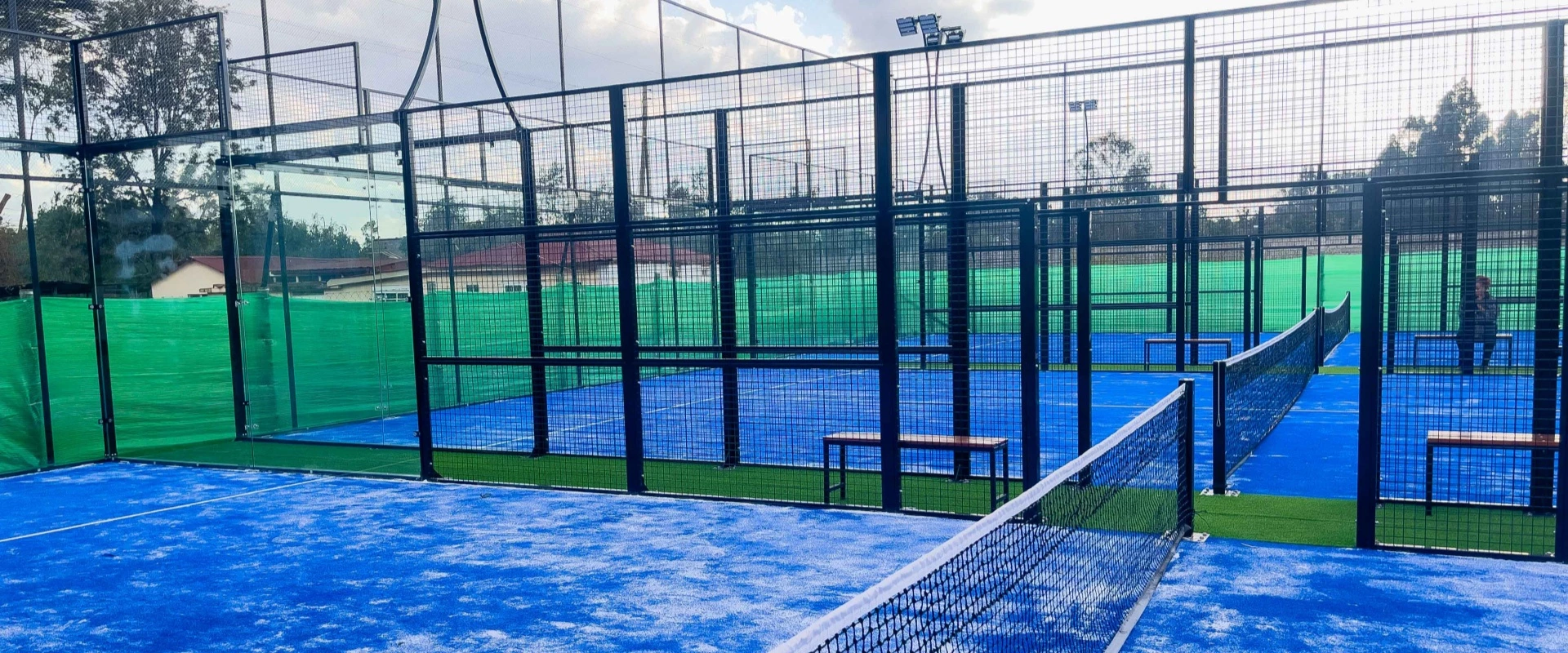
Padel Court with Electric Retractable Roof: Eliminating Rain Cancellations and Summer UV Dead Zones
Every commercial padel developer faces the same fundamental dilemma at the project planning stage: build open-air outdoor courts and lose money to the weather, or lease an indoor warehouse and absorb punishing commercial real estate rents.
In Central and Western Europe—across the UK, Germany, the Netherlands, Belgium, and northern France—meteorological records show an average of 120 to 160 days of measurable rain and snow annually. Meanwhile, in the US Sunbelt (Texas, Florida, Arizona, Southern California) and Southern Europe, intense summer heat and ultraviolet radiation turn open courts into uninhabitable concrete ovens between 10:00 AM and 4:00 PM.
For club operators who refuse to compromise between open-air atmosphere and 365-day cash flow, the UNIPADEL Padel Court with Electric Tent bridges the gap. By integrating a heavy-duty, motorized retractable roof directly over a competition-grade court structure, clubs gain instant shelter from rain and snow while blocking over 95% of harmful UV rays during peak summer sun—all at the press of a button.
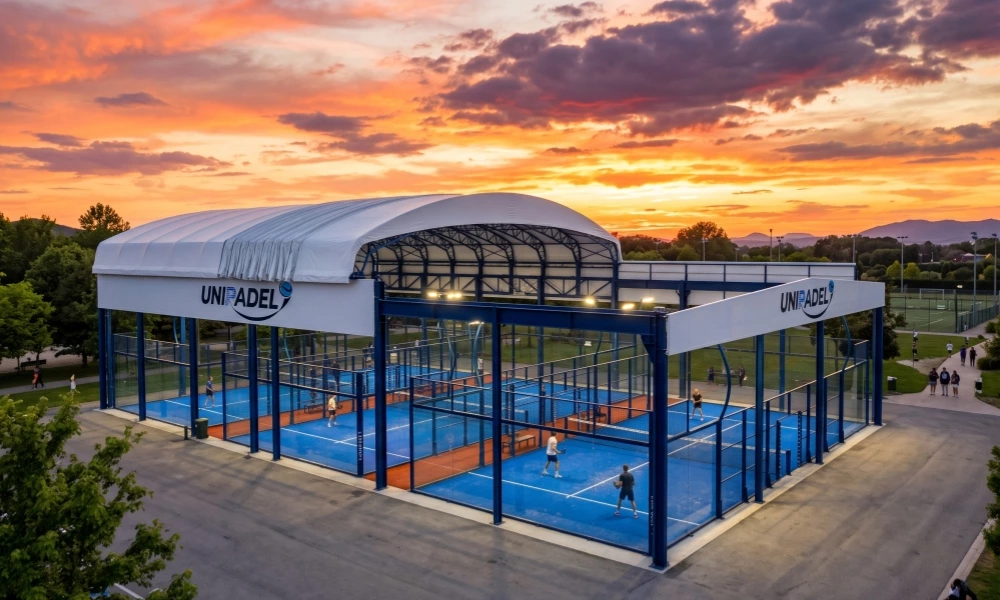
The Dual Climate Threat: How Weather Erodes Club Profitability
Open-air padel courts look great in architectural renderings, but real-world operating ledgers tell a harsher story. Depending on your geographic latitude, unshielded outdoor courts suffer from two distinct revenue leaks:
Central & Western Europe: 120+ Days of Rain, Frost, and Wet Glass
In temperate maritime climates, rain is not merely an inconvenience; it completely halts play. Unlike synthetic football pitches where athletes play through drizzle, padel relies on predictable ball bounce off 12mm tempered glass walls and sanded monofilament turf.
-
Glass Rebound Failure: When sheets of rainwater coat tempered glass, surface friction drops dramatically. Balls skid downward instead of rebounding cleanly, ruining rally dynamics and forcing players to cancel bookings.
-
Turf Saturation and Frost: Persistent autumn drizzle saturates silica sand infill, while winter overnight frost turns damp turf into a slip hazard until midday. Clubs with uncovered courts routinely forfeit 30% to 40% of their potential annual operating hours between October and April.
North America & Southern Europe: The Summer UV Dead Zone
In high-solar-radiation markets across Texas, Florida, Spain, and Italy, winter rain is replaced by brutal summer heat.
-
Midday Booking Collapses: Between late May and September, direct overhead sunlight heats artificial turf surfaces above 50°C (122°F). Recreational members, junior academies, and corporate groups refuse to book slots between 10:00 AM and 4:00 PM, leaving courts sitting empty for six prime daytime hours every single day.
-
Accelerated Material Degradation: Unfiltered ultraviolet radiation breaks down polymer chains in polyethylene (PE) turf fibers, dries out EPDM glass cushioning gaskets, and fades standard powder coatings years ahead of schedule.
How the UNIPADEL Electric Retractable Roof Solves Both Extremes
A fixed steel roof solves rain and sun, but it permanently sacrifices the open-air playing experience that players crave on warm spring evenings and crisp autumn mornings. The UNIPADEL Padel Court with Electric Tent eliminates that trade-off through dynamic, on-demand weather control.
1. Blocking 95%+ of Harmful UV Rays and Reducing Surface Heat
The retractable canopy utilizes an architectural-grade PVDF-coated PVC membrane engineered with high-density UV stabilizers and solar-reflective pigments. When extended during midday summer hours, the roof blocks over 95% of ultraviolet radiation and reflects solar infrared heat. Under-canopy ambient temperatures drop by 6°C to 10°C (11°F to 18°F) compared to exposed asphalt or turf, turning dead midday slots into comfortable, bookable hours for coaching clinics and daytime leagues.
2. One-Touch Weather Deployment in Under 3 Minutes
Driven by industrial-grade tubular and geared electric motors along precision-machined overhead tracks, the entire roof membrane opens or closes smoothly in approximately 2 to 3 minutes via wireless remote control or a club-house wall switch. When a sudden afternoon squall approaches, staff can seal the courts before a single drop hits the glass; once the clouds clear, the roof retracts to restore unobstructed blue-sky play.
3. Natural Cross-Ventilation Without HVAC Bills
Converting a standard warehouse into an indoor padel club requires massive capital outlay for commercial HVAC, air-exchange ducting, and dehumidification to prevent condensation on the glass walls. Because the UNIPADEL electric tent covers the overhead plane while leaving the court perimeter open to natural ambient breezes, players enjoy continuous cross-ventilation with zero mechanical air-conditioning overhead.
Structural & Mechanical Engineering Specifications
Building a motorized roof over a 20m × 10m playing field requires rigorous structural engineering to ensure the canopy never interferes with high lobs or compromises safety during gusty winds.
-
FIP-Compliant Overhead Clearance: Official International Padel Federation (FIP) rules mandate a minimum clear height of 6 meters (20 feet), with 8 meters (26 feet) recommended for competitive play. UNIPADEL designs its motorized roof trusses with an 10.0-meter interior clearance, ensuring even high defensive lobs never strike overhead beams or fabric folds.
-
Architectural Flame-Retardant Membrane: The canopy uses 850 g/m² to 950 g/m² high-tenacity polyester-reinforced PVC/PVDF fabric. It is certified flame-retardant (European B-s2,d0 / US NFPA 701), waterproof (100% hydrostatic seal), anti-fungal, and self-cleaning under rainfall.
-
Hot-Dip Galvanized Structural Frame (ISO 1461): Every supporting column, arched truss, and guide rail is fabricated from heavy-gauge Q235B/Q355B structural steel, hot-dip galvanized inside and out (≥75 µm zinc thickness) and finished with architectural polyester powder coating for 20+ years of corrosion resistance.
-
Integrated Linear LED Lighting: Because traditional 6-meter corner floodlight poles would obstruct a moving roof, UNIPADEL integrates IP66-rated, anti-glare LED linear light fixtures directly along the upper longitudinal trusses. Players receive uniform 400–500 lux illumination whether the roof is fully open or fully closed.
-
Automated Wind-Sensor Protection: Optional anemometer wind sensors monitor local gust speeds in real time, automatically retracting or locking the canopy according to pre-programmed safety thresholds in compliance with Eurocode 1 (EN 1991-1-4) and ASCE 7 structural codes.
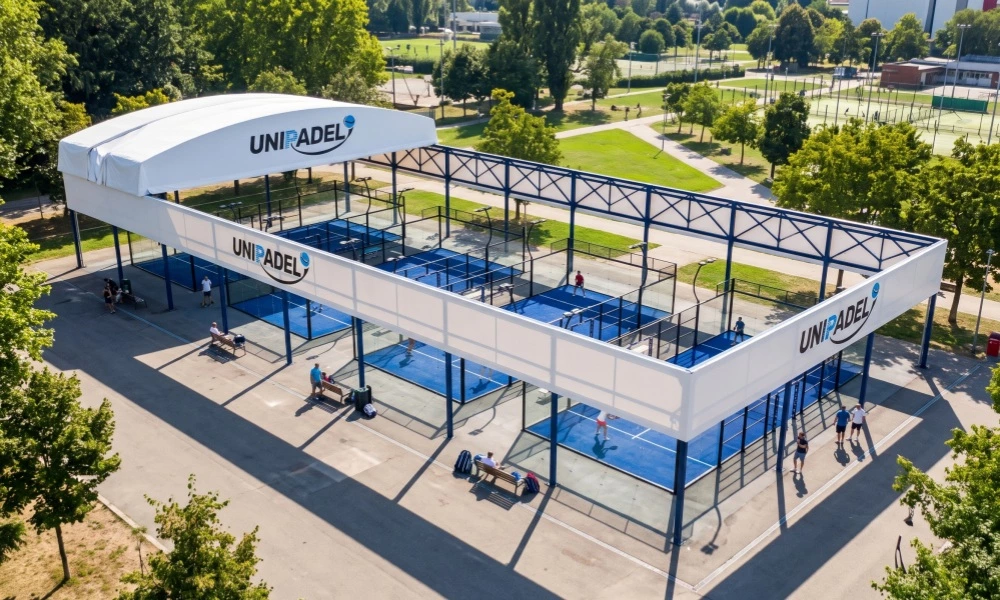
Facility Strategy Comparison: Open vs. Indoor vs. Electric Retractable
For investors evaluating site options, the financial and operational differences between an uncovered court, a leased indoor warehouse, and a motorized retractable roof facility are substantial:
| Facility Parameter | Open Outdoor Padel Court | Leased Indoor Warehouse | UNIPADEL Electric Retractable Roof |
| Upfront Equipment CAPEX | Lowest | Low (Court only; high building fit-out) | Moderate (Court + Motorized Roof System) |
| Monthly Real Estate / Rent | Low (Raw land / parking lot) | Very High ($12–$22/sq ft commercial rent) | Low (Land lease rates, not industrial warehouse) |
| Rainy Day Playability (120+ Days) | 0% (Cancelled / Refunded) | 100% | 100% (Closed canopy mode) |
| Summer Midday Play (10 AM–4 PM) | Poor (Extreme UV & heat stress) | High (Requires expensive HVAC) | High (95%+ UV shade + natural breeze) |
| Open-Air Atmosphere | 100% | 0% (Enclosed artificial environment) | 100% on demand (Open canopy mode) |
| HVAC & Dehumidification OPEX | £0 / $0 | £1,200–£2,500 / month | £0 / $0 (Natural cross-ventilation) |
| Municipal Permitting Speed | Moderate | Complex (Change of commercial use) | Faster (Classified as light/demountable canopy) |
Financial ROI Math: How Recovering Weather-Lost Hours Pays Back the Roof
To see how a motorized roof impacts club cash flow, consider a commercial 3-court outdoor facility operating in a climate with 120 rainy/snowy days and 90 hot summer days:
-
Baseline Uncovered Scenario:
At an average blended rental rate of €32 / $35 per hour, losing just 3.5 hours per court per day to rain, wet glass, or midday summer heat costs the club 315 billable hours per day across the year—translating to roughly €105,000 / $115,000 in lost annual court revenue.
-
With UNIPADEL Electric Retractable Roofs:
By keeping all three courts playable during rainstorms and shaded during peak UV hours, the club captures an average of 2.5 additional paid hours per court per day year-round.
-
3 courts × 2.5 extra hours/day × 330 operating days = 2,475 recovered hours/year
-
2,475 hours × €32 ($35) = €79,200 ($86,625) in additional annual gross revenue
-
-
Even after factoring in minor electricity consumption for the drive motors, the incremental net profit pays back the upfront cost of the motorized roof upgrade within 14 to 20 months, while dramatically increasing member retention and league reliability.
Combining Retractable Roofs with Modular Foundations for Leased Land
Many European and North American club operators build on leased commercial plots, retail parking lots, or municipal parklands where pouring permanent reinforced concrete slabs is either prohibited or financially risky upon lease expiration.
The UNIPADEL Padel Court with Electric Tent can be engineered directly onto our UNIPADEL Modular Foundation & Portable Base. This combination creates a 100% relocatable, all-weather turnkey club:
-
Zero concrete excavation or permanent soil alteration.
-
Expedited municipal approval under temporary or demountable sports structure classifications.
-
Full asset portability—if your lease ends in five years, both the steel sub-base and the motorized canopy unbolt and pack into containers for relocation.
Frequently Asked Questions (FAQ)
How fast does the UNIPADEL electric retractable roof open and close?
The motorized drive system extends or retracts the full 20-meter roof span in 2 to 3 minutes. Operators can stop the canopy at any intermediate position to block low-angle morning or late-afternoon sun while keeping the rest of the sky open.
Does the roof interfere with high lobs during competitive matches?
No. UNIPADEL engineers the supporting steel arches and retractable track beams with an interior clear height of 8.5 to 10.0 meters, comfortably exceeding the International Padel Federation (FIP) minimum requirement of 6 meters and tournament recommendation of 8 meters.
How does the electric tent handle heavy snow or strong winds?
The curved arch geometry and tensioned PVDF/PVC membrane are designed to shed rainwater immediately and prevent ponding. For regions with winter snowfall or high coastal winds, UNIPADEL customizes truss wall thickness, arch spacing, and wind-sensor automation to meet local Eurocode 1 or ASCE 7 structural load requirements. In extreme storm warnings, retracting the fabric into its protective storage hood eliminates wind-sail surface area entirely.
Can the motorized canopy be ordered in custom colors to match our club branding?
Yes. Both the hot-dip galvanized structural steel frame (customizable to any RAL color code) and the architectural PVC membrane (available in white, light grey, dark green, navy blue, or translucent daylight finishes) can be tailored to match your club’s visual identity.
Build a Weather-Proof Padel Club with UNIPADEL
You do not need to pay warehouse real estate prices to run a 365-day padel business—and you should never let 120 days of European rain or intense summer UV rays dictate your monthly cash flow.
Contact the UNIPADEL Engineering Team Today with your site dimensions and local climate zone to receive 3D architectural layouts, wind/snow load specifications, and a factory-direct quotation.