Español
 Franch
 русский
Hurricane-Rated Padel Courts: How Structural Engineering Lowers Insurance Premiums and Defeats Coastal Corrosion
Building a commercial padel club at a coastal resort, marina, or island destination offers unmatched real estate appeal and access to an affluent player demographic. Yet developers operating in Florida, Texas, the Caribbean, and coastal Southern Europe face two relentless operational threats: extreme wind loads and aggressive marine salt corrosion.
Standard padel courts—engineered primarily for sheltered inland European venues—fail rapidly under these conditions. When a tropical storm makes landfall, or when salt-laden ocean air batters exposed steel 365 days a year, structural failure becomes a severe financial and legal liability.
For club investors, resort operators, and general contractors in the US and Europe, specifying a hurricane-rated padel court is not a cosmetic upgrade. It is the baseline requirement for passing municipal structural reviews, securing commercial liability insurance, and protecting long-term asset value.
The Commercial Insurance Crisis: Wind Shear, Glass Blowouts, and Liability
One of the most common roadblocks in launching an outdoor padel venue is securing affordable property and general liability insurance.
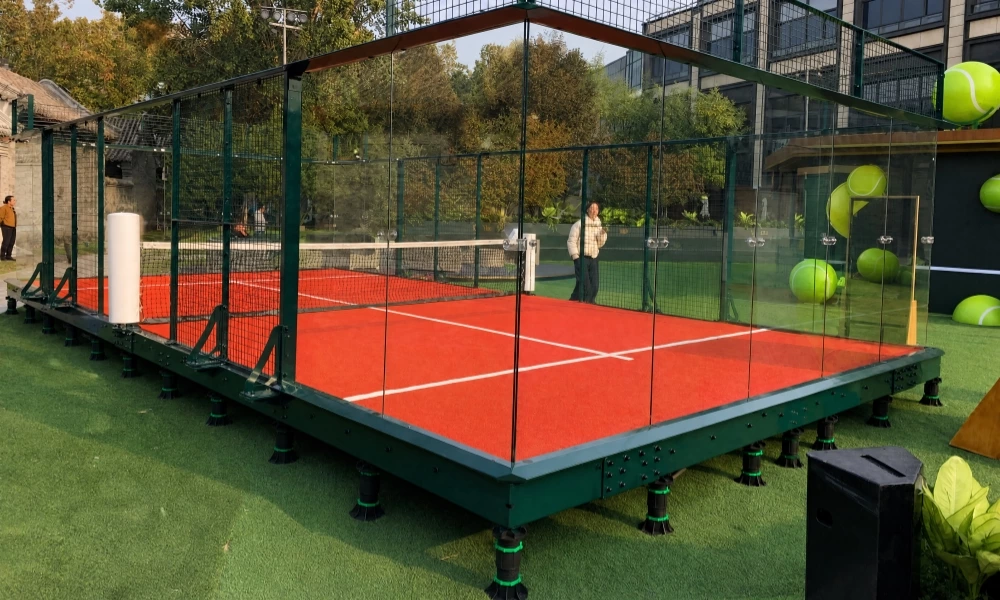
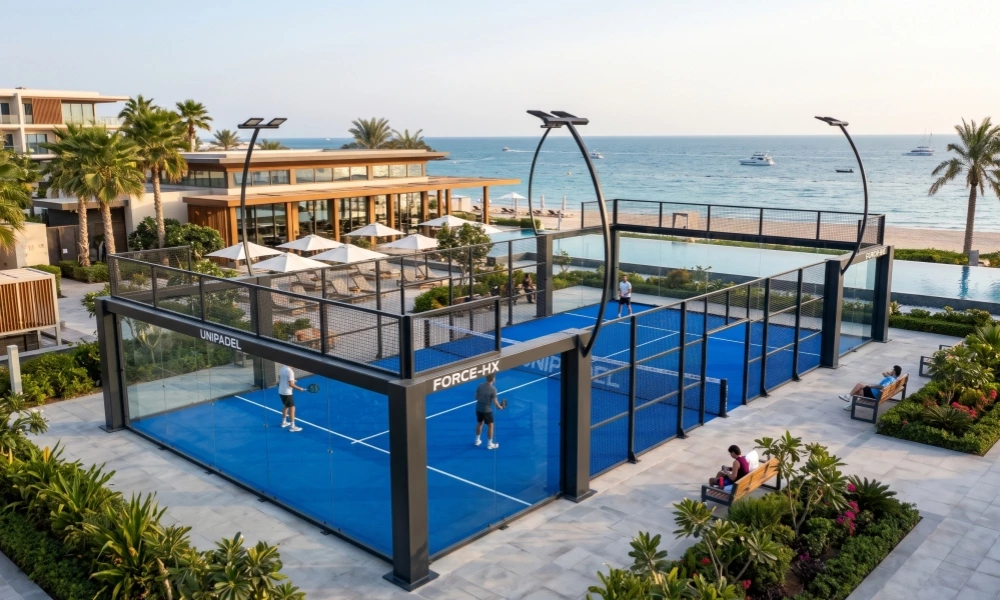
A regulation padel court surrounds players with 18 monolithic sheets of 12mm tempered glass standing 3 meters high. In high-velocity wind corridors, those solid glass walls function like giant vertical sails. When gale-force gusts or hurricane-strength winds strike the court perimeter, they generate immense lateral pressure on the windward side and violent suction uplift on the leeward side.
Why Standard Frames Fail Under High Wind
Conventional courts typically rely on light-gauge steel posts (2mm to 3mm wall thickness) spaced at standard intervals. Under severe wind shear, light-gauge columns deflect—or bend—beyond safe tolerances. Because tempered architectural glass cannot flex with the steel, excessive column deflection pinches the glass edges against the mounting bolts, causing sudden, catastrophic glass blowouts.
The Underwriting Bottleneck
In a worst-case scenario during a sudden coastal squall or tropical storm, shattered glass or collapsing perimeter frames pose a severe injury hazard to players, staff, and neighboring properties.
Commercial insurance underwriters price this risk aggressively. Across Florida, the Gulf Coast, the Carolinas, and exposed Mediterranean coastlines, insurers routinely refuse to bind coverage—or levy prohibitive annual premiums—unless the facility developer submits certified wind-load engineering proving the court meets local building codes.
The Engineering Solution: UNIPADEL FORCE-HX
To eliminate this structural vulnerability, UNIPADEL developed the Anti-Hurricane Padel Court | FORCE-HX alongside the heavy-duty FORCE-HS model.
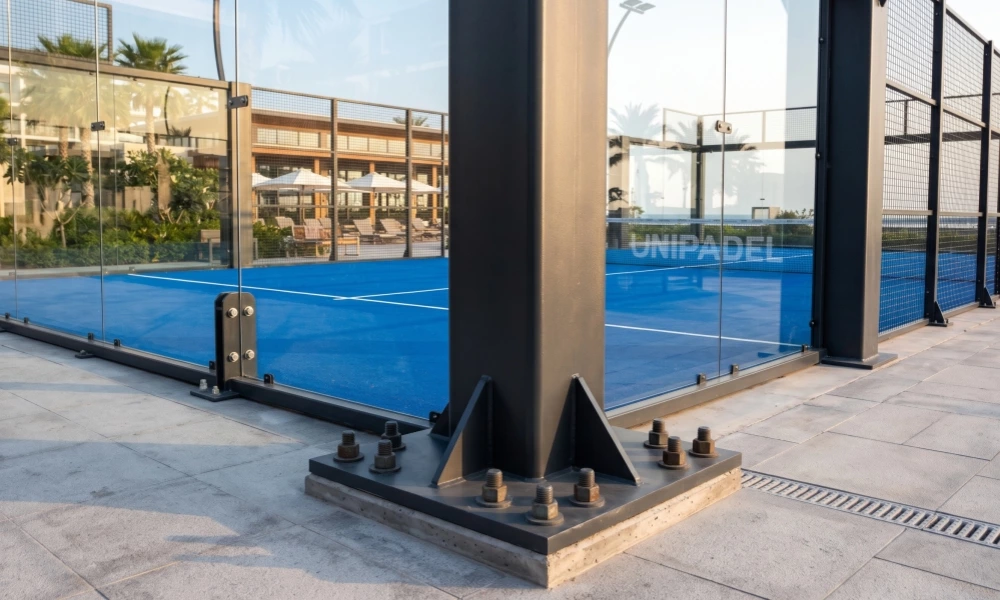
Rather than relying on standard commercial tubing, the FORCE-HX integrates oversized structural steel columns, double-reinforced horizontal wind transoms, and heavy-gauge base plates engineered to keep lateral deflection well within strict glass-safety limits. Submitting UNIPADEL’s certified structural calculation pack directly to your insurance broker and local building department demonstrates verifiable risk mitigation, accelerating permit approvals and lowering annual policy rates.
Technical Comparison: Standard Padel Court vs. UNIPADEL FORCE-HX
General contractors and structural engineers evaluating bids need hard metallurgical and mechanical metrics. The table below compares a conventional outdoor panoramic court against the UNIPADEL FORCE-HX hurricane-rated specification:
| Engineering Parameter | Standard Outdoor Padel Court | UNIPADEL Anti-Hurricane (FORCE-HX) |
| Primary Structural Columns | 80 × 80 mm or 100 × 50 mm (2.5–3.0 mm wall) | 120 × 80 mm / 150 × 100 mm Heavy-Gauge (4.0–5.0 mm wall) |
| Horizontal Wind Bracing | Single upper/lower perimeter frame | Dual-tier reinforced structural wind transoms |
| Maximum Wind Speed Rating | Up to ~75–85 mph (120–135 km/h) | Engineered up to 150+ mph (240+ km/h) wind zones |
| Tempered Safety Glass | 10mm or 12mm standard toughened glass | 12mm monolithic toughened glass (EN 12150 / ASTM C1048) |
| Glass Clamp & Cushion System | Basic point-fixings with thin PVC pads | Continuous EPDM shock-absorbing gaskets & reinforced clamps |
| Base Plate & Anchoring | 8–10 mm base plate; M12 expansion bolts | 16–20 mm gusseted base plate; M16/M20 chemical anchors |
| Anti-Corrosion Coating | Pre-galvanized tube + standard polyester paint | ISO 1461 Hot-Dip Galvanized (≥80 µm) + ISO 12944 C5 Marine Coat |
| Fastener Hardware Grade | Zinc-plated carbon steel or standard 304 SS | Marine-grade A4 / 316 Stainless Steel throughout |
By doubling down on column wall thickness and adding reinforced horizontal cross-bracing, the FORCE-HX distributes aerodynamic wind loads down into the concrete foundation rather than transferring torsional stress into the glass panels.
Navigating US & European Wind Codes (ASCE 7, FBC, and Eurocode 1)
Buying a structurally reinforced court is only half the equation; local municipal building officials will not issue a Certificate of Occupancy without documented proof that the structure complies with regional engineering statutes.
North American Compliance (ASCE 7 & Florida Building Code)
In the United States, commercial outdoor sports structures are governed by the International Building Code (IBC) and ASCE 7 (Minimum Design Loads and Associated Criteria for Buildings and Other Structures). In coastal regions—especially Florida’s High-Velocity Hurricane Zones (HVHZ) and Texas coastal counties—structural reviewers scrutinize:
-
Basic Wind Speed Maps: Courts must be engineered for site-specific 3-second gust speeds (often 130 mph to 175 mph depending on risk category and exposure class C or D).
-
Safety Glazing Certification: All 12mm glass panels must comply with ASTM C1048 and ANSI Z97.1 (CPSC 16 CFR 1201 Category II) impact safety standards.
European Compliance (Eurocode 1 & EN 1090-1)
Across coastal Spain, France, Italy, Portugal, and the UK, planning authorities and structural control offices require compliance with:
-
Eurocode 1 (EN 1991-1-4): Governs wind actions on structures, factoring in terrain roughness, coastal exposure, and dynamic vortex shedding across large glass facades.
-
EN 1090-1 (CE Marking): Certifies factory production control and structural welding integrity for load-bearing steel components.
-
EN 12150-2: The European benchmark for thermally toughened soda-lime silicate safety glass.
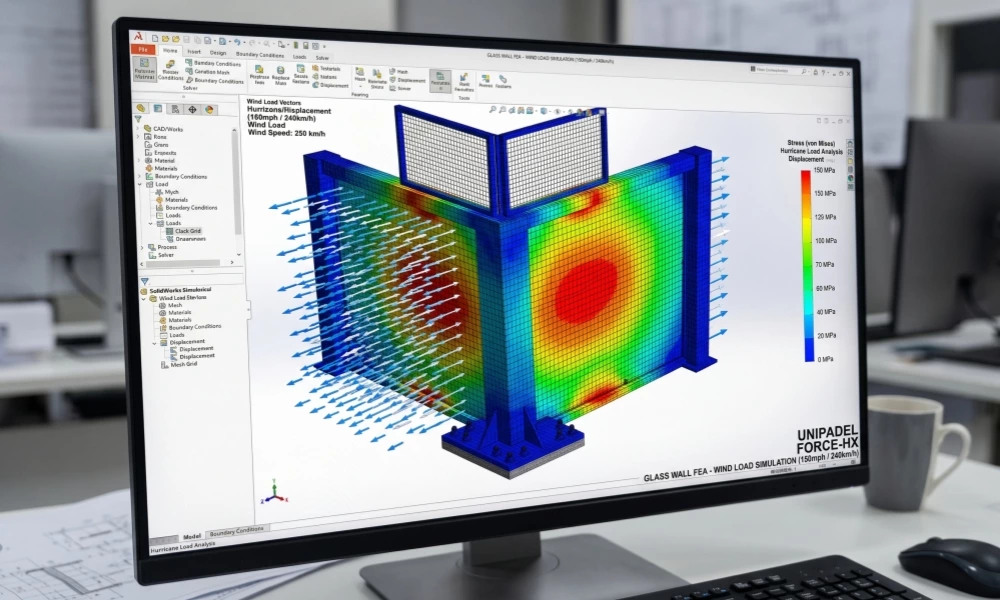
UNIPADEL’s engineering team supplies complete Finite Element Analysis (FEA) wind-load models, structural reaction-force tables, and certified material test reports with every FORCE-HX order, allowing your local licensed engineer (PE) to stamp and submit permit drawings without delays.
Defeating Coastal Corrosion at Beach Resorts and Yacht Clubs
For waterfront luxury resorts, yacht clubs, and beachfront real estate developments, padel is an anchor lifestyle amenity. However, positioning steel and glass within a few hundred meters of breaking surf exposes the court to continuous salt mist, high ambient humidity, and intense ultraviolet radiation.
The "Rust and Rattle" Syndrome
When developers install standard courts in marine environments, salt crystals settle inside unsealed tube joints and microscopic paint scratches. Within 12 to 18 months, orange rust streaks bleed down the columns and stain the glass, destroying the five-star aesthetic of the property. At the same time, persistent coastal trade winds cause lightweight frames to vibrate and rattle during play, undermining the guest experience.
UNIPADEL’s Multi-Stage Marine Defense
To guarantee long-term durability in harsh coastal climates, the FORCE-HX undergoes an industrial metallurgical treatment aligned with ISO 12944 C5 (Very High / Marine Corrosivity) guidelines:
-
Full-Immersion Hot-Dip Galvanization (ISO 1461): After all laser cutting and structural welding are completed, every steel column, frame, and mesh panel is submerged in molten zinc. This creates a metallurgically bonded zinc-iron alloy coating (≥80 microns thick) inside and outside every hollow tube, providing 20+ years of sacrificial corrosion protection.
-
Architectural Marine-Grade Powder Coating: Following galvanization and chemical surface etching, the steel receives an electrostatic coat of high-durability pure polyester powder cured at 200°C. This finish resists chalking, blistering, and UV degradation under harsh tropical sun.
-
A4 / 316 Marine Stainless Steel Hardware: Mixing standard carbon steel bolts with galvanized frames in salty air triggers rapid galvanic corrosion. UNIPADEL specifies A4 (316) marine-grade stainless steel bolts, nuts, and washers—the same alloy used in yacht rigging—eliminating seized fasteners and rust weeping at connection points.
Foundation Requirements for Hurricane-Rated Installations
A hurricane-rated superstructure is only as secure as the concrete beneath it. Because the FORCE-HX transfers substantial overturning moments (uplift and shear forces) to the base plates during extreme weather events, standard thin slabs are inadequate.
-
Reinforced Perimeter Ring Beam: UNIPADEL provides detailed foundation layout drawings specifying a reinforced concrete perimeter beam (typically 400 mm to 500 mm wide by 500 mm to 600 mm deep, depending on local soil bearing capacity and frost depth) tied into the playing slab.
-
Chemical Anchoring Systems: Rather than relying on friction-fit wedge anchors that can loosen under cyclic wind vibration, heavy-duty base plates are secured using high-strength epoxy chemical anchor rods embedded deep into the reinforced concrete beam.
Frequently Asked Questions (FAQ)
What hurricane category or wind speed can the UNIPADEL FORCE-HX withstand?
Depending on site exposure category and local concrete foundation anchoring specs, the UNIPADEL FORCE-HX is engineered to withstand sustained and gust wind loads up to 150+ mph (240+ km/h)—equivalent to a major Category 4 hurricane. Our engineering team calibrates column wall thickness and anchor schedules to match your exact zip code or municipal wind map.
Does UNIPADEL provide wind-load calculations for building permits and insurance?
Yes. Every FORCE-HX order includes a comprehensive engineering documentation package containing structural steel specifications, 2D/3D CAD foundation templates, baseplate reaction force data, FEA wind-load simulation reports, and CE / EN 12150 / ASTM C1048 material certificates. Local structural engineers use these files directly for municipal permit submissions and insurance underwriting.
How long does a FORCE-HX court last in a beachfront or island resort environment?
Thanks to full-immersion ISO 1461 hot-dip galvanization (≥80 µm zinc coating), marine-grade polyester powder coating, and 316 stainless steel fasteners, the structural steel framework is built for a 20+ year service life in coastal environments without structural rust degradation.
How many FORCE-HX anti-hurricane courts fit into a 40HQ shipping container?
Because the FORCE-HX uses heavier, thicker-walled structural steel columns and oversized base plates compared to standard courts, 3 complete FORCE-HX courts (including 54 sheets of 12mm tempered safety glass on welded steel A-frame racks, turf rolls, and LED floodlights) fit safely inside a single 40-foot high-cube (40HQ) container within international highway weight limits.
Protect Your Coastal Development with Certified Engineering
Developing a waterfront resort or commercial padel club in a high-wind corridor demands infrastructure engineered for real-world environmental extremes. Gambling on lightweight, uncertified frames exposes your business to rejected building permits, uninsurable liability, and premature coastal rust.
With the UNIPADEL Anti-Hurricane Padel Court | FORCE-HX, you secure certified wind-load resilience, marine-grade corrosion protection, and factory-direct pricing backed by proven global installations.
Contact UNIPADEL’s Engineering Team Today with your project location and local wind-code requirements to request our structural calculation package and a tailored factory-direct quotation.