Español
 Franch
  русский
Indoor Padel Courts in Chișinău, Moldova
Chișinău is not the first city that comes to mind when people talk about padel markets. But when you look at what Sportpark has built here, it's hard not to pay attention.
Sportpark is a multi-sport club in the Moldovan capital, set in a green, tree-lined part of the city. Before padel came into the picture, the facility already had a solid setup — tennis, table tennis, and a well-established member base. When the club's management started looking seriously at padel as a new revenue stream, they found UNIPADEL. The question they came in with was straightforward: we already run a full sports facility — how do we bring padel into it properly?
That question is more common than people realise. A growing number of multi-sport venues across Europe are realising that padel isn't a standalone business sitting next to their existing operation. It's a traffic driver — something that gives current members a reason to come back more often, while pulling in a younger demographic who might not have engaged with the club before.
Project Specifications
| Court Type | Panoramic Padel Court |
| Quantity | 2 sets |
| Frame Colour | Black |
| Turf Colour | Blue artificial turf |
| Glass Spec | 12 mm tempered, EN 12150-2 |
| Frame Material | Hot-dip galvanised Q235B steel |
| Certification | CE Certified · FIP-Compatible Structure |
| Location | Strada Nicolae Dimo 32, Chișinău, Moldova |
Why Panoramic, and Why Indoor
Sportpark looked at a few options before settling on the Panoramic Indoor Padel Court configuration. The reasoning wasn't complicated: if you're putting two courts inside a facility that already has a strong visual identity, the courts need to look the part.
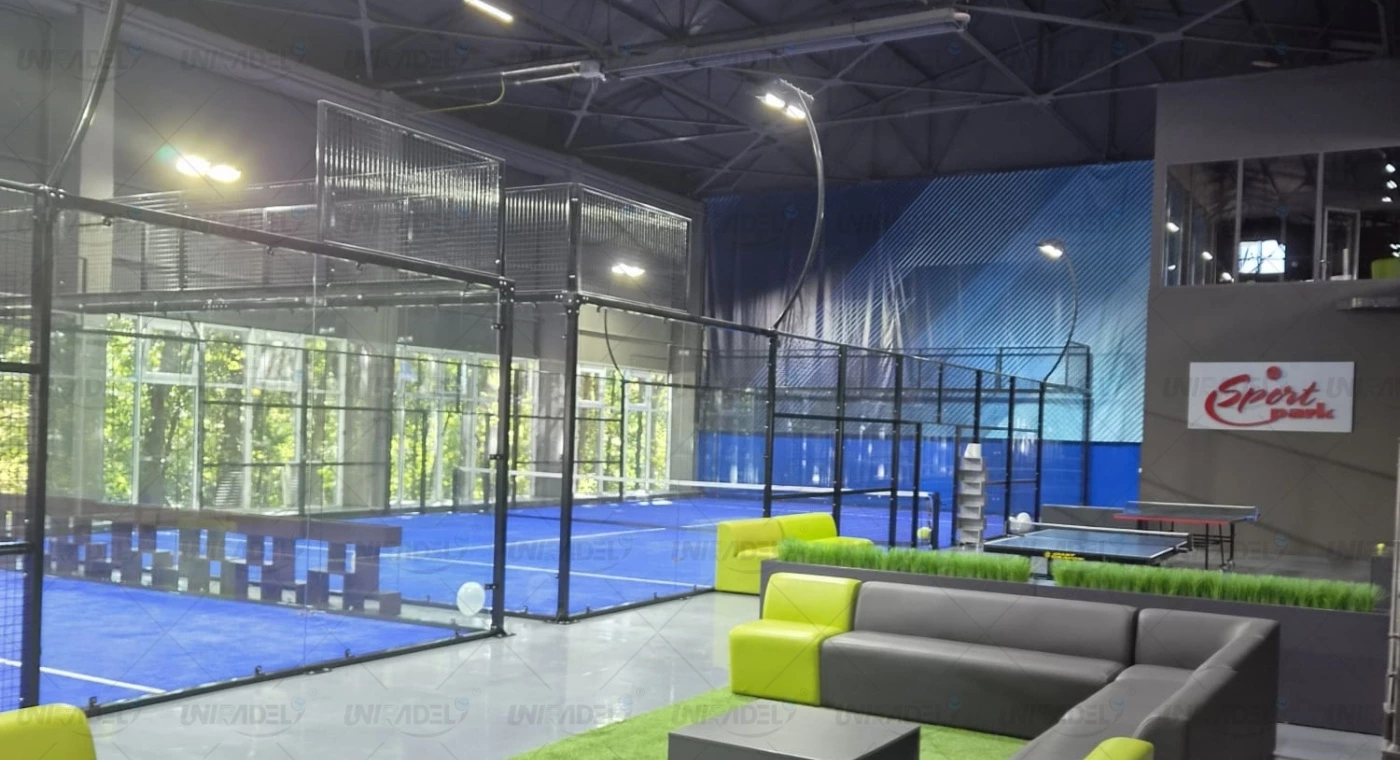
The panoramic design is built around full-height tempered glass back walls. There are no solid barriers breaking the sightline between the court and the surrounding space — players inside the court feel open, and people watching from the lounge area outside get an unobstructed view of the game. In a membership-based club, that kind of visual connection matters. It makes the courts part of the overall club experience rather than something tucked away in a back room.
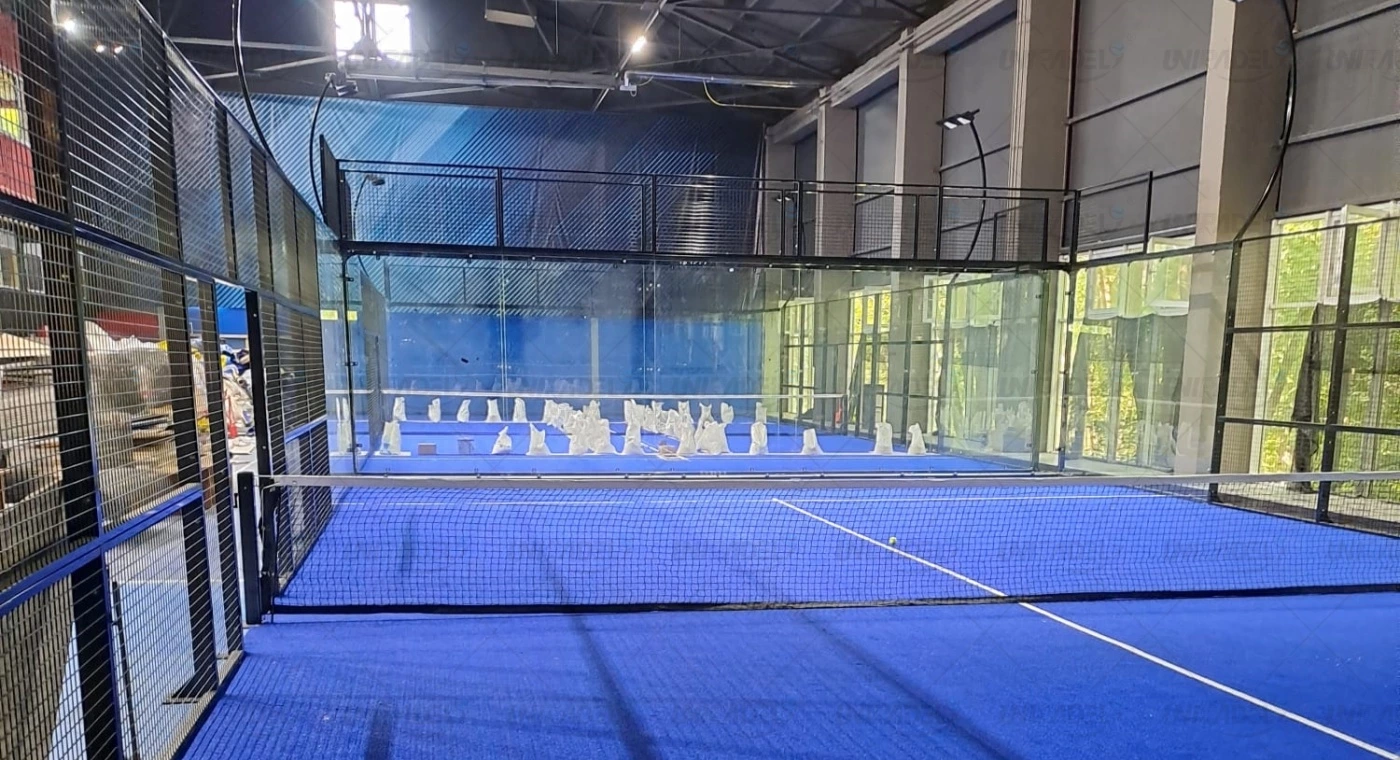
The building itself helped, too. Large floor-to-ceiling windows run along the exterior walls of the facility, flooding the space with natural light during the day. The blue turf and black steel frame read clearly in that light without relying on artificial lighting to carry the look — a practical detail that also reduces operating costs.
The Installation: Three Phases, No Surprises
Sportpark was a functioning club throughout the installation. There was no shutdown, no pause in operations. That constraint shaped how the project was approached from the start.
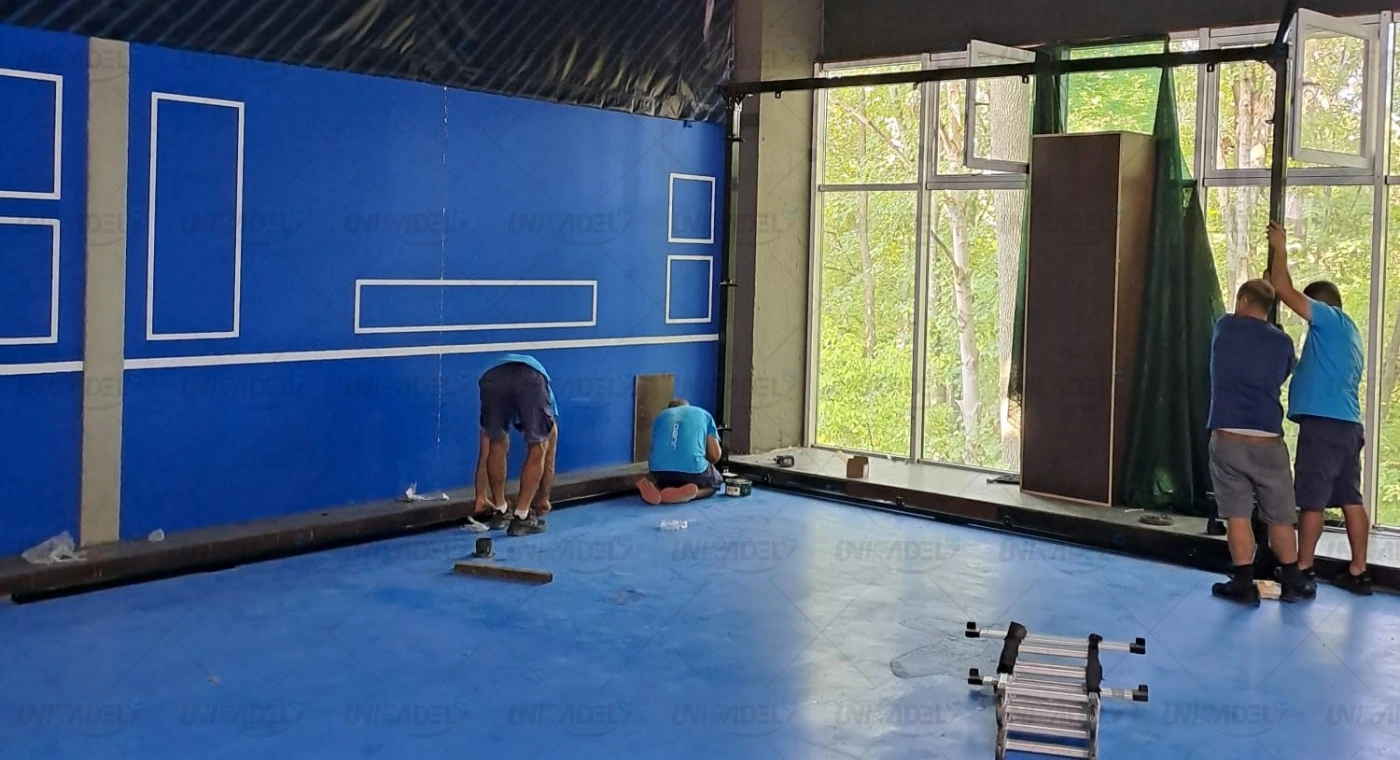
UNIPADEL's court structure is fully modular. Every steel component is pre-processed at the factory — cut, galvanised, labelled — so that on-site work is assembly rather than fabrication. No heavy machinery required. No major groundwork. The two courts were built in parallel, which kept the overall timeline tight.
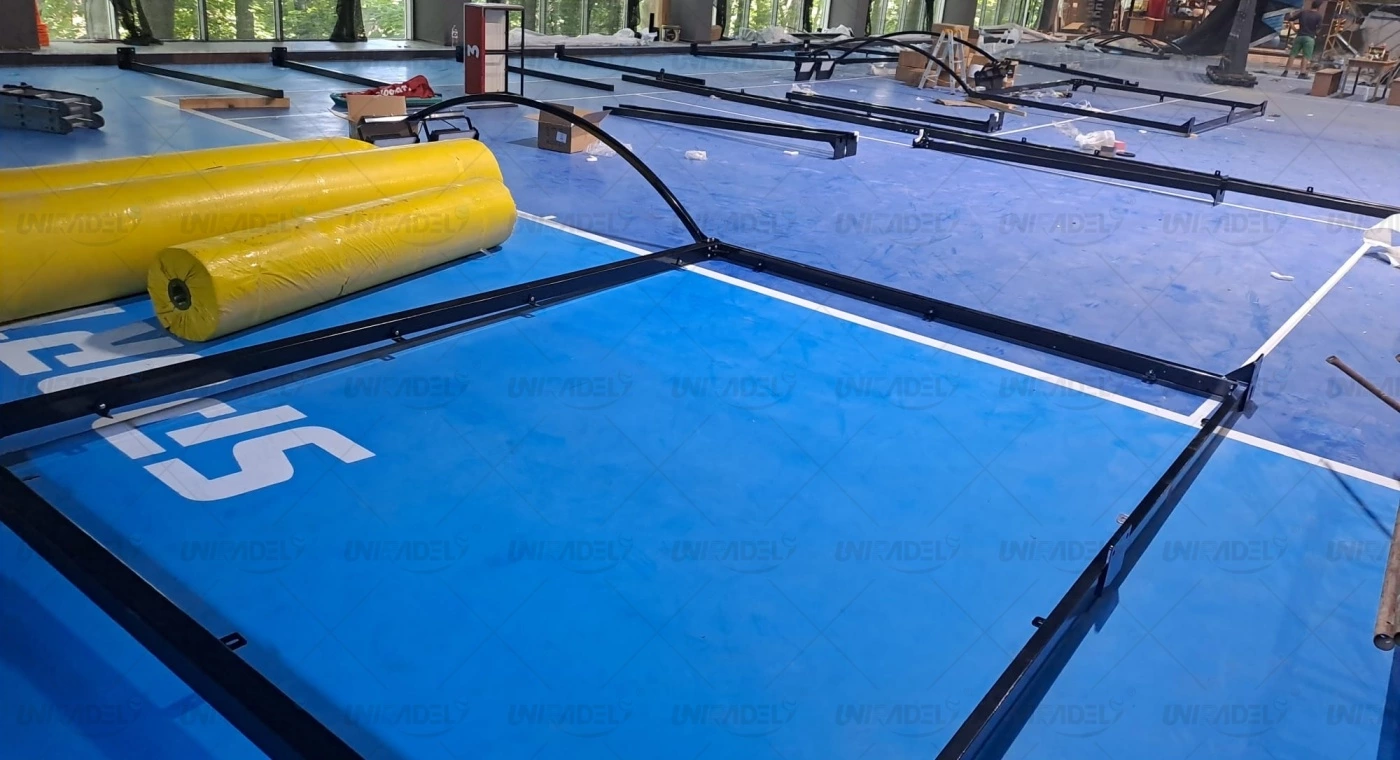
Phase one was foundation and base frame. The blue sports floor was already in place before the steel components arrived. Once on site, the team laid out the base frame elements for both courts simultaneously — bottom rails, column bases, C-shaped lamp arm components — and worked through the parts list systematically.
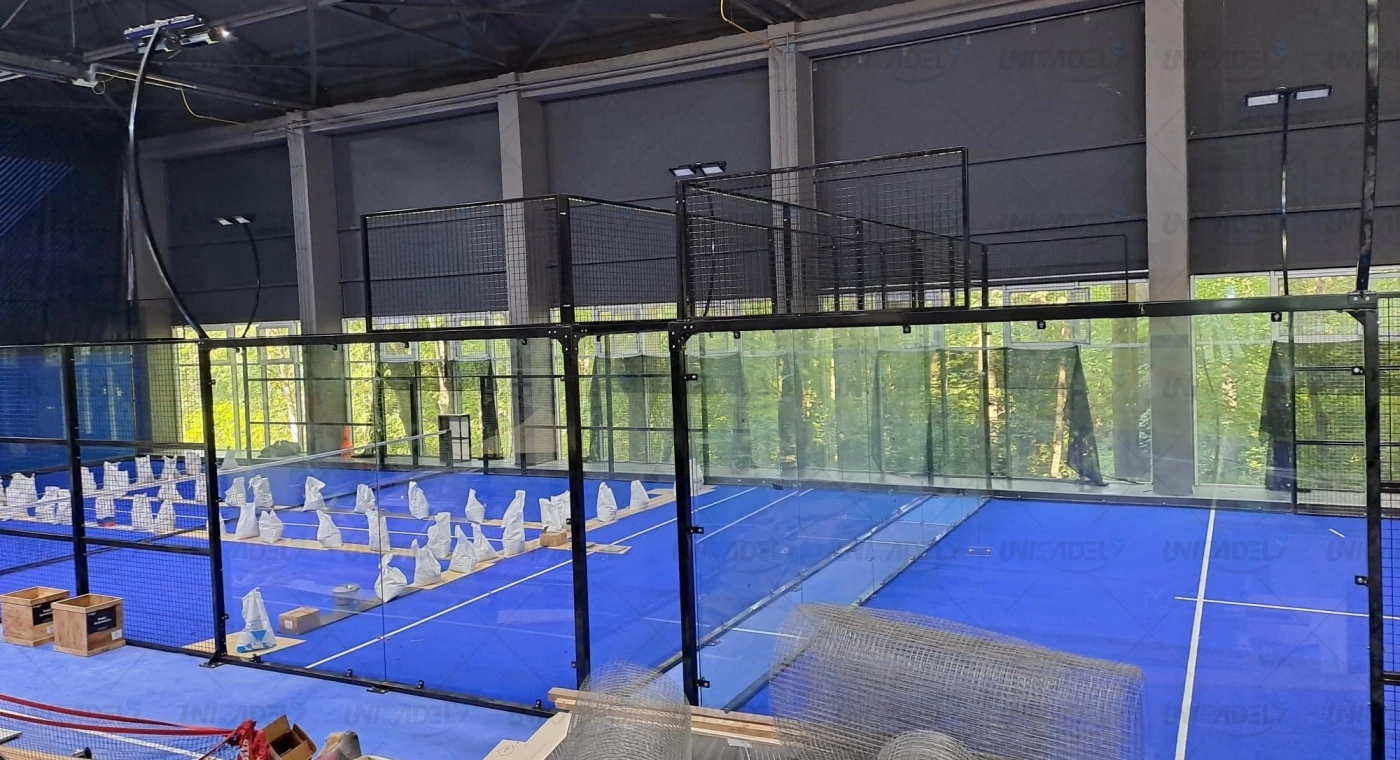
Phase two was the glass wall and wire mesh installation. This is the most technically demanding part of any panoramic court build. The tempered glass panels need to be positioned and secured with precision, because even small misalignment affects how the ball behaves off the back wall — and players notice. From the installation photos, you can see the glass panels standing in place with the upper wire mesh section taking shape around them, the two courts starting to look like courts.
Phase three was turf, line marking, and net installation. The blue artificial turf was cut, laid, and weighted down while the adhesive set — the white bags visible in some of the photos are just ballast bags used during this stage, standard procedure. White court lines were applied, the net went up, and the courts were ready.
More Than Just Courts: Fitting Into a Multi-Sport Facility
The finished space tells the real story of this project. In the photos from after completion, you can see the two blue courts sitting behind full-height glass, the UNIPADEL frames clean and black, natural light coming in from the exterior windows.
This doesn't look like a padel club that happens to have other things in it. It looks like a sports facility where padel is one of the headline features — which is exactly what it is.
That outcome doesn't happen by accident. When a supplier just hands over a technical drawing and tells the client to figure out placement, you end up with courts that feel bolted on. For Sportpark, the layout work started early — court orientation, spacing between the two courts, how the viewing area would sit in relation to the lounge, how the sightlines from the entrance would work. By the time installation started, those decisions were already made and the space was ready to receive them.
Moldova as a Market: Earlier Than It Looks
Moldova sits between Romania and Ukraine, with Chișinău as its only major urban centre. On a European padel growth map, it's easy to overlook. But that's also the point. Poland, Czech Republic, and Romania have seen fast growth in padel club numbers over the past few years, and the general trajectory across Eastern Europe is clearly upward. Moldova is earlier in that curve — lower competition density, a sports-minded urban population, and a club scene that's actively looking for ways to differentiate.
Sportpark's decision to start with two courts is a measured one. Two courts is enough to run a proper session schedule, build a local player community, and validate the revenue model before committing to expansion. It's a realistic first step, not an undersell of the opportunity.
A well-run sports club decided to add padel, worked with a supplier who understood the brief, and the project came in on time without major complications.
For anyone evaluating whether to add padel courts to an existing venue, that last part is worth sitting with. The product matters, but so does the process. A smooth installation in a live facility — one that doesn't disrupt the rest of the club, that arrives with a plan rather than improvising on site, that ends with courts that actually fit the space — is not the default. It's something you have to build for from the start.
If you're working through a similar decision for your own facility, feel free to reach out. We're happy to look at your space and talk through what makes sense.