Español
 Franch
  русский
How to choose the ideal location for a padel club in the UK? 2026 Selection Guide
Location Is the Decision That Cannot Be Undone
In the UK padel market, most investment mistakes are recoverable. You can upgrade court equipment. You can hire better coaching staff. You can redesign your booking system. You can even renegotiate membership pricing.
You cannot relocate a concrete slab.
Choosing the right location is the single most consequential decision in any padel club development — and the one most consistently underestimated by first-time investors. With over 1,553 operational courts and 860,000 active players in the UK as of mid-2026, and the market firmly on track to cross 2,000 courts by late 2026, the competitive landscape is intensifying rapidly. Sites that would have generated strong returns three years ago are now facing direct competition from better-located, better-financed operators.
This guide provides a complete, data-driven framework for how to choose padel club location UK — covering population catchment analysis, planning law, noise compliance distances, demographic profiling, property structures, and the financial modelling that separates viable sites from expensive lessons.
1. Customer Coverage Radius: Are Your Potential Users Sufficient?
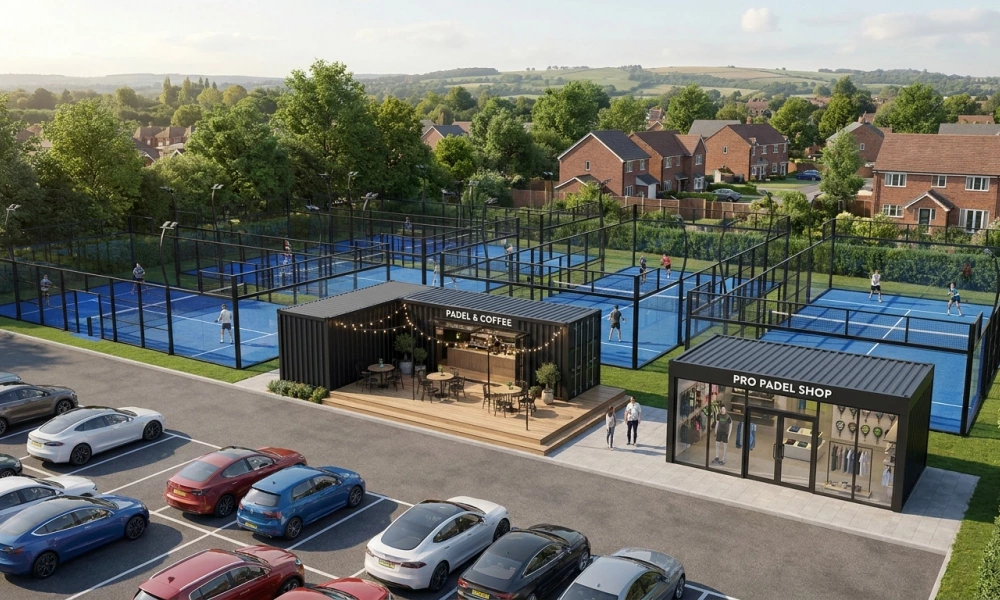
The first step in site selection is assessing the potential user base the location can reach.
According to the Lawn Tennis Association (LTA) investment assessment standards:
| Factor | Minimum Viable | Strong Site |
|---|---|---|
| Residents within 15-min drive | 50,000 | 100,000+ |
| ABC1 household proportion | 35%+ | 50%+ |
| Average household income | £40,000+ | £55,000+ |
| Existing padel courts within 10km | 0–1 | 0 |
| Active sports club members in area | High density preferred | Tennis/fitness/golf overlap |
This is the basic threshold for a viable business model. Below these figures, even with excellent operations, low attendance will struggle to sustain long-term profitability.
Padel club catchment area UK analysis should use drive-time modelling rather than straight-line radius. A 5-mile radius circle looks identical whether it crosses a river with no bridge, a motorway with limited junctions, or an open suburban grid with multiple access routes. Drive-time models reflect how people actually travel to leisure facilities.
By 2026, traditional "residential coverage" analysis is being replaced by "lifestyle coverage." Leading operators are not only looking at where their target users live, but also where they work, consume, and socialize. A club located near a city's business district can convert working people during lunch breaks and after get off work into a stable customer base, even if the surrounding residential population is limited.
Site Selection Assessment Questions:
- Is the population within a 20-minute drive greater than 70,000?
- Are there large office buildings, technology parks, or creative industry clusters nearby?
- Are there already a large number of tennis, squash, or gym users in the surrounding area?
2. Land Use Planning and Zoning: Is Your Site Permitted for Padel Court?
In the UK, the construction of a Padel Court typically requires a Planning Permission, and the site's Use Class directly determines whether approval will be granted.
Venue Types:
Indoor Padre Centre: Use Class E(d), Indoor Sports/Recreation
Community Outdoor Court: Use Class F2(c), Local Community Facilities
Hotel/Resort Amenities: Typically attached to the main building and require separate evaluation.
The Two Planning Tracks
Track 1: Indoor conversion from existing Class E use (fastest route)
If the building you are converting is already classified within Use Class E (which includes former gyms, health clubs, offices, retail units, and restaurants), converting to indoor padel (Use Class E(d) — indoor sport and recreation) does not require planning permission for the change of use. Building Regulations approval is still required, but the planning track is eliminated entirely.
This is why indoor warehouse conversions dominate new UK padel development. The planning risk disappears, and the timeline compresses from 12–16 weeks to a straightforward Building Regs process.
Track 2: Outdoor courts or conversion from B8/B2 use (full planning required)
Outdoor padel courts on greenfield or existing sports club land require planning permission under Use Class F2(c) (outdoor sport and recreation). Conversions from B8 storage or B2 industrial use require a full change of use application to Class E(d).
Key planning sensitivities to assess at site selection stage:
| Planning Factor | High Risk | Lower Risk |
|---|---|---|
| Green Belt designation | Site within Green Belt | Not Green Belt |
| Metropolitan Open Land | Site within MOL | Not MOL |
| Existing use class | B8, B2, Agricultural | Class E (any sub-category) |
| Residential proximity | <30 metres to nearest house | >50 metres minimum |
| Conservation area | Within conservation area | Outside |
| Tree Preservation Orders | TPOs on or near site | No TPOs |
| Flood risk zone | Zone 2 or 3 | Zone 1 only |
| Article 4 Direction | Local Article 4 removes Class E rights | No Article 4 |
3. The 30-Metre Noise Rule — The Planning Make-or-Break Factor
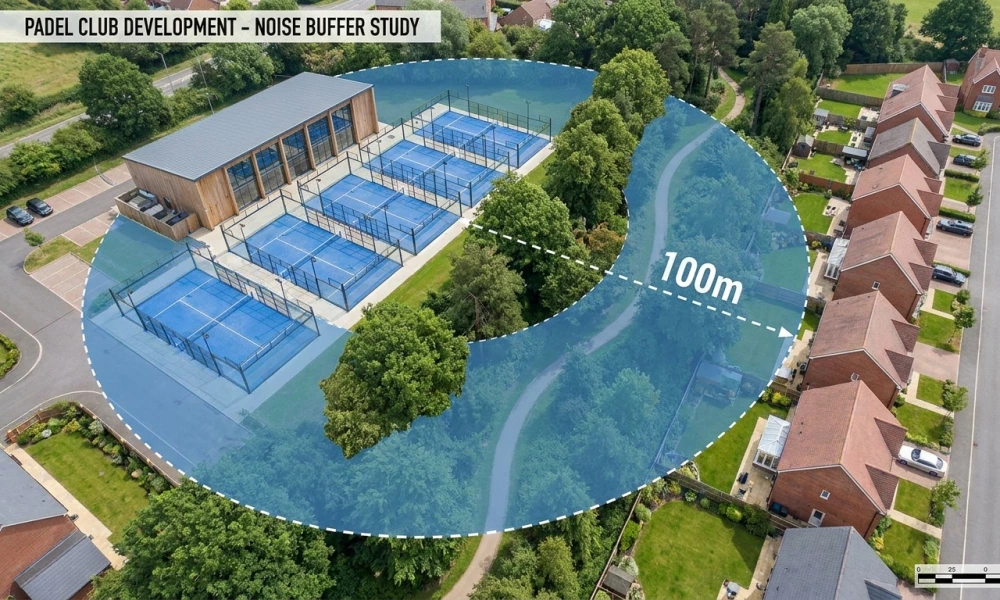
Padel club noise residential distance UK compliance is the single most common cause of UK padel planning refusals. Noise is not a secondary concern to be addressed at the acoustic consultant stage — it is a primary site selection filter.
The LTA recommended residential buffer: minimum 30 metres from the court perimeter to the nearest residential receptor. This figure derives from acoustic modelling of padel's characteristic sound profile — the sharp, impulsive racket-on-ball "pop" (70–80 dB(A) at source) and ball-on-glass "thwack" (65–75 dB(A) at source, with significant structural transmission through frame and glass).
Under BS 4142:2014, padel attracts acoustic character correction penalties of +3 to +6 dB for impulsivity and +2 to +4 dB for tonality — meaning the regulatory rating level can exceed the raw measured level by up to 10 dB. In quiet residential areas (background noise LA90 of 35–40 dB(A) at night), achieving compliance requires either substantial separation distance or engineered mitigation.
Sites within 30 metres of residential properties are high risk. Sites within 15 metres are extremely high risk.
Noise Mitigation Options When Distance Is Limited
| Mitigation | Noise Reduction | Cost Per Linear Metre |
|---|---|---|
| High-density acoustic fencing (≥12 kg/m²) | 10–20 dB(A) at receptor | £150–£300 |
| Anti-vibration neoprene glass mounting | 10–15 dB (structure-borne) | Included in UNIPADEL specification |
| Operating hour restrictions | N/A | Zero cost |
| Acoustic barrier planting (dense evergreen) | 3–6 dB | £50–£120/m |
4. Parking and Accessibility: Is it easily accessible to users?
Padel club parking requirements UK is a planning requirement and an operational necessity. The LPA standard for new sports facility car parking varies by local planning authority, but the industry benchmark for padel is:
3–5 parking spaces per court minimum.
For a 4-court club, this requires 12–20 dedicated spaces — a significant land allocation that affects site selection on constrained urban sites.
Parking mitigation in car-free urban areas:
In London Zones 1–3 and other high-density urban environments, many LPAs now support "car-free" or "car-lite" development where public transport accessibility is demonstrably high (PTAL score 4+). The Rocks Lane (Chiswick) padel development achieved planning approval with zero dedicated parking by demonstrating that the facility was within 200 metres of Turnham Green Underground station and explicitly prohibiting parking permits for club members.
For non-urban locations, parking provision is non-negotiable. Sites without adequate parking or the ability to secure shared parking agreements with adjacent uses should be deprioritised — the operational impact of parking shortages on court utilisation rates is direct and severe.
Cycling infrastructure: Secure cycle parking and shower facilities are increasingly expected by planning authorities for new sports facilities. Budget for 10–20 cycle spaces — low cost relative to total project budget, high value in planning officer goodwill.
5. Site Typology — Matching Venue Type to Location Strategy
Type 1: Indoor Warehouse / Light Industrial Conversion
Best for: Urban and suburban markets where land cost is prohibitive for greenfield development
| Factor | Performance |
|---|---|
| Planning complexity | Low (Class E to Class E(d) — often no permission needed) |
| Groundworks cost per court | £8,000–£18,000 |
| Annual playable hours | 4,000+ (year-round) |
| Capital cost per court (total) | £35,000–£65,000 |
| Noise compliance risk | Low (fully enclosed) |
| Payback period | 3–5 years (well-operated) |
Ceiling height requirement: Minimum 6 metres clear above playing surface. This is the primary physical constraint for warehouse suitability — measure from finished floor level to the underside of the lowest structural element. Most warehouse and light industrial units with 8–12 metre eaves height accommodate padel comfortably.
Padel court warehouse conversion location is currently the dominant model for new UK commercial development precisely because it eliminates weather risk, simplifies planning, reduces civil costs, and accelerates payback.
Type 2: Existing Tennis Club / Sports Facility
Best for: Clubs with existing LTA relationships, available underutilised land, and established member base
One standard tennis court footprint (23.77m × 10.97m) can accommodate one padel court with compliant margins, or two padel courts side by side with modest perimeter adjustment. Converting existing hardstanding can reduce groundworks cost by up to 60% compared to greenfield development — ring beam cut and poured into the existing surface, rather than full excavation.
UK tennis clubs adding padel courts report membership increases of 15–25% within the first year — the new demographic (younger, more social, corporate-focused) complements rather than displaces the existing tennis membership.
Type 3: Rooftop / Mixed-Use Development
Best for: Urban core locations (London Zones 1–3) where ground-level space is unavailable or prohibitively expensive
Rooftop padel requires structural engineering assessment of the host building's load capacity (typically 2.5–4.0 kN/m² for a padel court installation), acoustic analysis of sound transmission downward into the building, and planning assessment of overlooking impact on neighbouring properties. It is the highest-complexity site type but can generate the highest revenue per square metre in prime central London locations.
6. Competitive Landscape Analysis: What are your differentiating advantages?
In cities like London, Manchester, and Birmingham, the density of UK Padel clubs is rapidly increasing. Blindly choosing a location in an area with strong existing competitors will lead to price wars and customer diversion.
Competitive Landscape Assessment Methods:
- Number of competitors within a 15-minute drive — If there are more than two similar clubs, a clear differentiated positioning is required.
- Number and capacity of competitor stadiums — If competitors already have more than 8 stadiums, avoid direct competition in the same area.
- Pricing range — Check the local market average price (UK average £30–£60/hour) and assess your pricing range.
- Service differentiation — Do competitors offer teaching, tournament, or corporate packages? Is your advantage clear enough?
Site Selection Assessment Questions:
- Are there already established Padel clubs within a 15-minute drive?
- Is your differentiated positioning clearly defined (price, service, setting)?
- Are there niche customer groups (families, businesses, women) that competitors haven't yet covered?
7. Lease Term and Property Conditions: How Stable is the Long-Term Investment?
The investment in stadium infrastructure (over £30,000 per piece) dictates a payback period typically of 2 to 3 years or more. The lease term directly impacts the feasibility of the entire business model.
Padel clubs with short-term leases of less than 10 years often face the predicament of lease expiration and non-renewal just as renovations are completed and user base begins to accumulate.
Key Points for Property Assessment:
- Is the lease term at least 10 years (including renewal options)?
- Does the rent include a fixed increase cap (CPI-linked or a fixed percentage)?
- Does the landlord allow structural modifications (foundation pouring, lighting installation)?
- Does the building have sufficient electrical capacity (LED lighting systems have high power requirements)?
8. Demographic Profiling — Who Actually Plays Padel in the UK
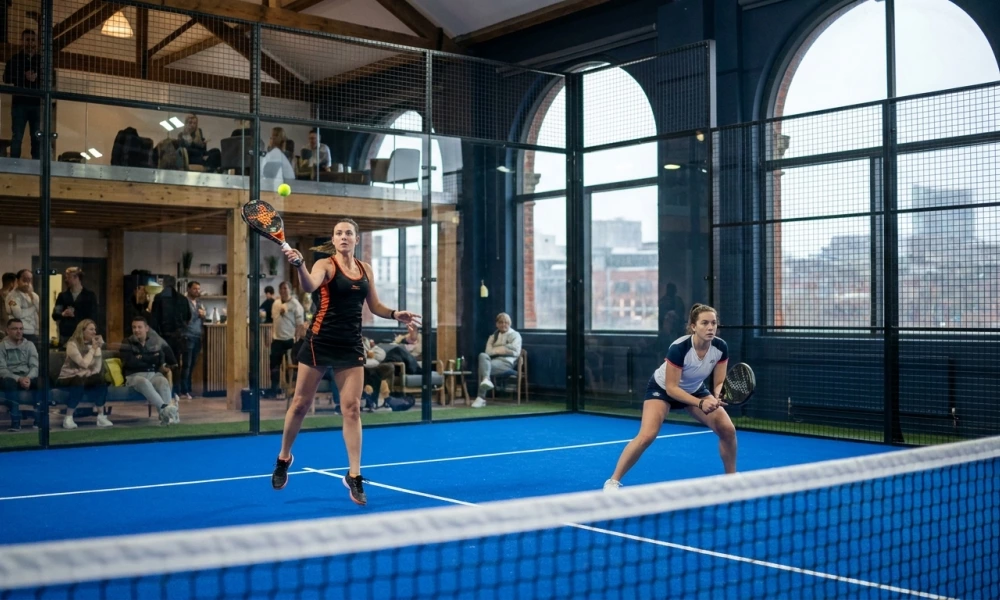
Padel club demographic UK targeting must be precise. Padel's UK player base has a highly concentrated socioeconomic profile that should shape every site selection decision.
Padel UK User Profile in 2026:
| Dimension | Data |
|---|---|
| Core age group | 25–45 years |
| Secondary age group | 45–60 (fastest growing segment) |
| Socioeconomic group | ABC1 — professional and managerial |
| Household income | £45,000+ typical active padel household |
| Gender split | Increasingly balanced — women's participation growing fastest |
| Sporting background | Strong overlap with tennis, squash, golf, gym members |
| Booking behaviour | App-first (Playtomic, Matchi) — 80%+ bookings digital |
| Primary motivation | Social sport, corporate networking, family activity |
Padel has been widely described as "the new golf" in corporate entertainment contexts — and this framing carries direct site selection implications. Sites adjacent to business parks, financial districts, technology campuses, and professional services clusters can access corporate wellness budgets and company account memberships that materially reduce peak/off-peak demand variance and provide guaranteed weekly revenue streams independent of individual consumer booking patterns.
Where these demographics cluster in the UK:
- London: Canary Wharf, Chelsea, Wimbledon, Richmond, Chiswick, Clapham
- Manchester: Didsbury, Altrincham, Northern Quarter corporate corridor
- Birmingham: Solihull, Edgbaston, Harborne
- Bristol: Clifton, Redland, Harbourside
- Edinburgh: Morningside, Stockbridge, Leith
Sites within or adjacent to these specific districts consistently outperform demographically broader alternatives in the same city.
9. Financial Modelling by Location Type
Padel club ROI location UK varies significantly by site type, urban density, and demographic quality. The following models represent realistic 2026 UK market performance benchmarks.
4-Court Indoor Urban Conversion (Manchester/Bristol/Sheffield)
| Financial Metric | Conservative | Realistic | Optimistic |
|---|---|---|---|
| Total CAPEX (4 courts, turnkey) | £280,000 | £260,000 | £240,000 |
| Court hire revenue (per year) | £180,000 | £230,000 | £290,000 |
| Coaching commissions | £30,000 | £45,000 | £65,000 |
| Corporate packages | £15,000 | £35,000 | £60,000 |
| F&B and pro shop | £10,000 | £25,000 | £40,000 |
| Total annual revenue | £235,000 | £335,000 | £455,000 |
| Operating costs (rent, staff, utilities, marketing) | £155,000 | £175,000 | £195,000 |
| Net profit | £80,000 | £160,000 | £260,000 |
| Net margin | 34% | 48% | 57% |
| Payback period | 3.5 years | 1.6 years | <1 year |
UNIPADEL: From Site Selection to Implementation
Finding the ideal location is only the first step. Ensuring the stadium design and construction fully comply with UK planning requirements is equally crucial.
UNIPADEL provides the following support for projects in the UK market:
- Structural Calculations – Compliant with UK BS/EN standards, directly applicable to planning applications
- Noise Control Solutions – Vibration-damping glass installation techniques and soundproof fencing design recommendations
- Lighting Specifications – Asymmetrical LED systems compliant with UK Parliament's light spill control requirements
- Site Layout Planning – Optimal stadium layout and ancillary area solutions based on your actual land area
- Project Timeline Planning – A reasonable construction timeline tailored to UK planning approval deadlines
UNIPADEL has served projects in multiple European markets, including the UK, Germany, and France, possessing a deep understanding of local European planning language and technical standards. Whether you are in the site selection assessment phase or already in the construction planning stage, our team can provide professional preliminary consultation support.
The Site Is the Strategy
In 2026, the UK padel market has enough court supply that the sites generating the strongest returns are not the ones that simply exist — they are the ones whose location decisions were right from the beginning.
Population catchment above threshold. Demographics that match the padel player profile. Residential separation that passes BS 4142 assessment. Planning use class that minimises approval risk. Lease terms that protect the full investment cycle. Car parking or transport access that matches the target user's behaviour.
Get these decisions right at the site selection stage, and the investment case for UK padel is compelling — payback in 2–5 years, net margins of 35–50%, and a growing addressable market of 860,000+ active players with supply still running behind demand.
Get them wrong, and the courts are built in the wrong place — and that is the one problem that cannot be fixed after the concrete has been poured.