Español
 Franch
  русский
Compliant with Kazakhstan's climate: padel court material and structural standards
Kazakhstan is not your average Padel market. Almaty experiences summer surface temperatures reaching +38°C; Astana has recorded winter lows of -51.6°C.
What happens to the standard padel court construction methods prevalent in Europe and the Middle East under Kazakhstan's climate?
— 10mm glass experiences "explosive thermal stress fracture" when the indoor-outdoor temperature difference exceeds 50°C;
— Ordinary polypropylene turf becomes brittle and cracks at -40°C;
— Shallow foundations that haven't reached the frost line tilt by 2–5 cm each spring after thawing, completely ruining the stadium's flatness;
— Untreated steel frames corrode from the inside through condensation in the high-humidity indoor stadiums during winter, within 3 to 5 years.
These are not hypothetical scenarios, but real-world examples that have already occurred in projects in Central Asia.
UNIPADEL will outline the core challenges that Kazakhstan's climate poses to the construction of the padel court, as well as the correct material selection and structural standards for each challenge, providing owners and developers planning to invest in construction in this market with readily applicable technical decision-making references.
Climate characteristics of Kazakhstan
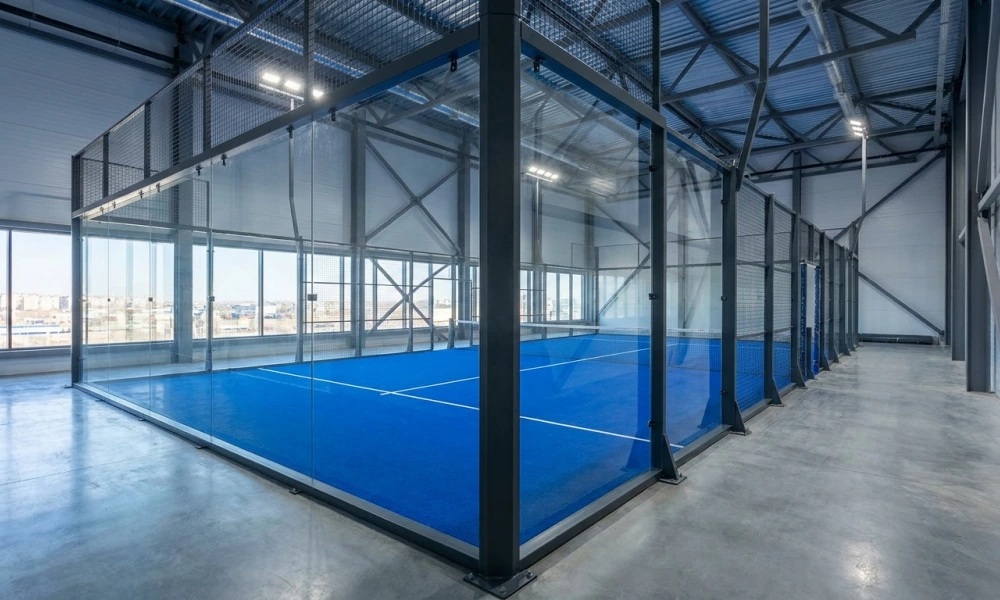
Kazakhstan has a typical continental climate, and its extreme climate is almost unparalleled in the global Padre market.
| Climate Parameters | Almaty (South) | Astana (North/Central) |
| Annual Temperature Range | -25°C to +38°C | -40°C to +35°C |
| Historical Extreme Low Temperatures | -37°C | -51.6°C |
| Number of Frost Days Per Year | Approx. 120–140 days | Approx. 170–190 days |
| Summer UV Index | 8–10 (Extremely High) | 6–8 (High) |
| Wind Characteristics | Valley Circulation Winds | Steppe Continuous Winds (Average Speed 5–7 m/s) |
This climate means that the padel court structure must withstand temperature cycles exceeding 60–80°C annually. Material selection standards must be designed for these extreme conditions, rather than referring to European or Southeast Asian material standards.
Glass Selection: Why is 12mm Hot-Soaked Tempered Glass the Minimum Entry Standard?
Temperature Difference and its Impact on Glass Thermal Stress
Padel Court has a large glass enclosure area, and the temperature difference between indoors and outdoors can easily exceed 50°C in Kazakhstan winters (18°C indoor heating, -35°C outdoors). Under such extreme temperature gradients, ordinary 10mm tempered glass experiences intensified internal reactions in the low-temperature environment, easily leading to "spontaneous thermal stress fracture"—the glass suddenly shatters without any external impact.
Correct Specification: 12mm Hot-Soaked Tempered Glass (HST)
Heat-Soaked Tempered Glass (HST) significantly reduces the spontaneous breakage rate after the standard tempering process through additional heat soaking (approximately 290°C cyclic heating).
| Specifications | Standard Market Configuration | Recommended Configuration for Kazakhstan |
| Thickness | 12mm | 12mm |
| Type | Standard Tempered Glass (ESG) | Hot-Dip Tempered Glass (HST) |
| Installation Method | Standard Fixing | Vibration-damping Rubber Gasket Mounting (Anti-freezing Heave) |
Sufficient thermal expansion gaps must be reserved during glass installation, and anti-vibration rubber gaskets must be used to absorb minor displacements caused by foundation frost heave and prevent the glass from being crushed by the frame.
Steel Structure: Hot-dip galvanizing is the only reliable solution for corrosion protection
The "Condensation Corrosion" Trap in Indoor Stadiums
Indoor padel stadiums in Kazakhstan face severe condensation problems in winter: the extreme cold outdoor air and the heated indoor environment create a huge temperature difference, causing a large amount of moisture to condense on the steel structure surface. If the steel frame only uses ordinary powder coating, the coating will crack during temperature cycles, allowing moisture to seep in and the steel to rust rapidly from the inside. Within 3 to 5 years, the structural integrity will be seriously threatened.
Correct Specifications: Do twice zinc dipping + fluorocarbon polyester powder spraying
This dual corrosion protection system, when properly maintained, can ensure a corrosion protection life of more than 25 years for the structure, covering the entire investment payback period of the stadium.
Artificial Turf: Polyethylene (PE) Monofilament is the Only Low-Temperature Option
The Risk of Turf Breakage at Low Temperatures
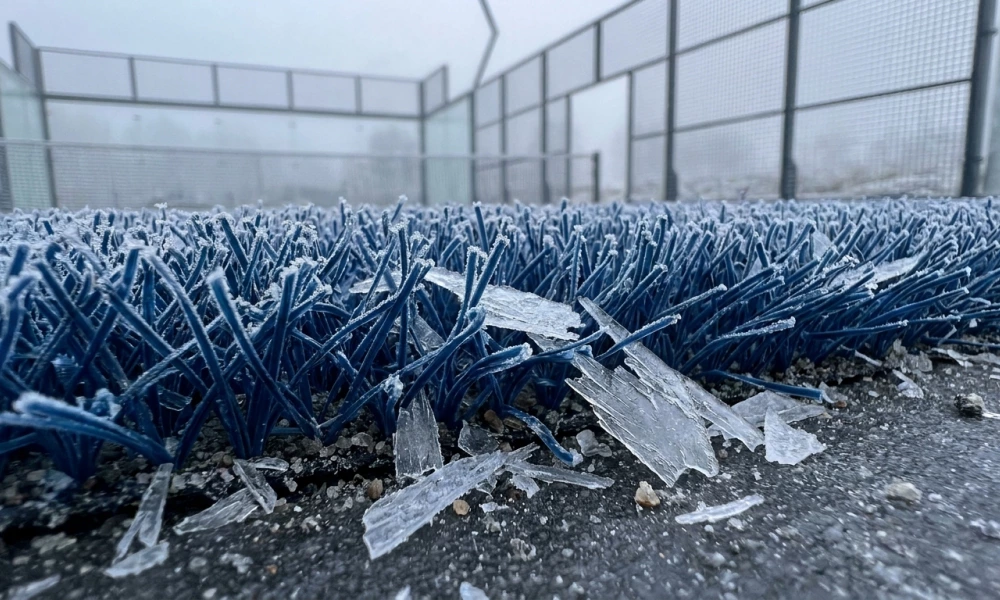
The polypropylene (PP) turf commonly used in padel courts is stable at room temperature, but it begins to become brittle below -25°C. In the extreme conditions of the Astana winter, where temperatures can reach -40°C, PP fibers can break and detach like a plastic film.
Correct Specifications: PE Monofilament Turf + PU Backing + Reinforced Drainage
Polyethylene (PE) monofilament turf maintains good flexibility even at -40°C. The polyurethane (PU) backing is frost-resistant and crack-resistant, and reinforced drainage holes prevent the formation of an ice lens layer beneath the turf.
Basic engineering: Different plans for different cities
Almaty: Earthquake Fortification is the Primary Prerequisite
Key Points of Seismic Design:
- Steel frame joints must be equipped with flexible hinges to allow for controlled deformation of the structure during earthquakes without transmission to the glass.
- Foundation anchors must use a seismic expansion anchoring system.
- Glass installation should use a floating snap-on fixing method, allowing the glass to shift slightly relative to the frame during seismic shaking, avoiding rigid compression that could lead to breakage.
Astana: Outdoor Foundations Must Penetrate the Frost Line
The soil freezing depth in Astana can reach 2.45 meters, far exceeding the standard foundation depth for most outdoor stadiums. If the foundation bottom is above the frost line, the frost heave force will "lift" the entire stadium every spring, causing anything from surface tilting that affects ball rolling to foundation cracking and permanent structural damage.
Indoor HVAC: Energy-Saving Heating
Indoor padel clubs typically have a ceiling height of 8–12 meters. Traditional convection heating systems trap hot air in the roof area, leaving players feeling cold on the ground, and are also extremely energy-intensive.
Indoor humidity must be controlled below 55%. Exceeding this threshold will cause extensive condensation on the glass surfaces, creating a "weeping glass" phenomenon. This leads to unstable ball trajectory, severely reducing the stadium's playability, and prolonged high humidity will accelerate steel frame corrosion.
Roof and Snow Load: A Structural Calculation Item That Cannot Be Ignored
For roofed stadiums or indoor arenas, snow load in Kazakhstan is a critical parameter that must be included in structural calculations.
- Astana (Zone IV): 240–300 kg/m²
- Almaty (Zones II–III): 120–180 kg/m²
Roof steel structures must be calculated independently according to these figures; generic structural schemes used in European or Southeast Asian projects cannot be applied.
UNIPADEL Solutions: A Complete System Designed for Kazakhstan's Climate
Facing Kazakhstan's extreme climate conditions, UNIPADEL offers a localized, proven, complete construction solution, covering the entire chain of support from material selection and specifications to technical documentation.
| Components | UNIPADEL Standard Configuration | Compliant with Specifications |
| Glass | 12mm Hot-dip Tempered Glass | EN 12150-1 / EN 14179 |
| Steel Frame | Twice zinc dipping + fluorocarbon polyester powder spraying | ISO |
| Turf | PE monofilament, PU backing, reinforced drainage holes, low-temperature toughness down to -40°C | FIP certified |
| Technical Documentation | Provides structural calculations and material certification reports to support approval by local building authorities. | - |
Success Story: Almaty Indoor Padel Project
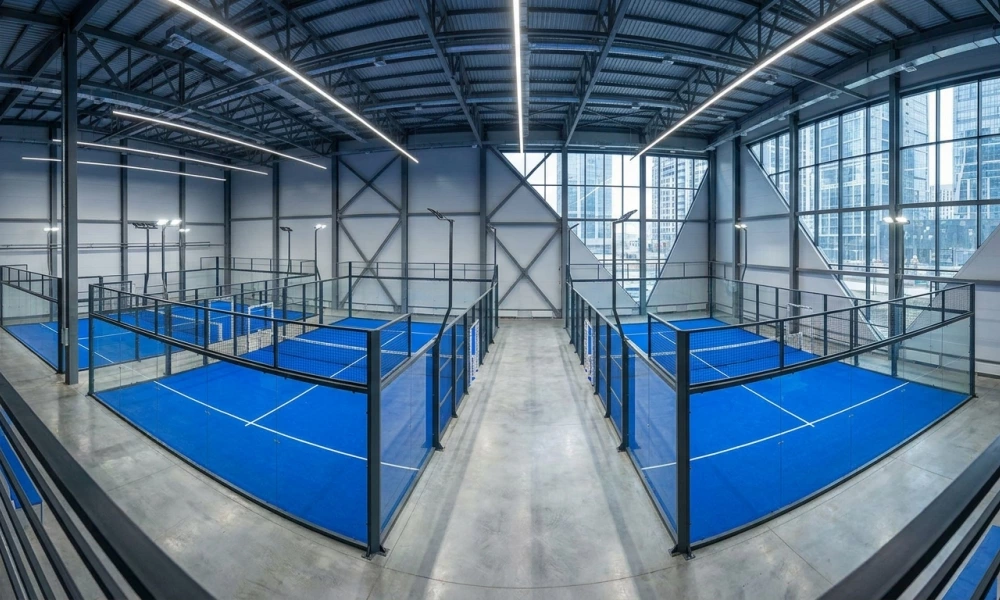
UNIPADEL has completed the supply and installation of the indoor Padel stadium in Almaty. The project utilizes a super panoramic Padel stadium configuration, with key technical highlights including:
- 12mm full glass enclosure, with a zero-explosion record after two complete winter-summer cycles in Almaty.
- Hot-dip galvanized steel frame combined with an anti-condensation coating, adapting to the high humidity indoor environment.
- FIP-certified PE turf, maintaining excellent ball speed and rebound consistency under local year-round climate conditions.
- Equipped with a professional LED lighting system, achieving B-level tournament standards (300 lux) and a uniformity coefficient ≥0.7.
The project is currently operating stably and is one of the few international standard Padel stadiums in Kazakhstan that has undergone complete climate cycle testing.
Conclusion
The Kazakhstan padel market is at a critical juncture, rapidly transitioning from "trial installations" to "professional, large-scale construction." The core hurdle in this transition is not funding, but a correct understanding of the local climate and the appropriate technology selection.
In Astana, where temperatures reach -30°C, or Almaty, prone to earthquakes, every material selection decision directly impacts the course's lifespan, operational safety, and long-term returns. Choosing a proven supplier and the right technical solution is the most crucial upfront decision in this market.
Planning to launch a padel court project in Kazakhstan? Contact the UNIPADEL team for customized technical solutions and quotations tailored to the different climatic conditions of various regions in Kazakhstan.